Soundtrack
- Famed composer Elmer Bernstein’s iconic score is one for the ages
- His majestic, traditionally-inflected music has stood the test of time
- Much-reissued over the years but there’s just one definitive 6-CD set
- Perennially popular soundtrack suffers predictable plague of pirates
- Much-recorded but detailing all with a direct lineage to the composer
- Excerpts and suites are staples of live film music concerts worldwide
The Ten Commandments: Writing on a Classic | Making of a Masterpiece | Collectors Guide, Pt 2: Soundtrack

When I was a boy my older brother introduced me to the operas of Richard Wagner, and the great Wagnerian themes have stayed with me all my life. Ever since music came into motion pictures I have sought for composers who could, in their own original way, embody Wagner’s concept that action, setting language and music should all blend into one perfect pattern. In The Ten Commandments Elmer Bernstein’s score achieves this ideal. Bernstein’s score is fine music [in its own right]. Its function in the film is that of painting a tone design: the music contributes to and forms part of the action, setting and language. It strongly accents or delicately supports each scene rhythmically, with spiritual and inspiring, violent and romantic music passages.
Sometimes unobtrusively and at others with compelling dominance, the symphonic score helps to impress upon the listener the age-old story of human strength and failing, of laughter and of tears, and of the divine spark that enlightens the seeker after truth. Music and pictures are a universal language. They speak directly to all the world. People of all nations will understand and enjoy Elmer Bernstein’s score for its own intrinsic beauty and because it will recall the inspirational theme of The Ten Commandments. – Cecil B. DeMille
The talented young musician Elmer Bernstein studied piano with Henrietta Michelson at The Juilliard School of Music and composition under such excellent teachers as Israel Citkowitz, Stephan Wolpe and the distinguished composer, Roger Sessions. Several of Bernstein’s chamber music compositions and a suite for orchestra have been widely performed. His sonata for viola and piano. merited a prize at the Chatham Square Music School in New York. His score for The Man with the Golden Arm has earned Bernstein wide popular recognition. Cecil B. DeMille, impressed with the young composer’s great ability, sincerity and integrity, assigned to him the highly coveted task of writing and scoring the music for The Ten Commandments. “I hope to continue to grow as a musician,” says Bernstein, “but at this moment I cannot even dream of ever again obtaining as important and challenging an assignment as composing the music for The Ten Commandments.”
“It was a very complex problem since the composition had to express Scripture, history and drama in music. The score is composed of symphonic themes identifying momentous events and significant personages as well as the great mass of people through whose trials and triumphs history moves. The music attempts to enhance the experience of actuality and to add to the atmosphere of authenticity. I hope that it also helps to suggest the lasting truth of the film’s inspired message. Of all the arts,” continues Bernstein, “I strongly feel that music is closest to religion. It is hard to explain what happens at the magical moment when suddenly there is music in my heart and mind and I can go to the piano and express it in sound. That is why I feel that music above all other arts can come closest to expressing religious experience and conveying it to others.” – Dot/London 2-LP (1956/1960)
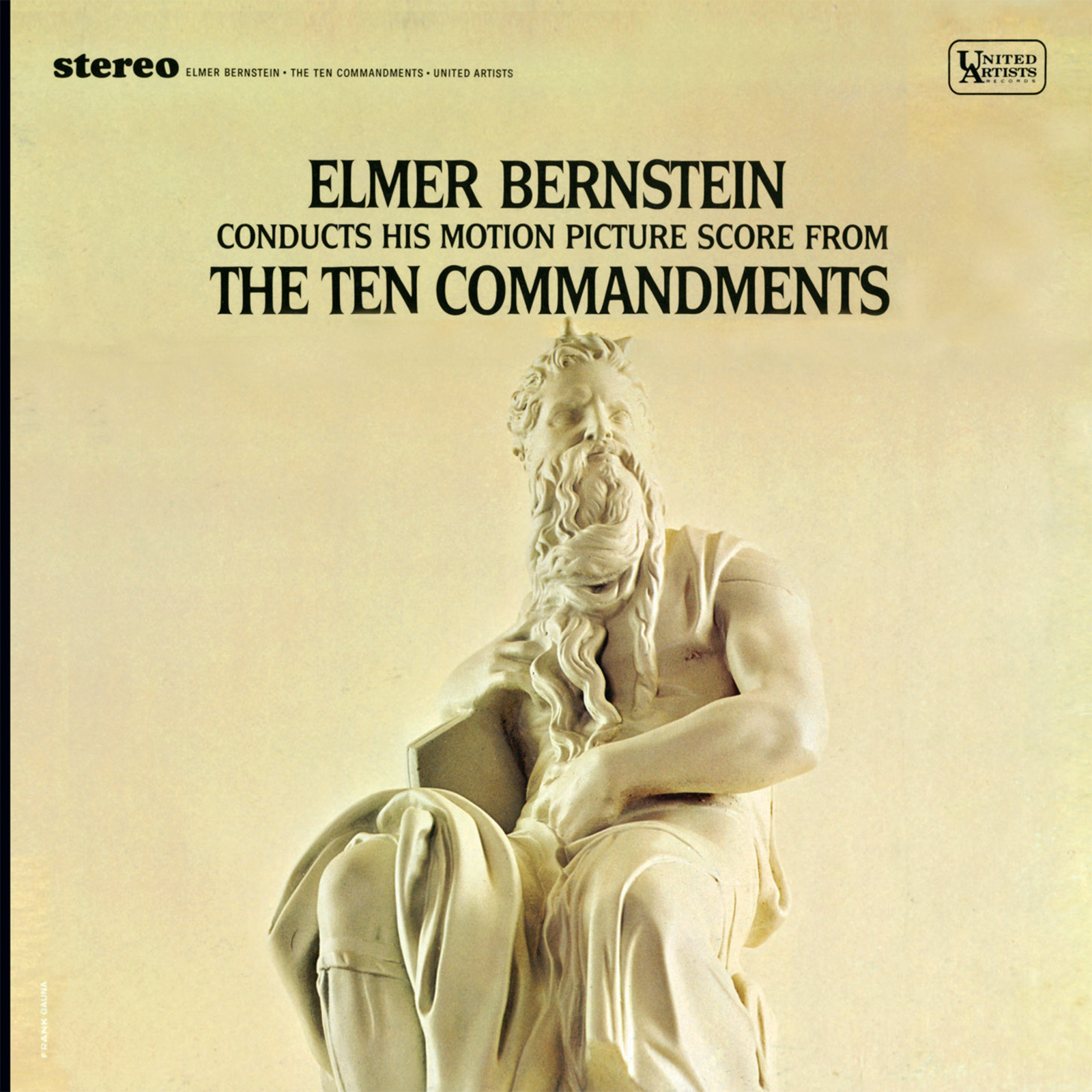
1966 LP
It is a rare opportunity for a composer of film music to be able to adapt his score to make a good record album. That I was afforded this opportunity to work with my themes from the original score and adapt them to modern recording techniques and album concepts, so long after its composition is a tribute to the durability of Cecil B. DeMille’s last and greatest success. Here in this album are the principal themes of the score, Moses, the Egyptian Queen Nefretiri, the Egyptian court, the Hebrew people, Jethro’s daughters, the Red Sea, the Exodus, Sephora and the Burning Bush, all newly orchestrated and arranged with a view to listening pleasure and to taking advantage of the newest in High Fidelity recording equipment.
Cecil B. DeMille is an almost legendary figure in the history of the motion picture. Ever since he embarked upon his most successful career almost sixty years ago, and even eight years after his death, DeMille’s pictures have played every single day of every year somewhere in the world. This is a success which stemmed from his uncanny understanding of the public and a relentless drive for the perfection of his concepts. This desire for perfection was reflected in tremendous attention to all the details of motion picture making and included an extraordinary understanding of the importance and function of music in a film. For him the role of the music was that of a story-teller. The theme associated with each character was usually heard when the character appeared on the screen. This concept is not unlike that of Richard Wagner, whom Mr. DeMille greatly admired.
It could be argued that film music can and should perform more subtle functions, but the fact of the matter is that the DeMille idea of the use of music was part of the total concept that worked very well for him because of his belief in what he was doing and his thoroughness in its realization. The many millions of people throughout the world who have seen The Ten Commandments in the ten years since its first release are testimony to the universal appeal of his achievement. Here then is a new impression in perspective of a year and a half of working on the picture, two notebooks full of notes from Mr. DeMille, endless rewrites and the passage of ten years. If you enjoy it, as I hope you will, it is an honour to the memory of Cecil B. DeMille, since much of his effort and spirit lives in this music. – El Bernstein, UA LP (1966)
Oh, Moses, Moses! Veteran composer Elmer Bernstein got his first major credit on Cecil B. DeMille’s classic biblical epic, providing a rousing, vibrant score full of unforgettable leitmotifs, from the portentous six note “God” theme to a proud fanfare for Charlton Heston’s Moses and a languid melody for Egyptian queen Nefritiri that’s just as smoothly campy as Ann Baxter’s outrageous performance in the role. Few composers have been handed assignments with this kind of scope so early in their careers, but Bernstein approached apocryphal moments like Moses’ encounter with the Burning Bush, the Hebrews’ exodus from Egypt and the parting of the Red Sea with moving piety, infectious energy and an uncanny sense of drama and awe. Originally presented as a two LP set, this 60-minute CD presents the lion’s share of Bernstein’s score, from the sweeping overture and exotic evocation of the river Nile to Bernstein’s incredibly moving finale with its gorgeous recapitulation of the composer’s gentle melody for Moses’ wife, Sephora. Despite the length here, there’s not a dull moment, and this broad, exciting album belongs in anyone’s collection. – Jeff Bond, VideoHound’s Soundtracks (1998)
As with the film’s audio design, much misinformation has been perpetuated about the nature of its various music recordings. Bernstein first conducted the Paramount Studio Orchestra in the actual film soundtrack sessions of his score in a quasi-stereo designed for mono mixdown. Accordingly, a mono double-LP (60:44) with customary added reverb was released a few months after the film in the US, UK and Canada. For 1960’s theatrical re-release another conductor, most likely Paramount regular Irwin Talbot, replicated it in a true stereo recording (59:56), confusingly issued in the US and UK in the previous LP’s Bernstein-attributed packaging but with a different catalogue number and “Stereo” notation. Bernstein is commonly cited as conducting the second recording but contradicted that himself; see his own sleeve notes above. Lastly, to tie in with the 1966 theatrical re-release Bernstein conducted an abbreviated and rearranged third version (29:14), again in stereo but with new orchestral arrangements.
- Various 2-LP/CD/MP3 The Ten Commandments Soundtrack (1957/1960/1966)
- Intrada 6-CD TTC: 60th Anniversary Soundtrack Collection (2016) review
Both stereo recordings, but not the mono, have been much-reissued and bootlegged over the years. Any release, on any format, not issued by or clearly licenced from Dot, London, Paramount, MCA or United Artists Records is pirated. Most significantly, for the film’s 60th anniversary soundtrack reissue specialists Intrada released a sumptuous CD box set (234:17) containing all three albums and every piece of music recorded during the 1956 sessions, including numerous outtakes. Bernstein belatedly revisited his score on record a third and final time when he conducted the Royal Philharmonic Pops Orchestra to an eight-minute suite of the main themes on 9-10 September 1992. It appeared on a US and Japanese best of CD and as a bonus track on his final score for Photoplay Productions’ two-hour Cecil B. DeMille: American Epic (2004) documentary (review/orig), completing the two great men’s creative circle.
- Denon CD/MP3 Elmer Bernstein by Elmer Bernstein (1993) Japan
- Tadlow CD Cecil B. DeMille: American Epic (2004) info/review
Keeping it in the family, composer Peter Bernstein conducted the National Symphony Orchestra Ireland at the National Concert Hall, Dublin, on 9 December 2022 in a mammoth,career-spanning concert commemorating his father’s centenary. The resulting live album’s release date was 4 April 2026, on what would have been the maestro’s 104th birthday. It’s complete on MP3 and a 100-limited edition 3-CD set, and there’s an MP3-only highlights album, with another eight-minute Ten Commandments suite included among the many aural delights on both versions. Bernstein junior followed up this magnificent tribute with the definitive biography of his famous father, who was the only person nominated for an Academy Award in every decade from the 1950s to the 2000s.
- W&C 3-CD/MP3 100 Years of Elmer Bernstein: Live Concert Recording/Highlights (2026) video, review
- Elmer Bernstein, Film Composer: An Authorized Biography (2023) – Peter Bernstein
- The Elmer Bernstein Collection for Piano, Vocal and Guitar (2010)
The Ten Commandments: Writing on a Classic | Making of a Masterpiece | Collectors Guide, Pt 2: Soundtrack