- Timeless biblical epic that cemented Charlton Heston’s iconic status
- Co-starred Yul Brynner, hot off his Oscar-winning turn in The King and I
- One of its seven Academy Award nominations was for Best Sound Recording
- But by its 70th anniversary, original soundtrack has been unheard for 46 years
- Iconic audio design has suffered successive fake stereo replacements to present day
The Ten Commandments: Writing on a Classic | Making of a Masterpiece | Collectors Guide, Pt 2: Soundtrack
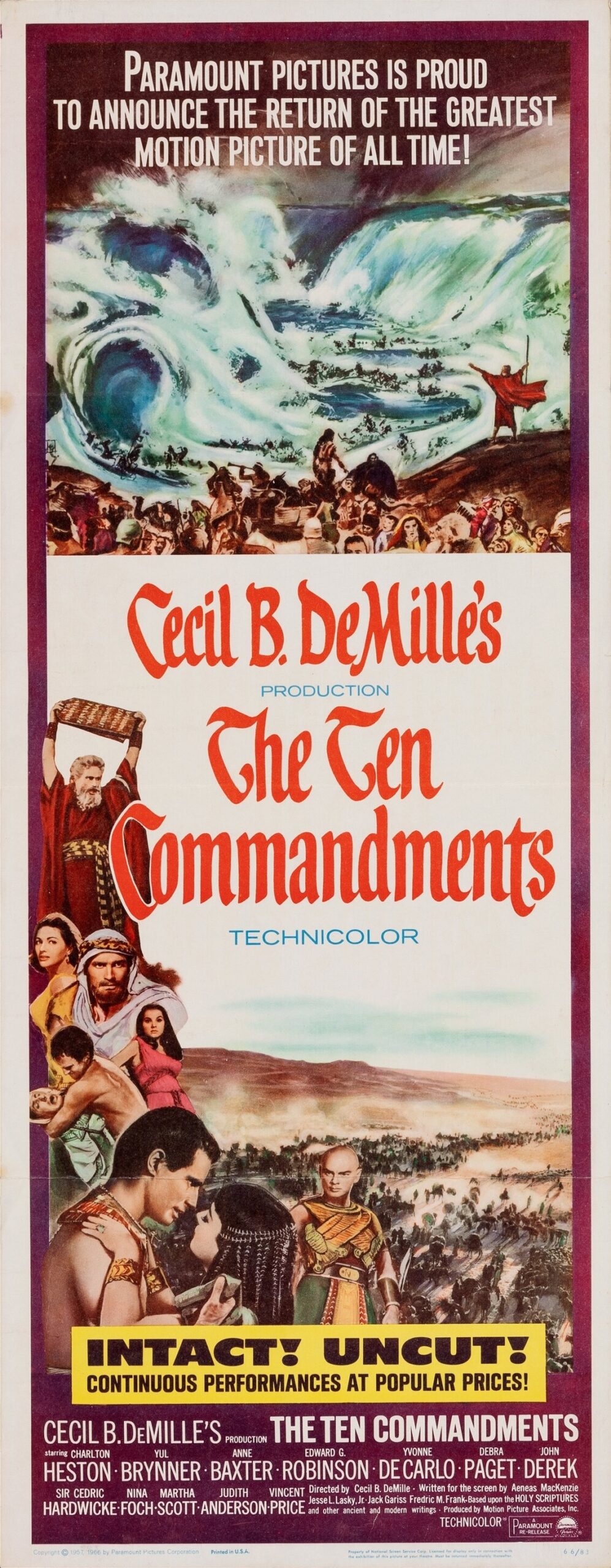
US 1966 re-release insert poster
The Ten Commandments – Matt Page
For sheer pageantry and spectacle, few motion pictures can claim to equal the splendor of Cecil B. DeMille’s 1956 screen epic, The Ten Commandments. Filmed in Egypt and Sinai on one of the biggest sets ever constructed for a motion picture, this screen spectacular boasts an unprecedented assemblage of Hollywood’s biggest stars. Heading the cast are Yul Brynner, Anne Baxter, Edward G. Robinson, Vincent Price, and Charlton Heston as Moses, the prophet who led his people to freedom. Now, for the first time, the uncut, fully restored version of Cecil B. DeMille’s classic is presented in widescreen format and Dolby Surround stereo.* Also included is a rare on-screen introduction by Cecil B. DeMille himself, plus original theatrical trailers and historical footage.
Ask any person which film embodies the word spectacle and Cecil B. DeMille’s 1956 epic, The Ten Commandments, is often named. With an approximate budget of 13 million dollars, it was Paramount’s most expensive film made up to that time. Upon its release, it became Paramount’s highest-grossing picture of the time as well as one of the all-time box office champions. To tackle the filming of a story as huge as The Ten Commandments, DeMille gathered an army of technicians and talent the likes Hollywood hasn’t seen since. 2,300 technicians and 25,000 extras were called upon to bring the life of Moses to the screen. The film started location shooting in 1954 at the sites where the story originally took place. Filming then resumed in Hollywood at Paramount for the interior scenes. Also, additional exterior scenes were filmed on the Paramount stages. The production was so huge it occupied nearly every stage on the lot.
The Sphinx Smiled for Me – Yvonne De Carlo
In casting his spectacle, DeMille hit upon some genius. In the original theatrical trailer for the film, DeMille recounts how Charlton Heston uncannily resembled Michelangelo’s statue of Moses. Yul Brynner, as the Egyptian Rameses, had already appeared in a few films. This was the same year he won the Oscar for Best Actor for his recreation of his stage monarch in The King and I. Anne Baxter, Oscar winner for The Razor’s Edge, captivates with her wonderful portrayal of Nefretiri. They are supported by Hollywood’s finest, including Edward G. Robinson, Vincent Price, John Carradine, Judith Anderson (in a portrayal reminiscent of her Mrs. Danvers in Hitchcock’s Rebecca), Yvonne De Carlo, John Derek and Sir Cedric Hardwicke. The film was a remake of DeMille’s own 1923 version of The Ten Commandments and theatrically re-released in 1966, 1972 and 1989. Included are the original 1956 trailer featuring an on-camera with Mr. DeMille, a 1966 reissue television trailer and the 1989 theatrical reissue trailer.
In commemoration of the 35th anniversary of the release of Cecil B. DeMille’s The Ten Commandments, Paramount is proud to present the film in a form as close to the original release as possible [sic]. Working with rare, original elements, the film has been digitally transferred to video, ensuring the finest quality. The soundtrack has been entirely remastered and remixed to Dolby Surround using the original three-track stereo music recordings and the original dialogue and effects tracks. This track has never before been available. The picture has been transferred from a low contrast print made from the original VistaVision EK [Eastman Kodak] negative. The film is presented in its original VistaVision aspect ratio, preserving the full image and closely duplicating the original theatrical presentation.* – US Paramount LD (1992)
[*Disingenuous: Rather than VistaVision’s theatrically-correct 1.85:1 aspect ratio, this LaserDisc is in erroneous but commonplace 1.66:1 which is achieved by cropping the left and right edges from a 1.78:1 master. All releases since have the latter ratio. Even worse that the original soundtrack has been completely remixed and replaced by studio shills, years after most of its 24 creators died.]
The Ten Commandments was restored to its original VistaVision splendor by combining the YCM color separation records to make a new 35mm internegative. This film element was transferred to film videotape utilizing the latest color correction advances. A digital restoration system was used to electronically remove film flaws and imperfections. A new 5.1 digital surround track was made by combining the stereo music tracks for the 1956 scoring sessions together with the film’s original sound elements. – US Paramount LD (1998)
Parting the Red Sea and Other Miracles – Paul R. Mandell

Brynner and Baxter: Dwarfed by the scenery (alt)
In the Grand Tradition: It is appropriate that in this, the Year of the Big Picture, the second of Cecil B. DeMille’s The Ten Commandments should appear on the screen. It has been 33 years since the first one, and doubtless there are many people who know nothing of that colossus of the old colossals except what they have read or heard. Viewing his current three-and-a-half-hour work, they may find a DeMille production a trying experience now and then, but a very educational one. They are bound to be, as their parents and grandparents were, impressed.
DeMille, a man of deep religious feeling, has taken Old Testament passages, made a variety of conjectures which seemed reasonable to him (after a look at the ancient historians, Philo and Josephus), and developed a story which is occasionally faithful to Biblical history and often faithful only to DeMille’s own vision of a “religious movie.” He takes most of his Biblical material from Exodus. The story he tells is chiefly the life story of Moses, from the bulrushes to the tablets on Sinai. A typical aspect of his works is the fact that, of the many stories which The Ten Commandments tells, none gets more attention than the foredoomed—and hypothetical—love affair DeMille has cooked up between Moses and the seductive Egyptian Princess, Nefretiri.
Optical Illusions: The present Ten Commandments is certainly as impressive as any movie DeMille has made. As usual, the settings—Egyptian temples, pyramids, and so on—soar right on up out of the picture. When Moses wanders in the wilderness, the wilderness is a bigger wilderness than one would have thought the globe had to offer. The ingenuity of the optical illusions is fascinating. There is the rain of fire, the burning bush, the rod turning into a serpent, and the water turning into blood. When the Red Sea parts, it is almost impossible to figure out how DeMille did it, and when it comes together again and swallows up the Egyptian pursuers it is even harder to explain. Finally, of course, there is the actual writing of the Commandments themselves, which DeMille has transformed into a hair-raising electrical storm. As always, there are great, colorful, flowing masses of people and animals, impressively handled; DeMille is without doubt Hollywood’s greatest traffic cop. But when it comes to directing individual actors, somebody else is champ. The authentically costumed actors in a DeMille movie rarely suggest anything but authentically costumed actors in a DeMille movie.
The Lesser Side: Much of the time, Charlton Heston does well enough with the role of Moses. Edward G. Robinson and Sir Cedric Hardwicke both manage to make something of their roles, the first as an oily betrayer and the other as a definitely British Pharaoh. Yul Brynner, as Prince Rameses in an interesting ponytail hair-do, is for once diminished by the costumes and scenery and partially paralyzed by an apparent lack of directorial help. Anne Baxter, as the loving Princess Nefretiri, tries very hard to rise above her material but does not make it. Circumstances beyond her control constantly force her to say things to Moses like, “Worship whatever gods you please, so long as I can worship you”—or, in reply to his, “What do you want, Nefretiri?” only “You, Moses.” This is the lesser side of DeMille; if he is to take the credit for what is impressive about his works, he must accept the responsibility for what is not. Each is quite a handful.
Summing Up: The genuine article in the colossal DeMille tradition. – Newsweek/2
DeMille’s Greatest/orig – Life
Three hours and 39 minutes of epic from the epic-master, Cecil B. DeMille. Pictorially stupendous. Boxoffice prognosis: strong. Chief flaw: length, Secondary objection: conventional story treatment. Previewed at Criterion Theatre. N. Y., Oct. 3.
Here at last is the epic, Cecil B. DeMille’s super-spectacular about the Children of Israel held in brutal bondage until Moses, prodded by the God of Abraham, delivers them from Egyptian tyranny. It’s a statistically intimidating production; the negative cost is $13,500,000 and 25,000 extras were employed, according to the producer’s count. This new version of DeMille’s silent (1923) saga, The Ten Commandments, overwhelms its audience—it’s that big. Pictorially it is greatly impressive, dwarfing all cinematic things that have gone before it. It’s unlikely that any producer other than DeMille would have attempted such a mammoth project and it’s to be doubted that many others could have held the extraordinary production under control. He has placed legions of men before the cameras, constructed sets that establish precedent in size and against the tremendous backdrop tells the great story of the collapse of the idolators through divine intervention.
That the boxoffice returns will be mountainous seems assured. Biblical entries of the past have won marked public endorsement and this one tops them all. Its theme, its photographic magnificence and the truly powerful publicity campaign must mean that Ten Commandments will run on and on. But this department shall refrain from predicting any specific gross, or the extent to which Paramount will or will not make beaucoup profit. In the enthusiastic language of the trade, a blockbuster is, currently, a tall revenue feature. When a picture grosses $10,000,000 or near it’s blockbusting. But look how tall Commandments must grow before it’s out of the red! In line with this, though, Par executives have unabashedly asserted that they have an economically supreme property.
No critical appraisal can be pure rave. While DeMille has broken new ground in terms of size, he has remained conventional with the motion picture as an art form. Emphasis on physical dimension has rendered neither awesome nor profound the story of Moses. The eyes of the onlooker, are filled with spectacle. Emotional tug is sometimes lacking. Commandments is too long. More than two hours pass before the intermission and the break is desperately welcome. Scenes of the greatness that was Egypt, and Hebrews by the thousands under the whip of the taskmasters, are striking. The construction of a gigantic new city to please the pharaoh is extremely impressive. But bigness wearies. There’s simply too much. Then, intermission. Commandments hits the peak of beauty with a sequence that is unelaborate, this being the Passover supper wherein Moses is shown with his family while the shadow of death falls on Egyptian first-borns. This is stirring and, in contrast with production generally, marked by simplicity and deep feeling.
Curiously, the miracles of God’s vengeance against the Egyptians, as detailed in the Bible, are not shown in their entirety. Instead, DeMille’s film devotes much footage to the events prior to the plagues and then the exodus, beginning, of course, with the finding of the infant Moses in the bullrushes by pharaoh’s daughter, his original role as Egyptian prince and the discovery that he is a Hebrew. The Bible left a 30-year hiatus in its recounting of Moses’ life from birth to manhood. DeMille states he tapped ancient historian sources and the discoveries of modern archeologists to improvise the story of the noble Egyptian prince who, upon learning the circumstances of his birth, elects to join his true people and, commissioned by a blazing message on Mount Sinai, sets out to “set my people free.”
Parting the Red Sea… Through the Years
The miracles of the Bible naturally necessitated camera trickery if they were to be depicted. The creeping shadow of darkness that destroyed the Egyptian first-borns, the trans-composition of Moses’ staff into a serpent, the changeover of the life-giving water into blood, flames to engulf the land and the parting of the Red Sea—these are shown. The effect of all these special camera devices is varying, however, and does not escape a certain theatricality, Against which stands the fact that DeMille’s endeavors with the optical process effects set a new high in grandeur and photographic enterprise. Perfect realism and conviction are not achieved, but the finished product still is impressive. Script by Aeneas MacKenzie, Jesse L. Lasky Jr., Jack Gariss and Frederic M. Frank is a tremendous job of organization. One scene segues into the next and characters in large number come on stage in fine continuity. The major flaw is that too much unmeaningful material is crowded into the first two hours of running time and the more uplifting excitement is left to the final passages.
In addition to serving as producer and director of the production, DeMille is sporadically heard as narrator to provide explanatory notes and appears in a two-minute prolog to comment on his source material. Performances meet requirements all the way but exception must be made anent Anne Baxter as the Egyptian princess Nefretiri. In expressing her intense love for Moses, even after discovering his background, Miss Baxter leans close to old-school siren histrionics and in instances this is out of sync with the spiritual nature of Commandments. Charlton Heston is an adaptable performer as Moses, registering as the conquering hero at the start and, later, revealing inner glow as he is called by God to remove the chains of slavery that hold his people. Yvonne De Carlo is Sephora, the warm and understanding wife of Moses. Yul Brynner is expert as Rameses, who inherits the Egyptian throne and seeks to battle Moses and his God until he’s forced to acknowledge that “Moses’ God is the real God.”
Competent work is done, too, by Edward G. Robinson, as the evil Hebrew; John Derek as Joshua; Debra Paget as Lilia, upon whom Robinson’s covetous eyes fall; Sir Cedric Hardwicke, the pharaoh who favors Moses until he learns of his birth; Nina Foch as the princess who finds the infant Moses and declares him as her own; Martha Scott as Moses’ real mother who sets him afloat in a basket to escape the pharaoh’s edict demanding death for all Hebrew male infants; Judith Anderson as the servant in the pharaoh’s household who witnessed the finding of Moses. Also offering contributions among the mighty cast are Vincent Price, John Carradine, Olive Deering, Henry Wilcoxon, H. B. Warner and Ian Keith.
Elmer Bernstein has provided a sensitive musical score. Rating nods for the overpowering photography, splendid in VistaVision and Technicolor except for some instances of obvious hocus pocus, are Loyal Griggs, as the top man behind the camera; assists by J. Peverell Marley, John Warren and Wallace Kelly; John P. Fulton, special effects; Paul Lerpae, optical photography, and Farciot Edouart, process photography. Set decoration and construction, costumes and art direction are other important credits. – Gene, Variety
Hollywood Reporter, LA Times/pt2 (/int/int), NY Daily News (arch), NY Times, Time (orig), Saturday Review
_01.jpg)
DeMille (alt)
The Ten Commandments: Writing on a Classic | Making of a Masterpiece | Collectors Guide, Pt 2: Soundtrack