- The five commandments: Thou shalt not…
- Do what cannot be undone at some future time
- Fail to indicate any unavoidably necessary changes
- Have the hubris to make a revision the de facto version
- Present commercial distortions of the original as “restorations”
- Harm the original while creating something else; log your methodology
- Four decade-old tenets of preservation and restoration still hold true in digital era
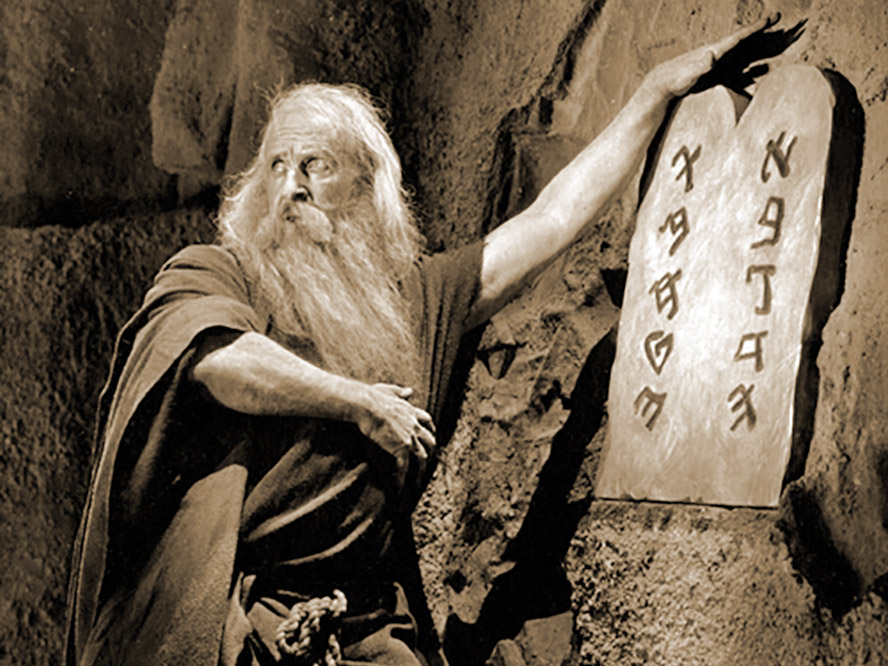
Theodore Roberts as Moses in The Ten Commandments (1923)
Like the terms “director’s cut” and “suitable for vegans”, “restoration” has become one of the most overused but misunderstood and misappropriated words of recent years, so we sorely need a reminder of what it actually means. Ever since this concise but influential and much–cited treatise was first published in the bilingual journal Griffithiana n° 38/39, October 1990, it’s been inaccessible for most, being only available in physical copies direct from Italian publishers la Cineteca del Friuli or online via ProQuest. Archivist Paolo Cherchi Usai said, “If I had to choose a single text in the vast literature pertaining to my profession, I would keep these two pages and happily leave everything else behind.”
“Archival restoration practices have come a long way in the past 40 years and it is now more or less set in stone that if you cannot authenticate, you do not fake.” – preservationist David Shepard, 2014
The Film Preservation Guide: The Basics for Archives, Libraries, and Museums (2004) PDF
There are several kinds of film restoration that may be undertaken and all of them may be appropriate for a film archive to collect. The only limitations to having a variety of film versions available for study are those of time and money. The time-consuming work of restoring a film may take away from the essential preservation tasks such as copying nitrate to acetate and may risk the very survival of other films. Probably the majority of films of the past could benefit from some kind of careful restoration work. In the present generation, film archivists can only hope to achieve a few of the more complex restorations. When setting out to restore a film, we must ask ourselves what it is we are trying to achieve.
1) The first consideration is the unrestored film as it has come to us, with all the losses that time and circumstance have brought. In the process of archiving paper materials, it is generally considered desirable to preserve the order given to a collection by its owner and creator. When it comes to films, the historian may want to know how and in what condition the work has survived. Defects are part of the film’s post-production history. In all kinds of restoration work it is said never to do what cannot be undone at some future time. We think the conscientious restorer will try not to destroy the surviving version while creating another one.
2) The second is the film as it was seen by its first audiences. This is usually considered the most important goal by film historians and archivists. To understand an old film, we try to get into the skin of those who saw it in its time. The film as it was shown for the first time is the goal of all our restoration projects at the Museum of Modern Art. We are not always able to reach it, but we get as close as we can. The first problems concern the need to determine what that version was. The solutions will differ with every film, according to what evidence can be found. The next problem is what to do when not all of the original footage can be found. Any solution is a compromise.
Titles explaining the missing scenes may be inserted, but should be in a different type face than that used in the original, to clearly indicate that they are a modern addition. When they exist, still photos or single frames may be used where the moving images should be, as long as it is clear that these were not actually “freeze frames” in the original. Such insertions are awkward and disruptive of the viewer’s enjoyment, but to ignore the missing scenes is misleading. To omit scenes without putting anything in their place is to join two shots that were never meant to be joined, to the destruction of the editing concept. The objection of some viewers to these devices is understandable. The classic Hollywood cinema is based on the spectator’s unconscious acceptance of an illusory reality. Anything that tends to break that dream-like illusion is resented. Nevertheless, we think that the function of a film archive is to make as clear as we can what the original version was.
Film: The Living Record of Our Memory (2021) DVD, Prime Video HD | screenings, trailer, intro, interview, award
3) A third kind of restoration is the film that its creator intended to make. As a restoration goal, this version assumes that the filmmaker is an artist and the film is a work of all that exists out of time. There are many cases where the artist’s vision has been reduced by circumstances, such as cuts inflicted by producers and distributors, by censors, by the market place. Perhaps the filmmaker ran out of funds before the vision could be fully realized. When the restorer finds a sequence that was filmed but not used in the released version, it is necessary to ask whether the filmmaker or someone else rejected it, and if so, at what point in the film’s history was it rejected? These matters are often difficult to determine.
There have been filmmakers who revised their work after seeing the film with audiences and making changes according to audience reaction. In some cases many years pass and the filmmaker is the one who has changed his ideas and his working methods. If anyone has tried to work with an aged filmmaker on the restoration of a film of his youth, he will know about the problems this may create. One has to give consideration as well to the fact that many films are not products of a single filmmaker’s vision but are the results of a working group. We think that a filmmaker should have the right to recreate his own film as long as it is not at the expense of destroying an earlier work. It should be the role of the film archive to protect the earlier work as far as it can.
4) Another possible version is the film that “plays well”, in other words, a film that keeps in mind a modern audience and the different way we may see things. This is usually a commercial restoration, one that is meant to be seen in theaters and on television. The most obvious example would be a silent film reissued in the sound period with a sound track added. As such versions are distortions of history, they probably should not be the work of film archives, but nevertheless they should be collected and preserved in the archive for future study. After all, they reflect their times, too. Sometimes early silent films are “stretched” by the use of optical printing to add repeated frames within the shots in order that they may be shown at sound speed on modern projectors. The process may be done more or less skillfully, but usually it results in a jerkiness that is destructive to the film’s rhythm. We think it is better to change the projection machine than to change the film itself.
5) Contemporary artists sometimes appropriate the work of an earlier artist, reworking it in their own image. Is it piracy or the legitimate territory of the artist? The conscience of the artist should decide whether or not this appropriation is an ethical one. We may grant the artist the right to borrow, but never to destroy the original while making it over into something else. To be sure, no one is very disturbed when what is appropriated has little artistic value, but we know that ideas of what has value change dramatically over time. There are probably other film versions that could be attempted. The one essential rule in all kinds of restorations is that the restorer must let us know what has been done. Unfortunately, we may be sure that the journalists and the promoters will distort whatever we try to tell them, but at least the restorer must write it down and, if possible, publish the history of the restoration, for the benefit of those who do have a serious interest.
In Focus: The Challenges of Film Reconstruction | The Art of Film Preservation
Related articles
- Alfred Hitchcock: Dial © for Copyright
- Bootlegs Galore: The Great Alfred Hitchcock Rip-off
- Beware of Pirates! How to Avoid Bootleg Blu-rays and DVDs
- Charlie Chaplin Collectors’ Guide, Part 2: The Bad, the Ugly and the Good