- Revisiting contemporary and modern critical appreciation
- Alfred Hitchcock’s Catholic dilemma makes gripping film noir
- Star Montgomery Clift’s priest plunged into an existential crisis
- Stark black and white photography highlights Quebec locations
- Priest in a hole: My secret condemns me now by the law of silence
- I’m losing my religion but keep the faith and lay your hands on me
Note: this is part of an ongoing series of 150-odd Hitchcock articles; any dead links are to those not yet published. Subscribe to the email list to be notified when new ones appear.
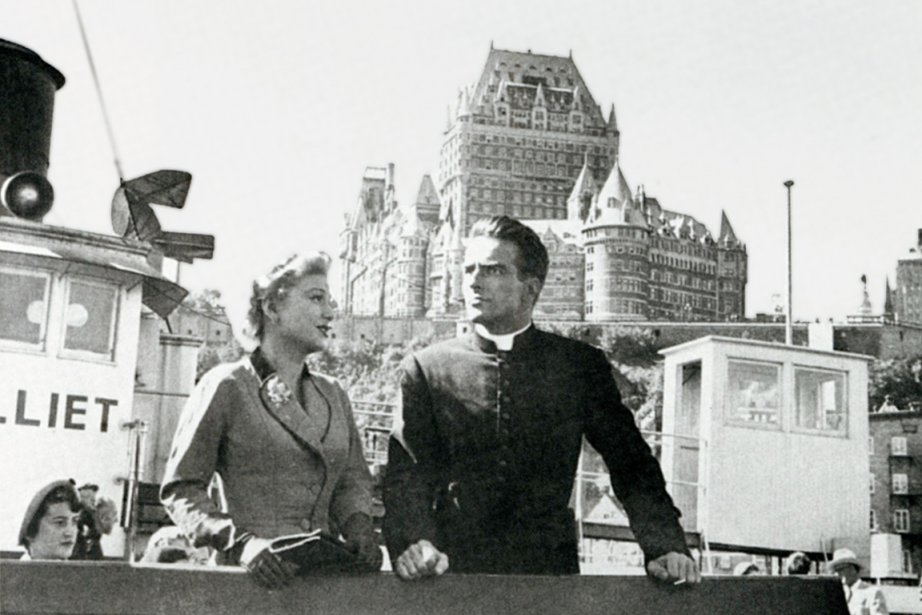
Monty: Nobody Asked Him/As You Were, Annie/review – Photoplay
Alfred Hitchcock’s newest movie is a swift, expert melodrama laid among the towers and stairs and terraces of the city of Quebec. Somewhat short on suspense, by Hitchcock standards, it is quite long on characters, atmosphere, and those little felicities of scene and gesture which are among its director’s special virtues. Although the story is centrally tricky and heavily compounded of coincidences, it comes off with a strong illusion of reality. These are not only dark but also convincing doings in Canada—at least as long as they are on the screen.
The script by George Tabori and William Archibald, after a novel by Paul Anthelme, deposits a square-jawed young Quebec priest (Montgomery Clift) in the very devil of a jam. In his dark church he receives the confession of a German refugee rectory worker (O.E. Hasse) to the effect that he has murdered a lawyer in the course of robbing him. The seal of the confessional, of course, keeps the priest from reporting the crime, and the criminal presently reneges on his own promise to lay himself bare to the police. Now it so happens that he disguised himself, during the period of the crime, in a priest’s cassock. And it further happens that the real priest may seem to have a motive for the killing. For, some years previously, he had a romance with a Quebec girl (Anne Baxter) who subsequently, as a married woman, was blackmailed by the murdered lawyer. A relentless police inspector (Karl Malden) closes in on the priest; the real criminal cravenly keeps his silence—and there is director Hitchcock’s opportunity for the baiting of breaths and the rasping of nerves.
He works it for a good deal of excitement, leading up to a fine courtroom scene and a surprise ending. He has trenchant assistance from his whole company, and Miss Baxter and Messrs. Clift and Hasse could scarcely be bettered in their unorthodox roles. Alfred Hitchcock has long known how to scare his audiences even with such innocent effects as a young priest’s suddenly dropping his bicycle. Perhaps there is not enough such sudden terror in this film to please old Hitchcock fans, but the director’s gifts as shown here make an appealing if not a stunning display. – Newsweek
Reviews: Breckenridge American, Dundee Courier, Film Bulletin/exploitation, Gainesville Daily, Harrison’s Reports, Look, NY Times, Straits Times, Times, Variety/orig
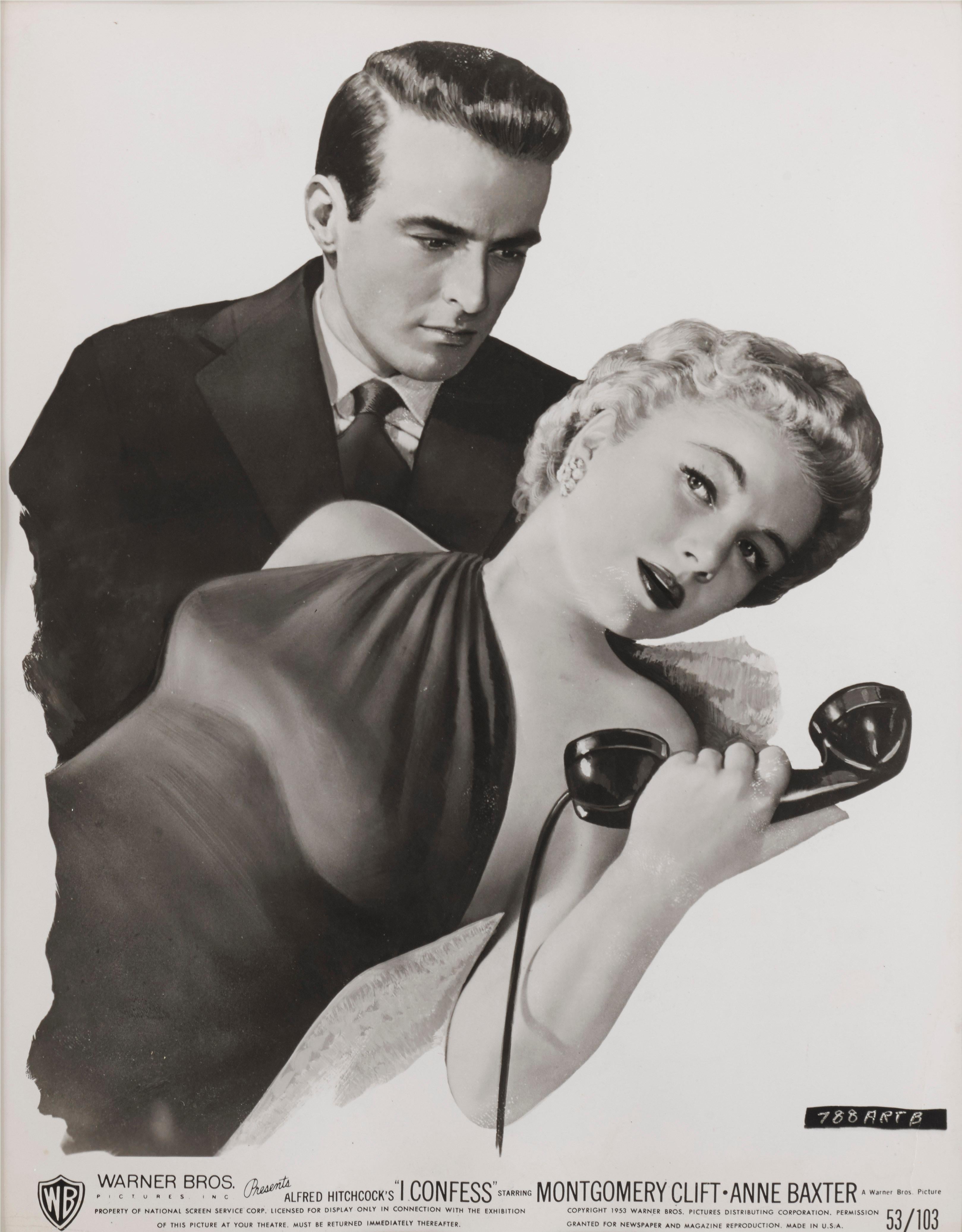
The Current Cinema: Meandering with Alfred
Alfred Hitchcock, who used to base his movies on fairly terse tales, has become increasingly fond of prolix scripts for his cinema exercises. In the old Hitchcock films, scenes went along at too rapid a clip to permit any of the characters to waste time on aimless dialogue; nowadays, the Master barely keeps things creeping, and his actors are often as windy as William Jennings Bryan. A sample of his new-day product is the picture called I Confess. Presumably, this is meant to be a kind of mystery drama. What it actually amounts to, though, is an exposition of the difficulties a priest can get into by keeping the secrets of the confessional inviolate. The theme is prinked up with murder and romance, but neither, as represented here, makes for suspense or entertainment. Based on a play [Our Two Consciences] by Paul Anthelme, adapted by George Tabori and William Archibald, I Confess recounts the adventures of a clergyman in Quebec who, after hearing the confession of a murderer, finds himself suspected of his Suppliant’s crime.
Since it is patent that no priest in the movies is going to be done away with unjustly by the civil authorities, the film begins to limp even before the first reel is unwound, but with dogged determination the Messrs. Tabori and Archibald try to make some sort of plausible case against their principal. There is, for instance, the circumstance that the priest, prior to taking holy orders, was loved by a lady who is now married. Although her association with our hero was as innocent as an Easter-egg hunt, the lady, obviously a simple-minded sort, has been paying blackmail to the man who was murdered to get him to keep the love story under his hat. She has informed the priest about this matter but has neglected to breathe a word of it to her husband. To the Quebec authorities, evidently a precipitate lot, this adds up to an almost watertight case against the cleric, but, of course, the whole thing is eventually cleared up cozily.
While one could hardly expect any actor to give real dimensions to the role of the protagonist in I Confess, it is possible that Montgomery Clift, who plays the part, was ill-advised to portray the priest as a sort of bemused juvenile, plainly too abstracted to lead one lamb, let alone a flock. As for Miss Anne Baxter, who is cast as the girl in Mr. Clift’s past, she seems so hell-bent on suffering that it is hard to imagine her as anything but a heroine of one of those lachrymose radio programs designed to keep ladies from their morning vacuuming. The Quebec criminal department is represented by Karl Malden, a veritable Javert when sniffing after a false scent, and Brian Aherne, a prosecutor who looks pained about everything that goes on. – John McCarten, New Yorker
German pressbook, Illustrierte Film-Bühne

Boxed in: Monty wrestles with an existential crisis
Hitchcock is back—and in top form
Things are looking up again. Three new films this week, and only one was poor. The real news is that Hitchcock, the greatest master of suspense, is in form again after some rather second-grade films. I Confess is the best Hitchcock I have seen since before the War—as good as the vintage Hitchcocks of The Man Who Knew Too Much, Thirty-Nine Steps and The Lady Vanishes era. From the typical Hitchcock opening angle shot of a deserted stairway, Quebec streets and pointing arrows leading straight to the body of a man lying on the floor, to the shot (a live one) that ends the pictures, here is a film that never for one moment relaxes its grip on the mind and the emotions.
The central theme, without any help from the director, is in itself highly dramatic. A man commits a murder and confesses to priest who makes him promise to give himself up. But the man, his secret safe with the priest, bound to silence by the sanctity of the confession. decides not to surrender. Slowly and inexorably, a chain of circumstantial evidence throws suspicion on the priest himself. Accused of the murder, he is brought to trial. Will he reveal the secret he alone knows apart from the murderer? This is a theme that could easily have been spoilt by poor direction, or overacting, or an indifferent script, or all three. Fortunately, all three are first-rate. The screenplay, by George Tabori and William Archibald, is based on a play by Paul Anthelme. The music is by Dimitri Tiomkin who, I suppose, will go down in history as the composer of the theme song of High Noon.
Hitchcock, who has never wasted screen time with irrelevancies, cuts out everything that might tend to distract attention from the terse, clear line of the story. Where flashbacks are used, they come naturally, and retain their hold on the present because they simply illustrate words spoken as the action progresses. I cannot imagine anyone better fitted for the difficult part of the priest than Montgomery Clift, who borings to it a restrained dignity and at the same time good looks, for the story also requires these. That accomplished actress, Anne Baxter. goes from strength to strength. In I Confess, she plays the part of a French Canadian lawyer’s wife who some years earlier had been in love with the priest. The murdered man turns out to be a shady character who had blackmailed her on that account.
When she tells the police she saw the priest on the night of the murder, to ask his advice, she believes she is providing him with an alibi: in fact she is incriminating him by providing him with a motive for the murder. Brian Aherne, who seems to have been out of pictures for years (he once starred with Marlene Dietrich, remember?), turns up, hardly aged at all, as the Crown prosecutor. And Dolly Haas, also I think an absentee, turns up, [deliberately] very much aged, as the wife of the murderer (O. E. Hasse). Nobody who appreciates an outstanding piece of filmcraft can afford to miss I Confess. – Brian Crozier, Straits Times
Robert Burks on shooting I Confess – American Cinematographer
A murderer’s confession triggers a priest’s ordeal
“Bless me, Father, for I have sinned.” Those words, passed from penitent to priest inside the dimly-lit confessional, seal a sacred compact of silence never to be breached or defiled. No matter how grievous the sin. In Alfred Hitchcock’s world of omnipresent dangers, those words can spin the all-enveloping web of a hellish nightmare. I Confess is director Hitchcock’s most compelling and darkly dramatic examination of inner spiritual turmoil and outer physical jeopardy.
Father Michael Logan, stolid, stalwart, to all appearances the embodiment of clerical piety, hears a murderer’s confession. Almost immediately Logan is plunged into peril, for circumstantial evidence and eyewitness accounts point to a priest as the killer – and the sacrament of penance forbids him to reveal what he knows. Hitchcock taps his Roman Catholic background to reinvent his familiar figure of hero as victim with an engrossing new twist: as calamity and coincidence conspire to paint Logan into a hopeless corner, it becomes the priest who must admit to himself – and confess – his own human frailty.
Logan’s moral crisis is grippingly realized in Montgomery Clift’s powerful performance. At the peak of his popularity and critical acclaim, four-time Academy Award nominee Clift (The Search, A Place in the Sun, From Here to Eternity, Judgement at Nuremberg) possessed piercing eyes and a brooding intensity that fascinated audiences, making him the perfect choice as Hitchcock’s endangered cleric inescapably headed toward imprisonment… or the gallows.
Oscar winner Anne Baxter (The Razor’s Edge, All About Eve) plays Ruth, Logan’s former girlfriend before his ordination, whose wildly romantic fantasies about their relationship expose Logan to private torture and public censure. Karl Malden, her fellow Oscar winner (A Streetcar Named Desire, On the Waterfront), is Inspector Larrue, whose attempts to prove Logan innocent are constantly thwarted, especially by Logan’s own silence. of a homicide charge only ensnare him further. O.E. Hasse as church caretaker – and actual murderer, Otto Keller – enters the pantheon of Hitchcock villains with a portrait of undiluted and, ironically, unrepentant evil.
Filmed in Quebec at locations highlighting that city’s old world traditions, I Confess races toward a climax that is unforgettable. And in true Hitchcock fashion, you’ll confess to being hooked all the way. – US Warner VHS and Betamax (1985), VHS (1990) and LaserDisc (1991)
Movie-Locations, H Zone, IMDb, house/français
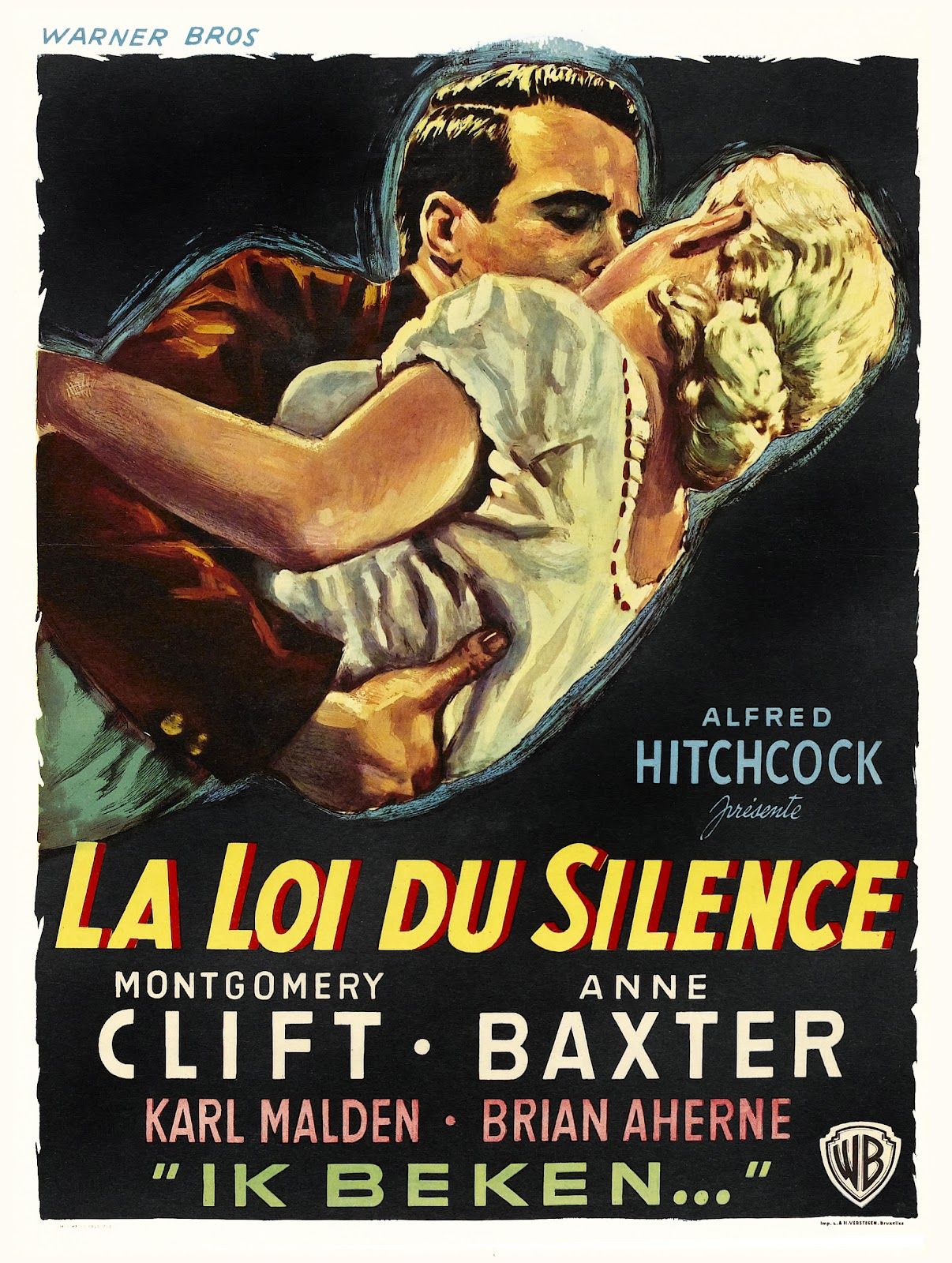
Belgian poster
Related articles
This is part of a unique, in-depth series of 150-odd Hitchcock articles.