- Alfred Hitchcock’s carefully planned, three-dimensional thriller was a big hit… in 2D
- Iconic blonde Grace Kelly cements her star power playing a rich, unfaithful housewife
- Robert Cummings, star of Saboteur, narrowly returns as crime author and her loyal lover
- Brit stalwart Ray Milland is a husband who wants out but divorce is last thing on his mind
- Scot Anthony Dawson is chosen weapon of destruction finding the first cut is the deepest
- Another Brit, Hitchcock favourite John Williams, is the dogged detective digging for truth
Note: this is part of an ongoing series of 150-odd Hitchcock articles; any dead links are to those not yet published. Subscribe to the email list to be notified when new ones appear.
Dial M for Murder: Writing on a Classic, Part 2 | Collectors Guide, Part 2: Home video and soundtrack

This US 1982 re-release poster screams its era, making it more akin to something by Hitch acolyte Brian De Palma; here are more.
Mounting fear turns to terror in Alfred Hitchcock’s classic mystery Dial M for Murder. With a glittering cast that includes Grace Kelly and Ray Milland, Hitchcock displays his genius for manipulating the audience through a maze of plot twists that will leave you guessing up to the last minute. Most of the action is set in the stylish London apartment of Tony Wendice (Ray Milland), a suave, former tennis champion whose luxurious lifestyle depends on the wealth of his beautiful wife Margot (Grace Kelly). It’s clear that Tony has targeted Margot for death, having discovered that his comfortable marriage is threatened by her love affair with Mark Halliday (Robert Cummings).
Tony blackmails a former university classmate (now a hardened criminal) into committing the murder but the ingenious plan goes awry. In the course of the cat-and-mouse game between the coolly confident Tony and Chief Inspector Hubbard of Scotland Yard (John Williams), we are led into a web of surprising turns and tangles that involve the all-important key given by Tony to his unlucky accomplice. As usual, Hitchcock’s fans can look forward to spotting his inconspicuous cameo appearance early in the film. Dial M for Murder is a thriller of crackling tension in the best Hitchcock tradition. – Curtis F. Brown, US RCA CED (1983)
It was the perfect crime… then the telephone rang
The three leading characters in Alfred Hitchcock’s ingenious thriller, Dial M for Murder, are a beautiful and wealthy wife, her greedy husband, and a young novelist. Jealous of his wife’s attentions towards the novelist, and anxious to lay his hands on her fortune — the husband decides, quite callously, to murder her. He blackmails a former associate with a criminal record, and arranges what appears to be the perfect crime. His plans, however, are foiled when the wife resists her unknown assailant and stabs him to death with a pair of scissors.
Undaunted, the unscrupulous husband re-jigs his murderous plans and attempts to convince a not-so-easily-duped police inspector that it was his wife who murdered the man because he was blackmailing her! With the help of the wife and the novelist, a situation is arranged in which the husband is revealed to be the villain he is. Grace Kelly stars as the wife, Ray Milland is her scheming husband, and Robert Cummings the helpful novelist. Based on the long-running Broadway and West End stage hit of the same name, Dial M for Murder is that rare thing: a truly brilliant thriller. – Japan Warner LaserDisc (1985)

French poster
A conniving husband discovers a Hitch in the perfect crime!
Dial “M” for the Master of Suspense, Alfred Hitchcock! The subject in this, Sir Alfred’s 39th film, is – of course – murder. And the much-emulated director labored over that subject with his customary precision, demanding the best. “This is nicely done,” he commented while rejecting rushes of the film’s murder scene, a scene in which scissors become a deadly weapon. “Bur there wasn’t enough gleam to the scissors, and a murder without gleaming scissors is like asparagus without the hollandaise sauce: tasteless.”
Dial M for Murder’s story – a very tasty blend indeed of elegance, excitement and suspense adapted from Frederick Knott’s stage hit – stars Grace Kelly, Ray Milland and Robert Cummings in a triangle of passion and greed. Kelly has fallen in love with Cummings; Milland, her husband, plots her murder, But when Milland dials a Mayfair exchange to set the plan in motion, his right number gets the wrong answer – and you get to sit back and watch the whole scheme unravel in the most unexpected ways!
Honored in 1974 by New York’s Film Society of Lincoln Center, Hitchcock spoke drolly to the gathering. The subject again: murder. After his speech he returned to his seat, then said, “As you see, the best way to do it is with scissors,” referring at once to Dial M’s weapon and to the artful editing that’s a hallmark of his films. With scissors. Gleaming scissors. So that’s how it’s done. Funny no one could ever do it as well. When you watch Dial M for Murder, you’ll discover why. – US Warner VHS (1987) and LaserDisc (1991)
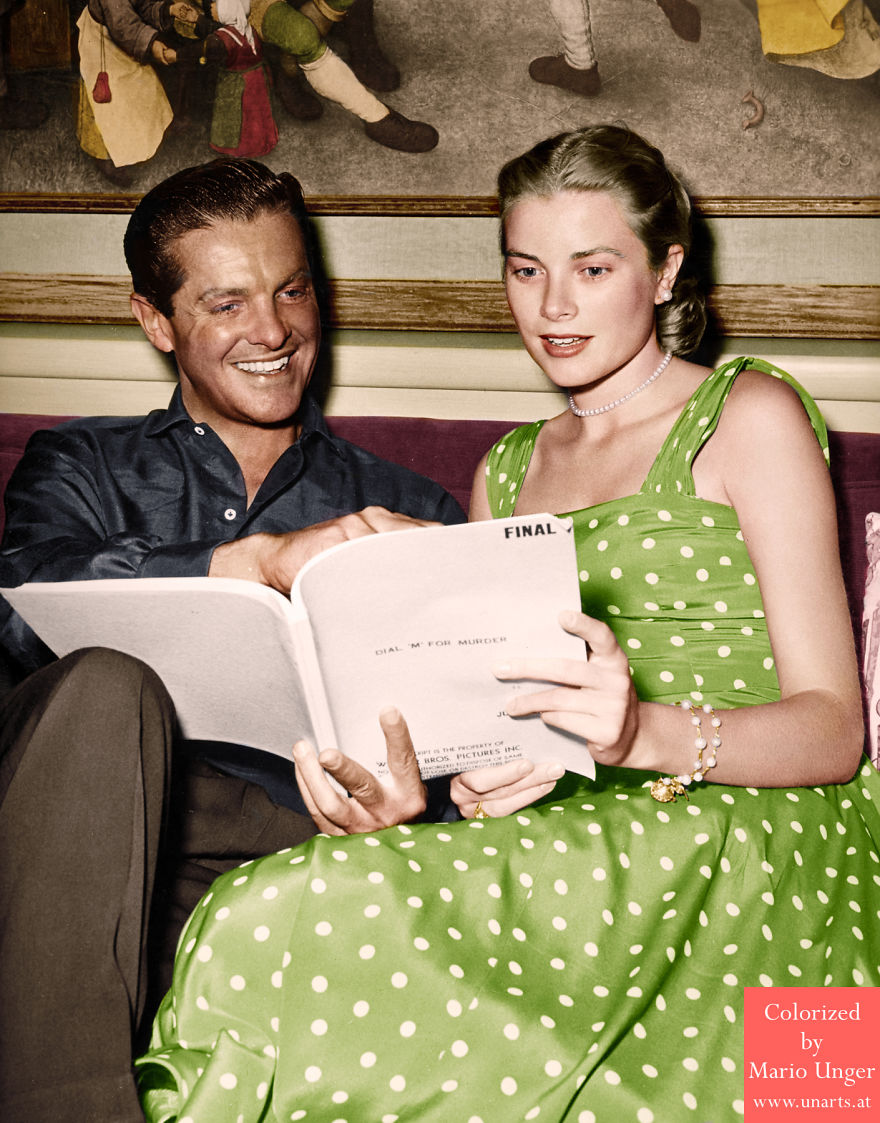
Robert Cummings and Grace Kelly go over the script under a life-sized copy of The Peasant Dance by Pieter Bruegel the Elder (c.1567). Paul Popper’s B&W original (alt) is colorized by Mario Unger (source). Typically for art lover Hitchcock, the Wendice’s apartment is adorned with other masterpieces.
A blend of high society elegance, excitement and suspense, Dial M for Murder ranks among Alfred Hitchcock’s best. Grace Kelly, Ray Milland and Robert Cummings star in a tale of three people consumed in a romantic triangle of passion and greed. Kelly has fallen in love with Cummings. Milland is the scheming husband who plots her murder. When Milland dials a Mayfair number to set the plan in motion, the right number gets the wrong result. A loose pair of gleaming scissors is all it takes to unravel a plot that takes the most unexpected turns. Artful editing and Hitchcock’s customary precision make Dial M a ringing success.
This is nicely done,” said Alfred Hitchcock between takes of Dial M for Murder, “but there wasn’t enough gleam to the scissors, and a murder with out gleaming scissors is like asparagus without hollandaise sauce — tasteless.” Hitchcock had spent a long week fretting over the crucial scene of Dial M for Murder, losing 20 pounds in the process, and every detail had been plotted with the director’s customary precision. Based on a play by Frederick Knott, this 1954 release stars Ray Milland as Tony Wendice, a retired tennis star who devises an elaborate murder scheme. Grace Kelly, in her Hitchcock début, co-stars as Margot Wendice, the intended victim.
Turned to Stone
At her first meeting with Hitchcock, the 23-year-old Kelly suffered an attack of nerves that left her nearly speechless. “In a horrible way,” she later recalled, “it was funny to have my brain turned to stone.” Hitchcock, for his part, seemed unimpressed with the young actress, commenting only that he would “have to do something about her voice,” which struck him as too high and thin. Despite this inauspicious beginning, Hitchcock soon took a liking to Kelly and gave her extensive coaching. Surprisingly, the director — who once said that “all actors are cattle” — even listened to Kelly’s ideas and suggestions. One scene, for instance, called for the actress to rouse herself from bed to answer a ringing telephone. Hitchcock felt strongly that Kelly should put on a red velvet robe to contrast with her blond hair. She disagreed. “I don’t think that this woman is going to put on this great fancy robe if she is getting up in the middle of the night to answer a ringing phone,” the actress said. “I’d just get up and go to the phone in my night-gown.” Hitchcock pondered the suggestion for a moment, then gave his assent.
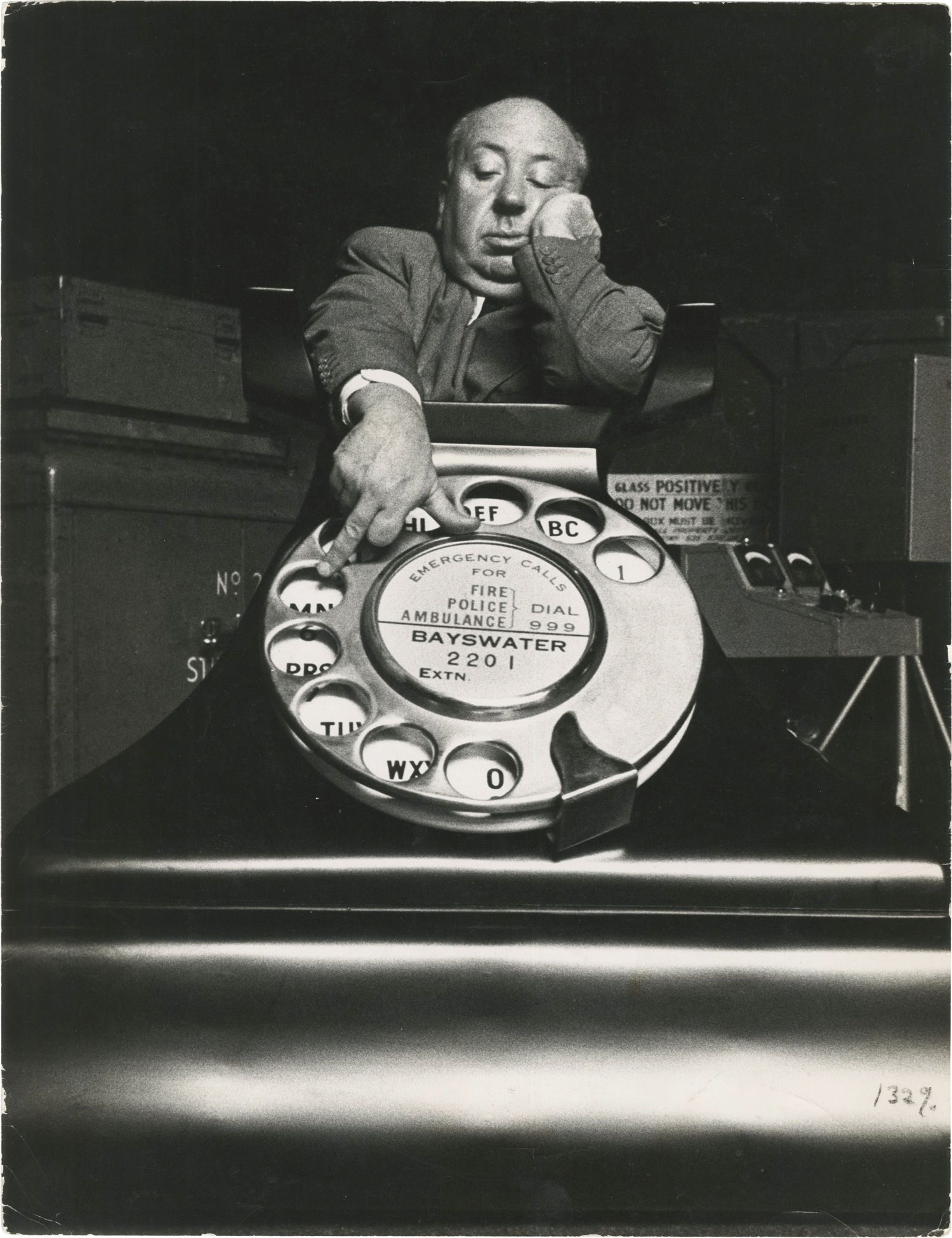
Hitchcock blondie: hanging on the giant telephone. Hitch also used similarly outsized props in Easy Virtue, Spellbound and Notorious (source).
Extra Dimension
Grace Kelly’s wardrobe, however, was the least of Hitchcock’s difficulties. Hollywood was then in the grip of 3-D, the new film making process that allowed moviegoers — once they had donned special glasses — to experience three “lifelike and thrilling” dimensions. Jack Warner, head of Warner Bros., insisted that Hitchcock use the new technology to shoot Dial M for Murder. Though Hitchcock generally loved to experiment with new techniques, the awkward 3-D equipment proved to be a nuisance. “Hitchcock was terribly encumbered and frustrated by having to do the picture in 3-D,” Grace Kelly remembered. “It was like having to go into a boxing ring with your hands tied.” Even so, Hitchcock managed to breathe life into the dying technology. For one scene, the director wanted a close-up of a finger dialing a telephone — underscoring the film’s title — only to discover that the 3-D camera couldn’t focus tightly enough. Hitchcock found a novel solution: he filmed the shot with a specially built giant telephone. A huge wooden finger did the dialing.
Shocking Tactics
As a respite from his technical woes, Hitchcock took a mischievous delight in trying to shock the seemingly prim and proper Grace Kelly. The director frequently wandered onto the set to share an off-color joke with Ray Milland, all the while glancing over at Kelly to gauge her reaction. Each time, the actress remained perfectly calm and unruffled. Finally, Hitchcock could no longer contain his disappointment. “Aren’t you shocked, Miss Kelly?” he asked. “No,” she replied, “I went to a girls’ convent school, Mr. Hitchcock. I heard all those things when I was thirteen.” Hitchcock was plainly charmed. So much so, in fact, that one month after finishing Dial M for Murder, Kelly was awarded the starring role opposite James Stewart in Hitchcock’s next film, Rear Window.
Behind the Scenes
Dial M for Murder was shot in 36 days. By the time of the film’s release the 3-D fad had already run its course; most theaters screened the movie in the normal “flat” version. Ray Milland, who won an Oscar for his role in The Lost Weekend, was quite modest about his exceptional talent. On acting, he said, “Learning to act at all is hard. I once spent two full days trying to walk naturally through a door.” Grace Kelly, in her first Hitchcock role, relished the chance to work with the famous director. “As an actor, I learned a tremendous amount about motion-picture making,” she recalled. “He gave me a great deal of self- confidence in myself.” Robert “Bob” Cummings, star of a popular television comedy series, co-stars in a rare dramatic role. Earlier, Hitchcock had considered not using Cummings for a role in Saboteur because of his “comical face.” – US Warner/Time Life VHS (1991)
Dial M for Murder: Writing on a Classic, Part 2 | Collectors Guide, Part 2: Home video and soundtrack
Related articles
This is part of a unique, in-depth series of 150-odd Hitchcock articles.