- The man who saw too much – but seeing isn’t always believing
- Ensemble: already large cast doubles in number by the final scene
- Soap opera in long-shot that turns the audience into willing voyeurs
- The window to the courtyard provides insights to the human condition
- This voyeuristic masterpiece operates on more levels than most Hitchcocks
- Role reversal: baddie is better known as a goodie – who ends up in a wheelchair
- Window pain? Re-release falsely marketed as a horror to cash in on Psycho’s success
- Lesser-seen, low-budget precursor served as shocking dry run for murderous masterpiece
Note: this is part of an ongoing series of 150-odd Hitchcock articles; any dead links are to those not yet published. Subscribe to the email list to be notified when new ones appear.
Rear Window: Writing on a Classic, Pt 2: More writing | Collectors Guide, Pt 2: Soundtrack and essays, 3: Home video, 4: Remakes
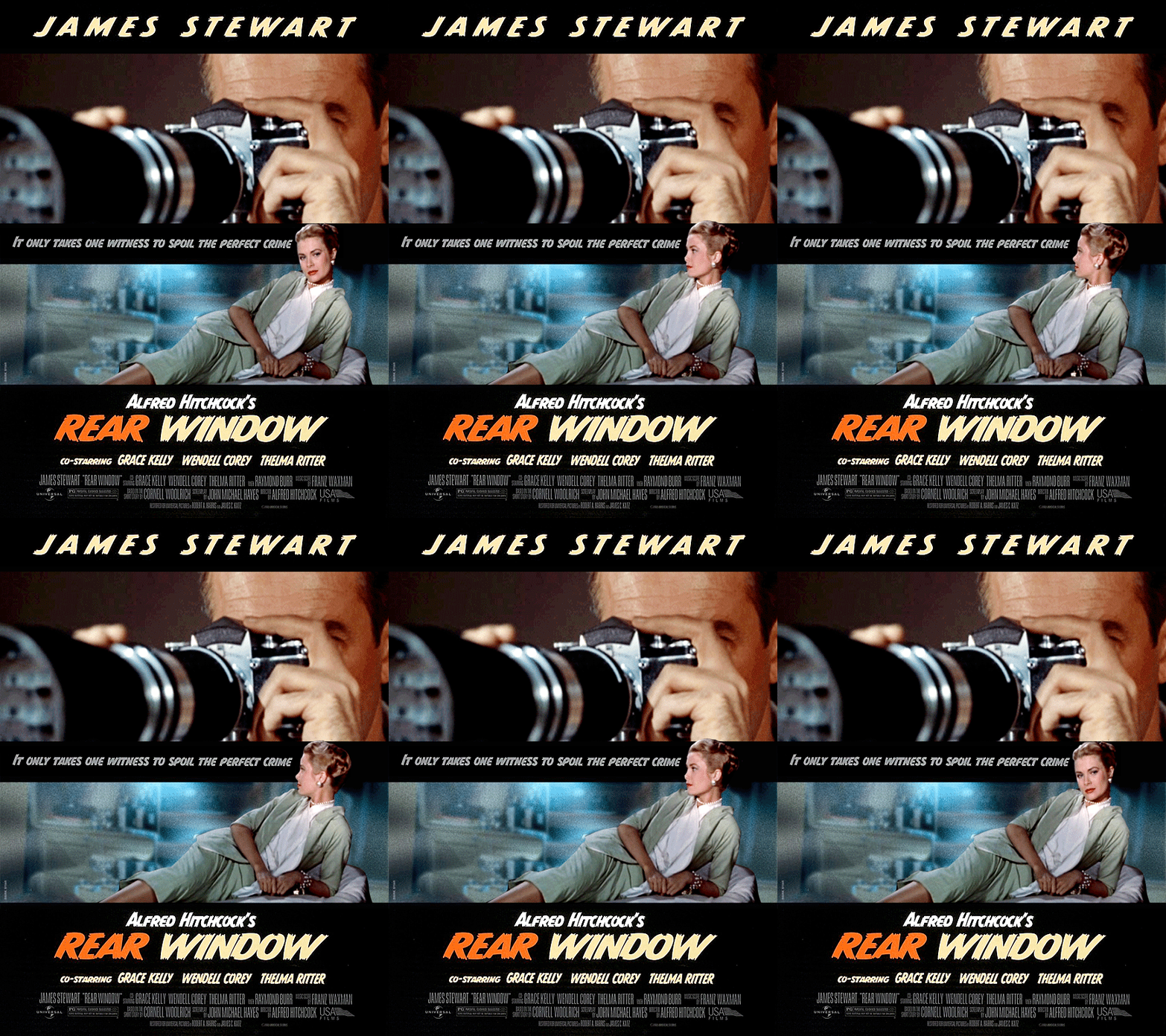
US 2000 restoration re-release one sheet poster animated by Michael Branson Smith, 2012
Contents
Production
Trailers: ↑1962 re-release/widescreen, US VHS, TV ad, Argentinian | 10 clips, 9 clips
Rear Window is a witty and macabre tale of voyeurism and murder starring Academy Award Winner, James Stewart and the late Princess of Monaco, Grace Kelly. Based on a short story by Cornell Woolrich, it is considered to be one of Hitchcock’s greatest films, as it attempts to unearth the peeping Tom in all of us, and illustrates how obsessive curiosity can kill more than a cat. When news photographer L.B. Jeffries (James Stewart) is confined to his room with a broken leg, he begins to pass his time spying on all the neighbours in his courtyard [including the “helicopter girls“]. Through his high-powered binoculars, he thinks that he sees Lars Thorwald (Raymond Burr) disposing of his invalid wife’s body. An action brought vividly to life through Hitchcock’s ever moving camera. Tension mounts as Lisa (Grace Kelly) acting as Jeff’s ‘legs’ attempts to discover more and culminates in typically ironic Hitchcock fashion. – Australia CIC VHS (198-)
This was often cited, alongside The Lodger and Shadow of a Doubt, by the director as one of his favourite own films and little wonder, when it was so successful and contains many of his favourite tropes including voyeurism. Throughout, we are privy only to the same information that Jeff can glean from his restricted vantage point, except for the opening credits sequence and when he falls asleep, and Thorwald leaves his apartment with a woman in black… The effect is bolstered by the fact that like Jeff we only have nicknames for the neighbours, and it’s telling that two of the women are named after body parts, when (possible) female dismemberment is the main theme. More subtly, the neighbours’ lives represent potential futures for both Jeff and Lisa, depending on how their relationship pans out.
The book Lisa pretends to read in the final scene, Beyond The High Himalayas (1952) by William O. Douglas, was aptly chosen as its author’s life had echoes of Jeff’s own, though Stewart being aged 46 to Kelly’s 23 when filming commenced stretches his credibility as a footloose, reluctant young bachelor. In an interview at the film’s 1983 re-release première, Stewart said Kelly had done all her own stunts, including climbing through a second story window from a fire escape, and that his ultimately breaking both legs was a last-minute improvisation. Not all of the film’s humour was scripted either, as with the couple on the fire escape Hitch once again demonstrated his penchant for deliberately misdirecting his actors in order to generate onscreen laughs.

Two’s company: Kelly and Stewart riding a bike on the set of Rear Window (alt)
Hitch began a happy working relationship on Rear Window with producer-director Herbert Coleman, who racked up credits on the rest of his iconic 1950s films, 16 episodes of the Alfred Hitchcock Hour, and Topaz. Late in his long life he was interviewed for several Hitchcock documentaries, including those for Rear Window, The Trouble with Harry, The Man Who Knew Too Much and Vertigo. Coleman’s assistant director credits include Frenchman’s Creek (1944), the recently-restored minor 3D classic Sangaree (1953), Roman Holiday (1953) and The Naked Jungle (1954). His posthumous memoir is a fascinating look at a stellar, seven-decade career, with particular focus on his collaborations with the master.
- A Hollywood Memoir: 1916–1988 (2003/2007) – Herbert Coleman
- Sangaree: US: Kino BD and DVD (2018), also in 3-BD Paravision Dreams: Golden Age 3-D Films
- Bootlegs: Italy (A&R Productions), Spain (Cinecom, Llamentol BD-R)
Rear Window was adapted by radio, film and TV scriptwriter John Michael Hayes, and was his first of four successive films with the director. It was joined by To Catch a Thief, The Trouble with Harry and The Man Who Knew Too Much; all are covered extensively in Steven DeRosa’s excellent book.
- Writing with H: The Collaboration of AH and John Michael Hayes (2011, shorter original 2001) – Steven DeRosa | book site
TCM | AFI: Martin Scorsese, Robert Towne | David Lynch, Mike Leigh, TFH
Raymond Burr
- US: Paramount 72-DVD Complete Series (2016, reissued 2020), also in CS Pack | MeTV
- Paramount 15-DVD Complete Movie Collection (2016, reissued/alt 2020) – and series/movies together
- Germany: Paramount DVD Seasons 1-6 (2009–2016) English/German audio and subs
- Telamo 26-DVD Spielfilm-Komplettedition (2021) – German dubs only
Tormented antagonist Thorwald was played by Raymond Burr, who was reportedly cast for his resemblance to David O. Selznick, Hitch’s erstwhile producer and rival. He was further made up with grey hair and glasses, with added mannerisms to drive home the effect. But the most familiar images of Selznick depict him as a younger man, so it’s important to bear in mind the way he looked much nearer the time of Rear Window’s release. The rampant megalomaniac deserved far worse than Hitch’s sly dig; for starters, see the part he played in causing the death of poor Robert Walker, star of Strangers on a Train.
- France: Showshank 14-DVD L’Intégrale des téléfilms (2015, reissued 2021) – French dubs only | teasers
- Australia: Via Vision 73-DVD Complete Series (2021) trailer
- Madman 13-DVD Complete Movie Collection (2019, reissued 2023)
- Spain:
DVD Feel Films/vol 2 and Classicmedia– bootlegs
In an ironic reversal, Burr is perhaps most famous for later playing TV lawyer Perry Mason (1957–1966, 1985–1993) and wheelchair-bound ex-cop Ironside (1967–1975, 1993). Much like Alfred Hitchcock Presents, both have seen partial releases in various countries, such as the UK’s season One and Two DVDs of Perry Mason, but I’ve listed the most complete sets available. Note 1993 TV reunion movie The Return of Ironside can be found in the box sets, as a standalone UK DVD and US stream.
- US: Shout! Factory season 1, 2, 3, 4, also in Complete Seasons 1-4 (2020) | TV spots
- France: Elephant 56-DVD L’intégrale saisons 1 à 8 (2016) – French dubs only | trailer, credits/alt
- Australia: Via Vision 56-DVD Complete Series/alt (2023) clips
Foundation Interviews: Perry Mason/Ironside
Cornell Woolrich
Prolific thriller writer Cornell Woolrich was responsible for the short story on which Rear Window was based, 1942’s “It Had to Be Murder“, first published under a pseudonym in the February 1942 issue of Dime Detective Magazine and retitled for anthology publication as “Rear Window”. A controversial 1990 US Supreme Court decision involving its copyright renewal rights led to tying up the domestic distribution of various notable films. But Woolrich’s tale was itself based on an earlier story, “Through a Window” (1894), by none other than H.G. Wells. Later in 1942, Woolrich published Phantom Lady, which was soon adapted as a film noir classic of the same name and hitch scribe Joan Harrison’s début production. On a related note, check out the excellent retro-Hitchcockian novel set during the production and release of both Young and Innocent and Rear Window.
- After-Dinner Story/Six Times Death (1944) – Woolrich, as William Irish
- The Best of William Irish (1944)
- Rear Window collections – Woolrich
- Four Thrillers by Cornell Woolrich (1983)
- Fenêtre sur cour – William Irish
Though they never worked together directly, Woolrich had many close Hitch connections. Four of his short stories were adapted as episodes of Alfred Hitchcock Presents; and “Three O’Clock”, retitled “Four O’Clock”, as a Hitch-directed episode of related TV series Suspicion (1957–1958). (“Three O’Clock” was also the basis for joint radio and TV episodes of 1949’s Starring Boris Karloff.) Woolrich’s 1941 novel The Black Curtain was filmed as 1942 noir Street of Chance and a first-season episode of the Alfred Hitchcock Hour. Shoehorned in between those were a 1943 radio version starring Cary Grant, followed by a 1948 remake with Robert Montgomery. Both were for Suspense, the long-running radio drama series whose 1940 pilot episode, The Lodger, was directed by Hitch as promotion for his upcoming Foreign Correspondent. Both Cornell’s story and Hitch’s film have been the subject of various legal disputes which look set to recur indefinitely:
Media Law: Rear Window Analysis – Lucas Wright
For more in much the same (bloody) vein, check out criminally-undersung gem 1949’s The Window, also based on a Woolrich short story. Although made on a much lower budget, it’s every bit Rear Window’s equal and is very capably helmed by cinematographer-director Ted Tetzlaff who lensed well over 100 films, including Notorious.
Re-releases
Despite being only eight years old and with The Birds still over six months from completion, Rear Window was re-released worldwide to capitalise on the demand for a ‘new’ Hitchcock in the wake of Psycho’s blockbuster success. It was somewhat disingenuously marketed as a slasher to ride the wave even further, as exemplified by the ad below. More in keeping with its actual theme and tone, “The Palms, Detroit, had a model stand behind a ‘Rear Window’ so that her silhouette could be seen from the street through the drawn shades as bally[hoo] for the Paramount film. The stunt used nightly had the model combing her hair, applying make-up, and removing her hose while Alfred Hitchcock’s recorded voice was broadcast over a PA system.” Further re-releases have occurred periodically ever since, perhaps most markedly in 1983 after the film’s long unavailability, and on the occasion of each new restoration or remaster.
You couldn’t say that nowadays… Motion Picture Exhibitor trade magazine advert for the 1962 re-release; pressbook
Rear Window: Writing on a Classic, Pt 2: More writing | Collectors Guide, Pt 2: Soundtrack and essays, 3: Home video, 4: Remakes
Related articles
This is part of a unique, in-depth series of 150-odd Hitchcock articles.