Home video
- Clear window: preserved print and two separate restorations released across multiple formats
- Breakdown: three versions but they’re in seven variant transfers, all detailed for the first time
- Follows Universal’s usual pattern of incrementally improved releases over past few decades
- Each new issue carries over (almost) all the previous extras and sometimes adds yet more
Note: this is part of an ongoing series of 150-odd Hitchcock articles; any dead links are to those not yet published. Subscribe to the email list to be notified when new ones appear.
Rear Window: Writing on a Classic, Pt 2: More writing | Collectors Guide, Pt 2: Soundtrack and essays, 3: Home video, 4: Remakes

Italian four sheet poster by Averardo Ciriello. Like most countries’ titles, it translates as “The window to the courtyard”.
Contents
- Dream sequence version
- 1983 theatrical print
- 2000 restoration
- 2012 restoration
- Screenshots
- Extras
- Summary
- Related articles
Dream sequence version
In 1986, Universal re-edited Rear Window for TV broadcast, padding out its 112-minute running time by slowing down the opening credits and repeating the music to fit, and inserting several dream sequences for Jeff, compiled of blurry, repeated footage. Given Universal’s predilection for endlessly meddling with all the original, director-approved versions of their 14 Hitchcocks (but especially Vertigo and Psycho), I’m surprised they haven’t given us an alternative Rear Window ‘dream sequence version’ on home video. Seeing the altered segments as extras would be interesting but no new ones have been produced since 2008’s Legacy Series DVD.
Even more surprising is that Universal didn’t choose to convert it to 3D during the latest Avatar-driven wave of the format’s popularity; especially as it’s a more suitable scenario than the one film Hitch actually did shoot in the format, the apartment-bound Dial M for Murder. Back in 2012, at the time of Rear Window’s first appearance on BD, Writing with Hitchcock author Steven DeRosa had some fun with the concept of post-converting it for 3D release. He went as far as creating a fake blog, press release and videos, generating much discussion in the process. By strange coincidence, the following year Taiwanese bootleggers BitWel did release several (shoddily converted) Hitchcocks on 3D BD-R but no Rear Window.
1983 theatrical print

UK 1983 re-release quad poster by Lonsdale & Bartholomew Ltd., Nottingham; see the entry for Suspicion. US posters were the basis for the first domestic VHS, Betamax and LaserDisc sleeves.
Rear Window is one of the five “Missing Hitchcocks” along with Rope, The Trouble with Harry, The Man Who Knew Too Much and Vertigo, which were largely withdrawn from circulation from 1967–1983. Their newly struck but fairly average-looking 35mm theatrical re-release prints, complete with cue blips and open matte aspect ratios, were also used for the first home video releases from 1984 onwards. Universal’s transfer chopped off the film’s closing curtains along with the logo of original distributors Paramount; it also cropped a little from the sides of the widescreen image and added much more top and bottom than was intended to be seen, as with the US 1962 re-release’s trailer. All VHS, Betamax and LaserDisc releases worldwide are open matte and all but two recycle the same transfer. Although the final US and Canadian VHSs from 2001 were released alongside the first DVD, sharing the same sleeve design and 2000 restoration, only the latter is in widescreen.
Columbia Daily Spectator, NY Times, Philadelphia Daily News, The Times
2000 restoration
↑ 2000 re-release trailer | Sharon Stone intro
Immediately following Vertigo’s expensive and widely publicised photochemical restoration in 1996, the same team of Robert A. Harris and James C. Katz administered similar life-saving treatment to Rear Window. This was achieved with Harris stating while it “was overprinted and the negative damaged, what was left of the original elements still had some vibrancy remaining and could be at least useful for something.” The much-vaunted results were re-released in cinemas worldwide from early 2000 to great success and first appeared on DVD a year later. The pair provided many enlightening interviews and soundbites, such as those below, to promote their photochemical restoration and several on-disc extras directly refer to it.
Baltimore Sun, Chicago Tribune, CNN, Deseret News, Film History, Journal Record/part 2, New York Times, Salon, SFGate, Sun Sentinel | Columbia Daily Spectator, New York, Variety
All this publicity, the fact all extras including the 2000 restoration documentary have been carried through every release to the present day, and the later all-new digital restoration being completely unannounced, means most are under the mistaken impression the Harris-Katz version is on every release. In fact, it is only available on 35mm theatrical prints, the final North American VHSs mentioned above, and on every DVD ever issued; all DCPs and HD home video formats have the new digital restoration.
Nonetheless, all formats from DVD onwards feature a theatrically-accurate 1.66:1 aspect ratio transfer but with marginally different framings on successive releases. The primary English audio track and all dubs are in original 2.0 mono; thankfully there are no anachronistic surround remixes here, à la To Catch a Thief, North by Northwest, Vertigo, Psycho, etc. The 2000 revamp correctly reinstates the film’s film’s closing curtains along with the original Paramount logo. But what it does get wrong is to follow Harris and Katz’s usual conceit of placing their restoration credits at the end of the film, with extra score music playing over them, instead of at the beginning where they properly belong. There, they still do their job but are no more intrusive than trailers, presentations or anything else placed before the feature. When the lights come on, our thoughts should be on the artistry we’ve witnessed, not the latter-day technicalities involved in bringing it to the screen.

2001 Canadian DVD (rear)
- US/Canada: DVD (2001)
- UK: DVD/alt (2001, reissued 2005, 2007, 2013, 2017)
- Italy: DVD (2001, reissued 2004, 2007, 2015)
- Germany: DVD (2001, reissued 2006, 2008, 2012)
- France: DVD (2001, reissued 2006, 2007, 2009)
- Spain: DVD (2001, reissued 2009, 2012, steelbook 2008)
The first round of DVDs all have a decent but slightly soft transfer which is a little brighter and sharper on the NTSC discs than their PAL counterparts. They carry a respectable selection of extras including the original script on DVD-ROM. Apart from the handful of examples detailed below, the exact same initial DVDs have been endlessly repackaged and reissued singly or in box sets everywhere since their first release.
2005 remaster
The film was remastered and reissued in 2005 as part of the US 15-DVD Masterpiece Collection and, minus the script, had the same extras as the previous disc. This same DVD has been repackaged and reissued in the US and Canada ever since.
- US: DVD (2012), also in 5-DVD AH Essentials and these box sets
- Canada: DVD (2012), also in 5-DVD AH Essentials and these box sets
Rear Window – Glenn Erickson
2008 remaster
A second refinement of the 2000 restoration appeared a few years later on US, France and Netherlands-only, Legacy Series/Special Edition 2-disc sets. Their marginally improved transfer is aided by the bulk of the extras being on the second disc, leaving the feature room for almost 1½ times its previous bitrate.
- US: 2-DVD Legacy Series (2008)
- France: 2-DVD Édition Spéciale (2011, reissue 2017), also in 8-DVD/4-film AH: Les Classiques
- Netherlands: 2-DVD Special Edition (2011)
Newly added is an audio commentary by film scholar John Fawell, who clearly has a passion for this film, having authored at least four essays and a fine book devoted to it. But unsurprisingly, he makes no mention of the film’s versions or restoration anywhere, much like its countless other commentators – which is where my articles come in. There are also three new featurettes totalling 65 minutes and “Mr. Blanchard’s Secret”, an episode of Alfred Hitchcock Presents directed by the man himself. Apart from the latter, all extras have been ported over to Rear Window’s HD discs but this remains its peak on DVD.
2012 restoration
BD steelbook artwork (rear)
- US: BD (steelbook 2019), also in 5-BD AH Essentials
- Canada: BD, also in 5-BD AH Essentials
- UK: BD (reissue 2014, steelbook 2019)
- Italy: BD
- Germany: BD (steelbook 2019)
- France: BD (reissue 2015)
- Spain: BD
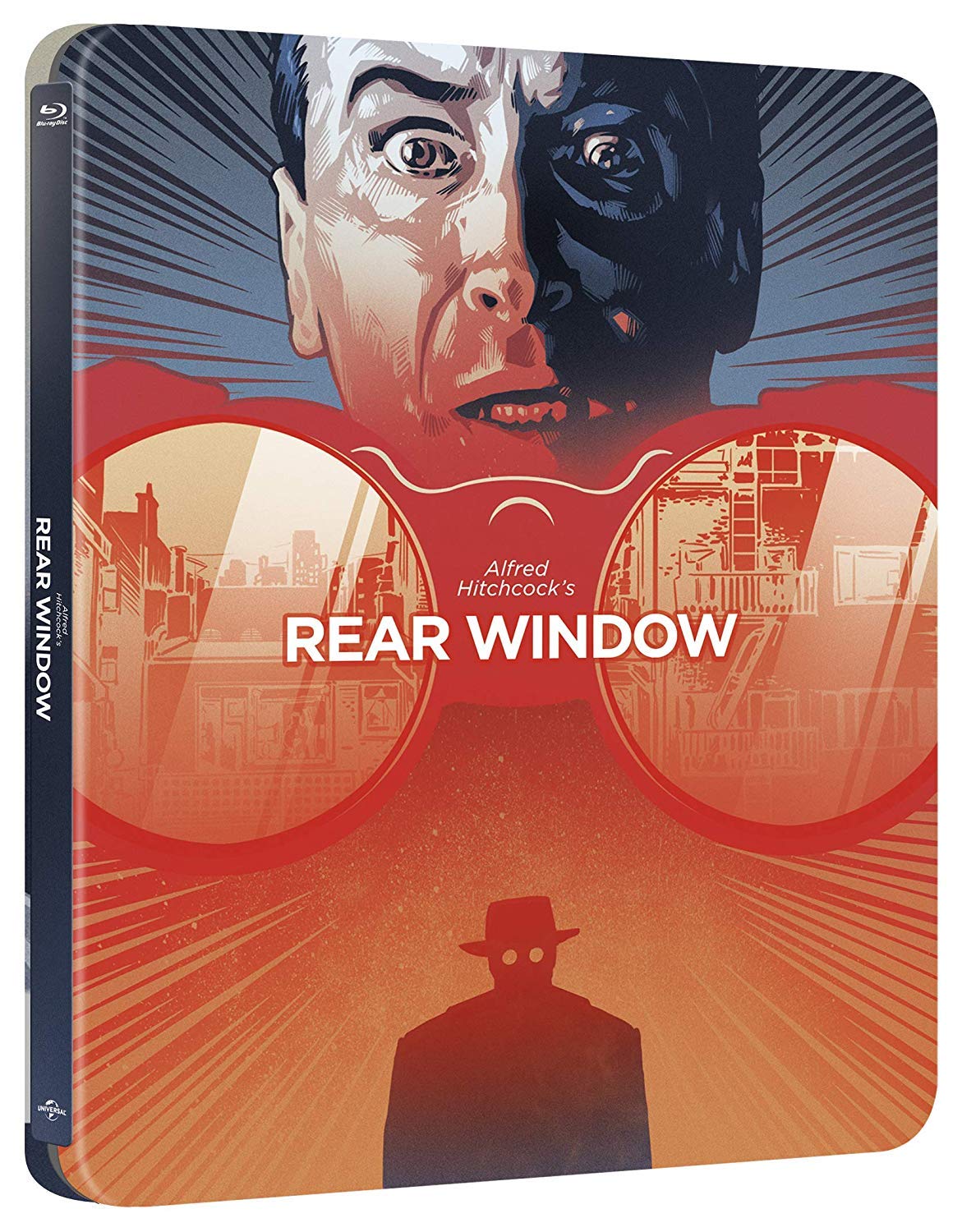
As with Vertigo, when it came time to create a HD master for DCP, BD and then pending streaming services, Universal opted to abandon Rear Window’s 2000 photochemical restoration (and its obtrusive end credits) and, thanks to advances in digital tools, scan the original negative at 4K resolution. Without even realising the ensuing results are an entirely new restoration, most observers praised the results of the digital clean-up and regrade; a view not wholly shared by Robert Harris, who carried out the earlier restoration. The audio on all versions decidedly remains a mixed bag. Either way, owing to the increased resolution and lossless audio, it’s a much better option overall than the previous standard definition releases.
The Legacy Series DVD contents are essentially replicated on the BDs and latest UHD-BDs; in many countries the former has also been repackaged and reissued several times. Once again, said contents include the documentary Rear Window Ethics: Remembering and Restoring a Hitchcock Classic (2000, 55:10), despite it pertaining to the earlier restoration.
2020 remaster
US 4K UHD-BD steelbook; more pics
Now Showing: worldwide screenings
- Prime Video HD | YouTube
- US: UHD-BD/BD and steelbook (2021)
- Canada: UHD-BD/BD (2021)
- UK: UHD-BD/BD steelbook (2021)
- Italy: UHD-BD/BD steelbook (2021)
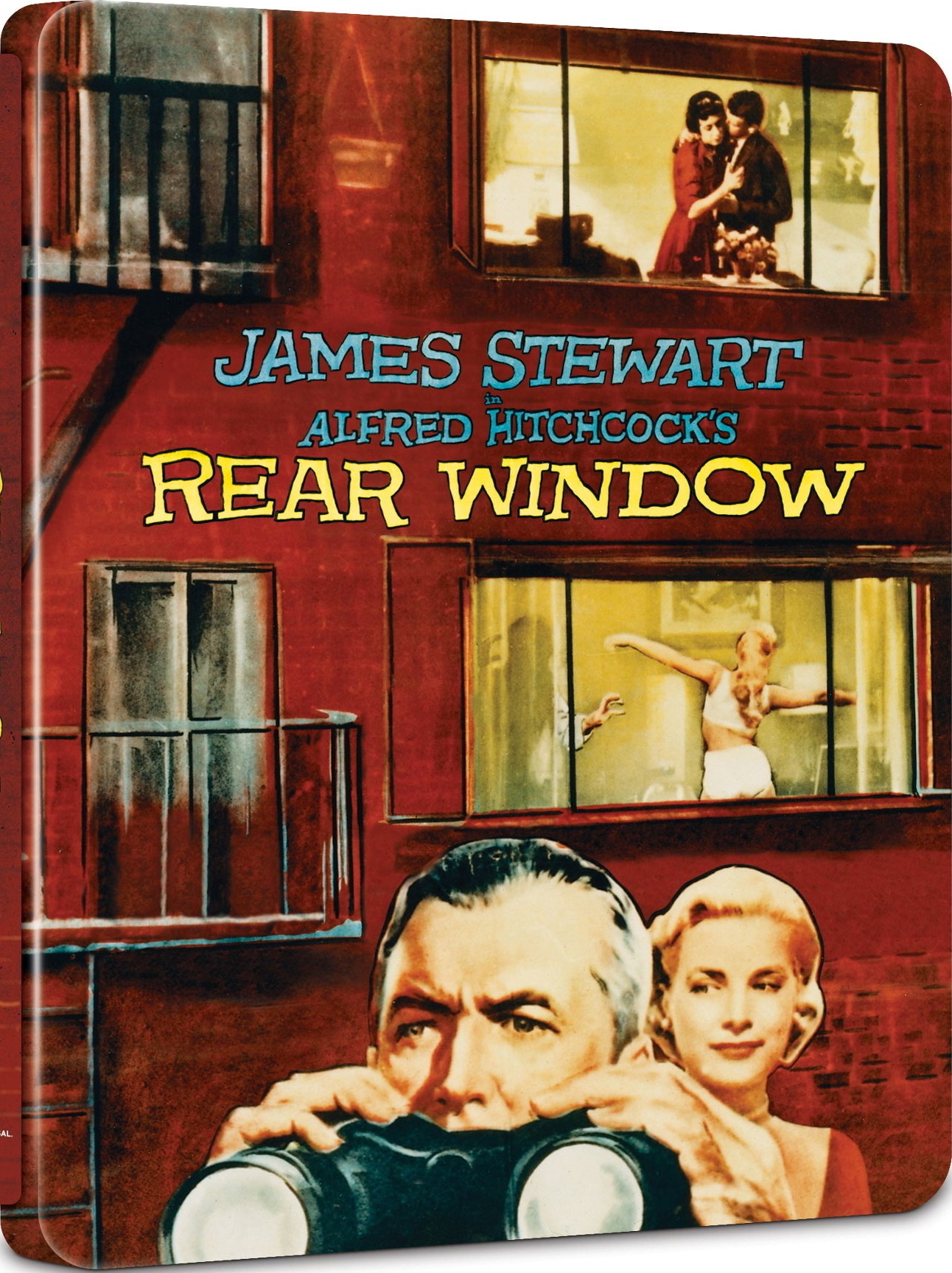
Again as with Vertigo, the 2012 restoration was given a further digital clean-up and HDR pass, readying it for the latest generation of HD formats. Incidentally, Paramount also redid the opening and closing credits in at least German, since broadcast on TV, but naturally only the original English version has been released on home video. Note that in the dual format sets, only the Psycho BD has been remastered; the other three BDs are the exact same previously released discs. As ever, beware the bootlegs; basically anything not bearing Universal Studio’s imprimatur, such as Russia’s Deval BD-R.
- Germany: UHD-BD/BD and steelbook (2021)
- France: UHD-BD/BD and steelbook (2021)
- Spain: UHD-BD/BD and steelbook (2021)
- Scandinavia: UHD-BD/BD (2021)
- Japan: UHD-BD/BD and steelbook (2021)
Screenshots
All but the earliest of Rear Window’s ever-evolving transfers can be compared at the Hitchcock Zone, Caps-a-holic and below. Its audio too has changed over the years, though not always for the better.
- Trio: DVD Eu/Oz 01, US 01, US 05, US 08 | BD
- View: DVD Eu/Oz 01, US 01, US 05, US 08 | BD
- Stewart: DVD Eu/Oz 01, US 01, US 05, US 08 | BD | 4K BD
- Kelly: DVD Eu/Oz 01, US 01, US 05, US 08 | BD
- Cameo: DVD Eu/Oz 01, US 01, US 05, US 08 | BD
- Lobster: DVD Eu/Oz 01, US 01, US 05, US 08 | BD | 4K BD
- Yard: DVD Eu/Oz 01, US 01, US 05, US 08 | BD
Extras
- Audio commentary by film scholar John Fawell
- Rear Window Ethics: Remembering and Restoring a Hitchcock Classic (55:10)
- “Conversation with screenwriter John Michael Hayes” (13:10)
- “Pure Cinema: Through the Eyes of the Master” (25:12)
- “Breaking Barriers: The Sound of Hitchcock” (23:31)
- “Hitchcock/Truffaut” interviews (16:14)
- 1962 re-release trailer (2:40)
- 1983 re-release trailer (6:14)
- Photo gallery (3:08)
- Original script DVD-ROM – 2001 DVDs only
- Production notes – 2001/2005 DVDs only
- Universal: 100 Years trailer (2:28) – LS/SE DVDs and BDs only
- Alfred Hitchcock Presents: “Mr. Blanchard’s Secret” – LS/SE DVDs only
- “Masters of Cinema: AH” 1972 interview (33:39) – Masterpiece Collection bonus DVD
Summary
US theatrical print
- Standard definition, open matte transfer:
2000 restoration
- All DVDs worldwide and open matte 2001 US/Canadian VHSs, except for…
2005 remaster
- DVDs: US/Canadian 2005–present
2008 remaster
- DVDs: US/France/Netherlands Legacy Series/Special Edition
2012 restoration
- All BDs and 2K DCPs
2020 remaster
- All UHD-BDs, streaming copies and 4K DCPs
Rear Window: Writing on a Classic, Pt 2: More writing | Collectors Guide, Pt 2: Soundtrack and essays, 3: Home video, 4: Remakes
Related articles
This is part of a unique, in-depth series of 150-odd Hitchcock articles.