- Director’s homage to Alfred Hitchcock reuses his writer and composer
- Homme wrecker: from bridal path to warpath for an angel of vengeance
- Hell hath no fury like a woman widowed – who turns widowmaker herself
- Detailing every preserved and restored official home video release available
- First complete recording history of Bernard Herrmann’s acclaimed score

Contents
Production
“Carefully and perfectly made… frame after frame!” – New York Times
An engrossing, enigmatic tale of passion and revenge, this 1969 Golden Globe Nominee for Best Foreign Language Film is “so alive that one keeps being surprised at every step” (New York Times, review). The bewitching Jeanne Moreau is “simultaneously stunning, chilling and altogether remarkable” (Boxoffice) as a woman who will stop at nothing to avenge her husband’s death! Julie (Moreau), a beautiful young bride, has just married her childhood sweetheart and the love of her life. But, moments after the ceremony in a bizarre twist of fate, her beloved is murdered on the steps of the church.
Emotionally distraught, Julie becomes obsessed with her bridegroom’s death and begins a descent into madness as she relentlessly pursues the men responsible. One by one, Julie sees to their demises and with each murder more bone chilling and diabolically clever than the last, the question is not about who will be next — but rather how they will meet their ghastly end. Displaying his renowned cinematic genius, François Truffaut, in homage to Alfred Hitchcock, has created a masterpiece of suspense and macabre that is so “cool, witty and disturbingly heartless” (Saturday Review), it will keep viewers on the edge of their seats straight through to its unforgettable last scene. – US MGM/UA VHS (1999; 1991/LD)
- The Bride Wore Black – Jeff Stafford
- The Bride Wore Black – Andrew Sarris
- Jeanne Moreau in The Bride Wore Black – Adrian Danks
- Woolrich, Truffaut, and The Bride Wore Black – Sharon Buzzard
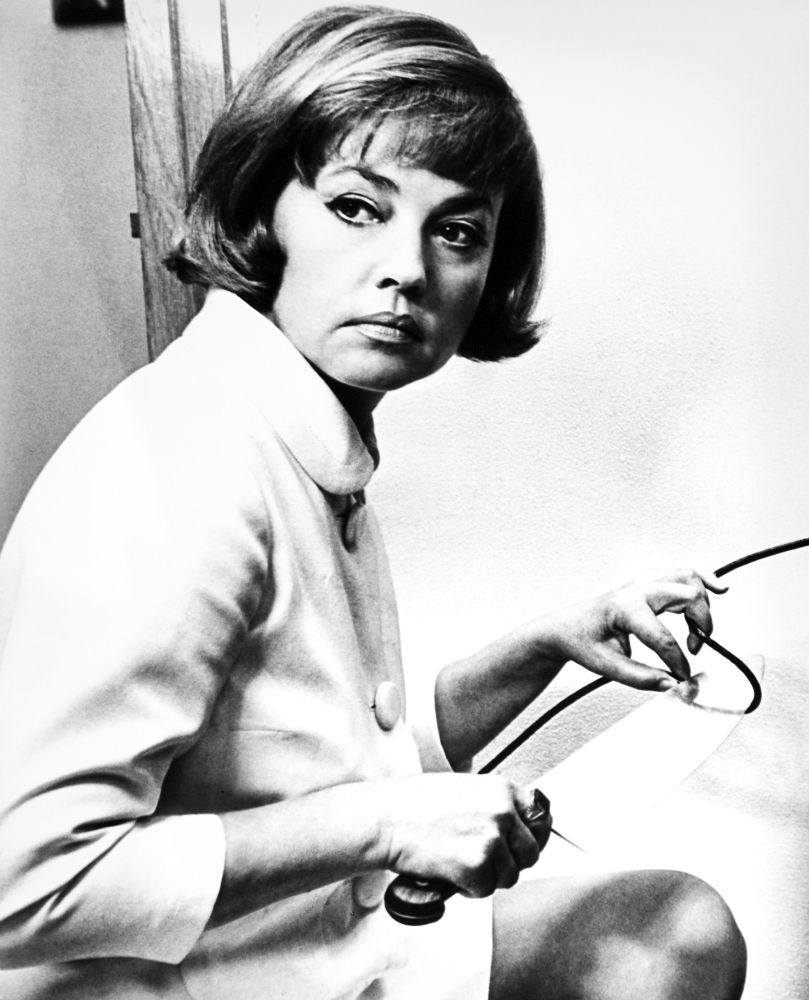
Jeanne Moreau cuts the telephone wire so she may go about her crime without interruption
The Bride Wore Black is First-Rate Truffaut
“I have long been sure that Hitchcock is the greatest director of films in the world” – François Truffaut, interviewed in The New Yorker, Oct. 31, 1964.
If François Truffaut’s beautiful film The Bride Wore Black, which stars Jeanne Moreau as the most vengeful of women, is to be fully enjoyed it must be regarded as an homage to his idol, Alfred Hitchcock, and not as an emulation of the Master of Suspense. To demand of it the edge-of-the- seat tension of a Psycho is not merely to be disappointed but also to miss the point. In dismissing it as second-rate Hitchcock is to overlook that it’s first-rate Truffaut. At the outset Truffaut has put himself in a contradictory position: How is he to maintain suspense, which means the viewer must become so involved in what’s happening on the screen that he forgets he’s watching a movie, and yet comment on its mechanics in regard to Hitchcock’s, art? The answer is that Truffaut is not so much honoring Hitchcock specifically for his mastery of suspense as for the reason for his accomplishment, which is his incomparable ability to express himself by purely visual means.
So The Bride Wore Black (at the El Rey) is in truth a successful attempt by Truffaut to express sentiment (his feelings about Hitchcock, Miss Moreau’s character, her victims) as well as Hitchcock creates suspense, and in the manner of the master. To do this Truffaut chose this ‘40s murder mystery by the often underrated Cornell Woolrich, who was so busy those days he wrote it under his usual pseudonym of William Irish. There is a faintly absurd quality about its carefully formulated plot, the kind that Hitchcock has so often been required to turn into gold, but Truffaut lets it alone, even to the point of allowing it needlessly to telegraph itself in favor of playing against it with his tender compassion for Miss Moreau and her victims. (What makes her want to kill five men won’t be revealed here.).
Adding to the deliberately vintage tone of the film are some of the star’s costumes and especially the richly romantic and atmospheric score of Bernard Herrmann, who has worked with Hitchcock on a number of films. Miss Moreau, too, makes her contribution to this effect by reminding us more than ever of Bette Davis—a comparison as frequent as it is reportedly loathsome to the French star—because of her determination not to hide the ravages of time and in her absolute confidence as she
carries out her revenge. Yet rarely has a murderer been so sympathetic, so poignant in her wounds. On the other hand, a number of her victims are equally appealing—Michel Bouquet’s exquisitely timid bank clerk; Charles Denner’s artist, candid as he is sensual; and for whom Miss Moreau strikes a symbolic Diana, Goddess of the Hunt, pose that’s complete with deadly bow and arrow. With its stunning, incredibly mobile camera work by Raoul Coutard, The Bride Wore Black is a worthy tribute to Hitchcock’s style. But its sensibility makes the film entirely Truffaut’s. – Kevin Thomas, LA Times
Chicago Sun-Times, Newsweek, Variety
Home video

Italian four sheet poster
After publishing six Jazz Age novels about the smart set to general indifference, Rear Window source scribe Cornell Woolrich pivoted to crime for 1940’s The Bride Wore Black and never looked back. Following a 1958 French radio adaptation it became the basis for La Mariée était en noir, Hitchcock acolyte François Truffaut’s most overt homage (source) to the Master, although he later expressed dissatisfaction with the results. The film is owned worldwide by MGM, whose earlier SD transfer is trounced in every area by their HD remaster, as exemplified by the screenshots at Caps-a-holic.
Preserved transfer
- US: MGM DVD (2001, R0 reissue 2015) US trailer
- Canada: MGM DVD (2007)
- UK: MGM DVD (2007), also in 5-DVD FT Collection
- Italy: MGM DVD (2008), also in 7-DVD FT Collection | clip
- Germany: Pierrot le Fou/Zweitausendeins DVD/reissue (2009)
- France: MGM DVD/alt (2008), also in 21-DVD Truffaut – L’intégrale
- Spain: MGM DVD (2007)
The MGM DVDs are non-anamorphic and barebones, though the US has the trailer, and all have an optional English dub. The anamorphic German has a decent selection of German-language extras including an audio commentary but is not English-friendly. Essentially, there are no great options unless du sprichst Deutsch. As ever, beware the bootlegs from Chile (Cinematekka/set), Italy (A&R Productions), Korea (movieholic), Spain (Feel Films BD-R), US (Mr. FAT-W Video), etc.
Remastered transfer
- US: Twilight Time BD (2015)
- Kino BD (2023)
- UK: Radiance BD and ltd ed BD (2023)
- Germany: Explosive BD and DVD (2024)
- France: Arte Éditions BD and DVD (2025), also in 8-DVD and 8-BD FT – La passion cinéma | trailer
Only the US Twilight Time disc is region 0 and will play anywhere; the rest are locked to regions A or B accordingly. Extras-wise, the Twilight Time exclusively features an isolated music and effects track, optional English dub, liner notes leaflet and a 79-minute Herrmann interview CD. It also has an audio commentary and the US trailer, which are repeated on the Kino Lorber. The German BD has a short featurette, an image gallery, and the US and French trailers. The wholly French-language-only BD has a pair of short contemporary interviews with the director and star, a three-minute Truffaut short and the French trailer. But it also has a slightly inferior 1080i/25fps transfer; an alternative is the German with domestic, French and English subs. Lastly, the UK BD has 41 minutes of new and vintage interviews, a 25-minute short written by Truffaut, the US trailer, a substantial booklet and reversible sleeve. Basically, the first and last are best.
Soundtrack
Film Score Rundowns: The Bride Wore Black/videos/MIDI – Bill Wrobel
Composer Bernard Herrmann’s original film scoring session recordings, conducted by André Girard, are long lost but they also yielded 11½ minutes of music for a French four-track EP. 40 years later it appeared on the first of just two more legit releases, joined by a US LP from 1970s bootleggers Cinema Records and Red Bitch Music’s illicit 2013 CD-R and MP3 rip of Kritzerland’s CD.
- UA 7″ EP La Mariée était en noir (1968)
- Kritzerland CD Twisted Nerve/The Bride Wore Black (2008) info
- Universal 5-CD Le Monde Musical de François Truffaut (2014)
The lead 1968 cue, “Julie et l’écharpe” (Julie and the scarf), additionally appears on two releases; a UK 7″ retitles it after the film, while a french CD set (but not its edited vinyl version) also contains “Arrestation de Delvaux et fuite de Julie” (Delvaux’s arrest and Julie’s escape).
- UA 7″ “The Bride Wore Black”/“Attack on the Iron Coast” (1968)
- Universal 3-CD Nouvelle Vague – Chansons et musiques de films (2011)
Herrmann’s friend and colleague Elmer Bernstein recorded a tribute album of his film music in London on 1 and 2 December 1992, including “A Musical Scenario” suite arranged by Christopher Palmer.
- Milan CD/MP3 Bernard Herrmann Film Scores (1993) Royal Philharmonic Orchestra cond. Elmer Bernstein (11.27)
- Milan CD Bandes Originales des Films de François Truffaut (1994)
- Milan CD Hitchcock 100ème (1999)
- Milan CD François Truffaut – Les Films Noirs (1994), also in 5-CD Truffaut – L’Intégrale (1995, reissued 2001)
- Milan 21-MP3 Vivement Truffaut! (2013)
The Stéphane Kerecki Quartet’s version of “Julie et l’écharpe” appeared on their 2014 film soundtrack covers album, and a covers compilation CD appended to a collection of original Truffaut film music also containing the original:
- Outnote CD/MP3 Nouvelle Vague (2014) – Stéphane Kerecki Quartet (4:45)
- Universal 5-CD Le Monde Musical de François Truffaut (2014)
Finally, Herrmann’s original, fully orchestrated score was dusted off for a superb 50th anniversary recording that adds over 20 minutes of unused music to the 35 heard in the film.
- Quartet CD/MP3 The Bride Wore Black Complete Score (2018, reissued 2020) Basque National Orchestra cond. Fernando Velázquez (56:57) review