- Risen again: über producer-director first dramatised Bible’s Book of Exodus in 1923
- His own remake succeeded in topping the spectacular silent version in every respect
- God is in the detail: no expense spared on lavish sets, costumes and production design
- International: shot in Hollywood and on location in the Middle East for added authenticity
- Blockbuster: incredible effort and expense paid off for one of the highest-grossing films ever
The Ten Commandments: Writing on a Classic | Making of a Masterpiece | Collectors Guide, Pt 2: Soundtrack

Soundtrack album artwork
A Cast of Thousands
In an age when A-list directors wield as much power as their above-the-title stars, one name from Hollywood’s Golden Age remains synonymous with the image of the all-powerful director, conjuring ideas of epic film-making on a truly grand scale. Cecil B. De Mille and his forty years behind the lens carved him a place in cinema history as an innovator, an artist, a mythmaker and, arguably, the father of the modern blockbuster. There is no finer showcase for DeMille’s talent and vision than his last film, The Ten Commandments. On its release in 1956, The Ten Commandments was the crowning glory of DeMille’s illustrious career and of Paramount Pictures’ studio output. Its combination of an all-star cast, a universally engaging “human” story, and cutting-edge special effects generated huge public interest and unprecedented ticket sales, and established a formula for box-office success that underpins many of today’s biggest hit movies.
DeMille had become friends with legendary star Charlton Heston during the filming of The Greatest Show on Earth (1952). Heston’s big break had come in 1941 with director David Bradley’s Peer Gynt. His second role for Bradley, playing Marc Anthony opposite Harold Tasker in Julius Caesar, raised his profile considerably, but it was The Greatest Show on Earth that made Heston a star. The charismatic and physically imposing young actor more than held his own alongside more established names, including Betty Hutton, Cornel Wilde, Gloria Grahame, James Stewart and Dorothy Lamour.
And it was during the filming of DeMille’s big-top drama that the director apparently settled on Heston as his number one choice for the lead role in The Ten Commandments. DeMille later admitted that he chose the rising star because of Heston’s resemblance to artist Michelangelo’s statue of Moses. The Ten Commandments was the first of a string of big-budget hits that provided Charlton Heston with his finest roles. Touch Of Evil (1958), The Big Country (1958), Ben-Hur (1959), El Cid (1961) and The Agony and the Ecstasy (1965) all helped to elevate the actor to bona fide superstar status, but it is impossible to separate Heston from the iconic role of Moses, The Lawgiver – a part of which Heston himself is understandably proud.

US style B one sheet poster
If Charlton Heston got a “lucky break” with The Greatest Show on Earth, Yul Brynner was born to be a movie star. Leaving post-revolutionary Russia for a childhood in China, Brynner arrived in Paris in 1930, aged 15, and enjoyed his first taste of show business as a trapeze artist. In 1941, he left war-torn France for the United States, where he studied acting as part of the Michael Chekhov troupe – other students of the highly respected Chekhov included Gary Cooper, Anthony Quinn, Gregory Peck and Marilyn Monroe. Brynner moved from stage work to CBS television where, as the director of the live drama program Actor’s Studio, he provided a young Marlon Brando with his first TV role. On the release of The Ten Commandments, Yul Brynner was riding the crest of a wave, playing to huge popular and critical acclaim as King Mongkut of Siam in Walter Lang’s classic musical, The King And I. Brynner’s unique physical presence, exploited by Lang to Oscar-winning effect – his walk, his accent, his penetrating stare – leant the actor an air of nobility that made him perfect for the role of legendary Egyptian Pharaoh, Rameses, in The Ten Commandments.
Anne Baxter was the granddaughter of legendary architect Frank Lloyd Wright. Kick-starting her film career with the Richard Thorpe western 20 Mule Team, she built a name as one of the hardest-working leading ladies in Hollywood. A-list crime thrillers, westerns, war films and melodramas provided Baxter with a steady stream of high-profile roles, playing opposite some of the biggest names in the business. She was directed by Orson Welles In The Magnificent Ambersons and took the title role opposite Bette Davies in All About Eve (1950).
Rounding out DeMille’s stellar cast was Edward G. Robinson. Robinson, born Emanuel Goldenberg, arrived in the United States at the age of 10 with dreams of becoming a rabbi. Any religious calling, however, was lost to a love of stagecraft he developed in his teens. A scholarship to the American Academy of Dramatic Arts was followed by swift and sustained professional success that outlived the silent era and saw Robinson become globally famous for a series of notable gangster roles. He was always capable of great range and depth, as demonstrated in later films such as Silver Dollar (1932), I Loved A Woman (1933), Kid Galahad (1937) and Double Indemnity (1944). In 1956, The Ten Commandments was by far the biggest movie in which Robinson had ever been involved.

US one sheet poster
Not Even God Parted the Red Sea… Twice!
DeMille had already enjoyed huge success with a 1923 version of the Ten Commandments story, starring Theodore Roberts as Moses. In order to top a film that was already considered something of a classic, DeMille was determined to employ state-of-the-art special effects in his second telling of the tale. This time, he would give the audience something they’d never seen before… literally. Work on the key scene, the parting of the Red Sea, began five years prior to the film’s release, under the supervision of long-time DeMille collaborator and Paramount effects wizard Gordon Jennings. However, in the midst of preparations for the epic scene, Jennings died. While DeMille battled with the loss of a friend and trusted colleague, the search began for a replacement. Paramount’s solution was John Fulton, respected in the trade for his work on Universal’s Invisible Man films, and an Oscar-winner for Samuel Goldwyn’s Wonder Man (1945).
The Ten Commandments was to be shot in “Vista Vision” (Paramount’s widescreen process) and the obvious choice for Director of Photography, thanks to his experience with the system, was Loyal Griggs. Griggs had shot Paramount’s first VistaVision movie, White Christmas (1954), and won an Oscar for his work on 1953’s Shane.
Authenticity was a key feature of DeMille’s landmark production. Many key scenes for The Ten Commandments were shot in authentic biblical locations around Egypt, the Red Sea and Mount Sinai itself, now known as Jebel Musa. In addition, the stone tablets that carry the commandments in the film – measuring 21″ x 11″ x 1″ – were hewn from Sinai rock and carved in ancient Hebrew under the supervision of Dr. Ralph Marcus, Professor of Oriental Studies at the University of Chicago. The commandments are written in the Phoenician alphabet, an ancient writing form that employs no vowels and is contemporary to the time of Moses.
At the beginning of 1953, Paramount’s plans for The Ten Commandments were put into action and work began on “the Great Miracle” – the parting of the Red Sea – on the studio lot in Hollywood. In order to accommodate the cameras and equipment, not to mention the largest movie miniature of all time, the dividing walls and fences between Paramount and neighbouring RKO were dismantled. The miniature, designed by John Fulton, was built to one-fifth scale, using over 30,000 cubic feet of concrete. To create a rushing wall of water, an elevated tank was positioned above the sea’s divide. When the tank’s fifteen hydraulic valves were opened, thousands of gallons of water were released in a thin sheet onto a ramp 32 feet wide by 80 feet long.
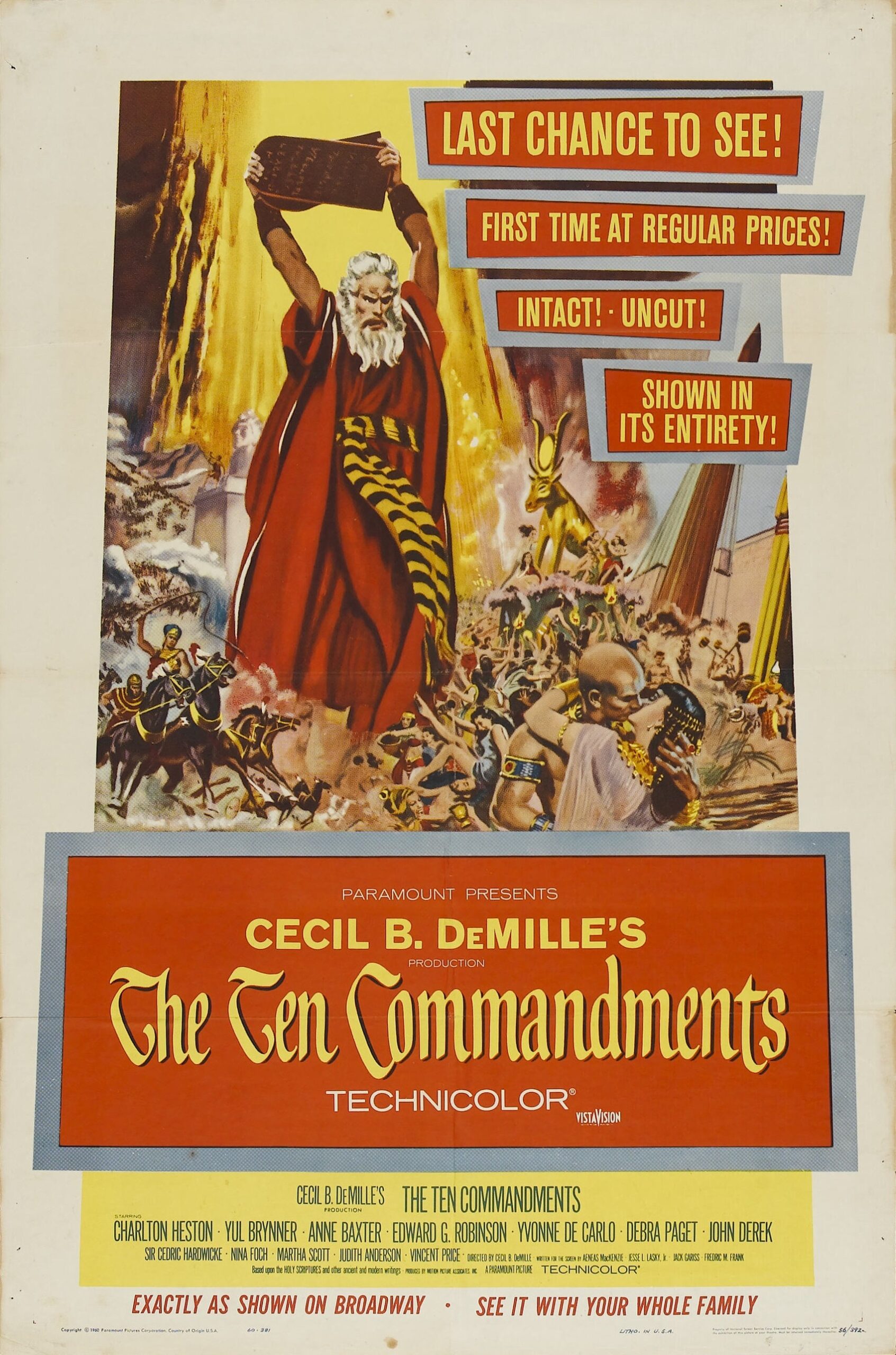
US 1960 re-release one sheet poster
Rounded planks broke the flow of the cascading water, creating the illusion of a violent, stormy seabed. Four high-speed VistaVision cameras captured the action from platforms positioned around the miniature, and a second unit shoot of six separate water sequences was later composited into seamless, ground-breaking matte shots – the intricate, photo-realistic paintings used by Hollywood to create countless landscapes. After the scale and expense of the parting of the Red Sea, DeMille employed a neat cost-cutting trick when the waters returned to drown his Egyptian army. He simply ran the “parting” footage backwards, interspersing the action with cutaways to actors’ reaction shots.
Of course, the spectacle of The Ten Commandments doesn’t end with the parting of the waves. DeMille knew that his central special effects set piece could not be allowed to overshadow the on-screen depiction of the power of God Himself. He set to work devising a way to bring supernatural drama to the very skies of his biblical epic. Three separate sequences of “Britt smoke” clouds were filmed against a hazy sky, then combined in an optical printer. For the parting of the Red Sea, the huge twister that appears to suck water out of the exiles’ path was double-exposed and run backwards in the camera to create the “living” clouds that denote the presence of awesome supernatural power.
With little margin for error, this process was nerve-racking and time-consuming, but the final result is an impressively clean effect, free from the matte lines that plagued effects work and gave away the joins between reality and painted illusion until the advent of computer-generated (CG) technology. For the record, The Ten Commandments used more matte paintings than any previous film. The Paramount matte department, headed by Paul Lerpae, was stretched to capacity, but the technicians’ skill and time paid off with spectacular results. The paintings produced for The Ten Commandments are remembered as among the finest examples of a lost filmmaking craft. For the exodus scene alone, 102 separate matte set-ups were used, each with the sky left black for the addition of those groundbreaking “smoke-clouds.”
For the final piece of the puzzle – the music score – DeMille had intended to use close friend and long-time collaborator Victor Young, who is perhaps best known for the classic Nat King Cole hit When I Fall In Love. Unfortunately, Young was seriously ill at the time of the production, but recommended an up-and-coming Hollywood composer, Elmer Bernstein. In the space of five years, Bernstein had scored some 21 films, and had narrowly missed out on Oscar glory following a nomination for The Man with the Golden Arm (1956). His work on The Ten Commandments surpassed his previous oeuvre, capturing the gravity of the story and heightening the drama of the piece magnificently. DeMille’s response to the young musician’s work was unequivocal. “Your music will surely outlive me,” he told Bernstein, “and possibly even yourself.”
The Ten Commandments opened in the United States on October 5, 1956. It went on to break box-office records around the world. “There is every indication,” said Boxoffice magazine, “that the feature will play to enraptured, theatre-filling audiences for many generations to come.” The prophecy came to pass with the advent of television: DeMille’s masterpiece has become one of the most frequently screened films on US network TV. Since 1990, The Ten Commandments has been a regular feature of ABC’s Easter schedule. When the network dropped the movie in 1999, their telephone switchboard was jammed with calls from irate fans demanding the reinstatement of their seasonal favourite.
The Ten Commandments was nominated for seven Academy Awards in the categories of Best Picture, Best Sound Recording, Art Direction, Costume Design, Cinematography, Special Effects and Film Editing, and took the Oscar for Best Special Effects. The movie’s modest showing at the Oscars, however, belies its initial impact and lasting influence on audiences and filmmakers alike. Today, it is recognised as among the great works of cinema’s first century. As the pyramids of Giza stand in testament to a once-mighty empire, so The Ten Commandments is a lasting monument to Hollywood’s Golden Age. – Lancelot Narayan and Toby Starbuck, Paramount Golden Classics 2-DVD (2004)
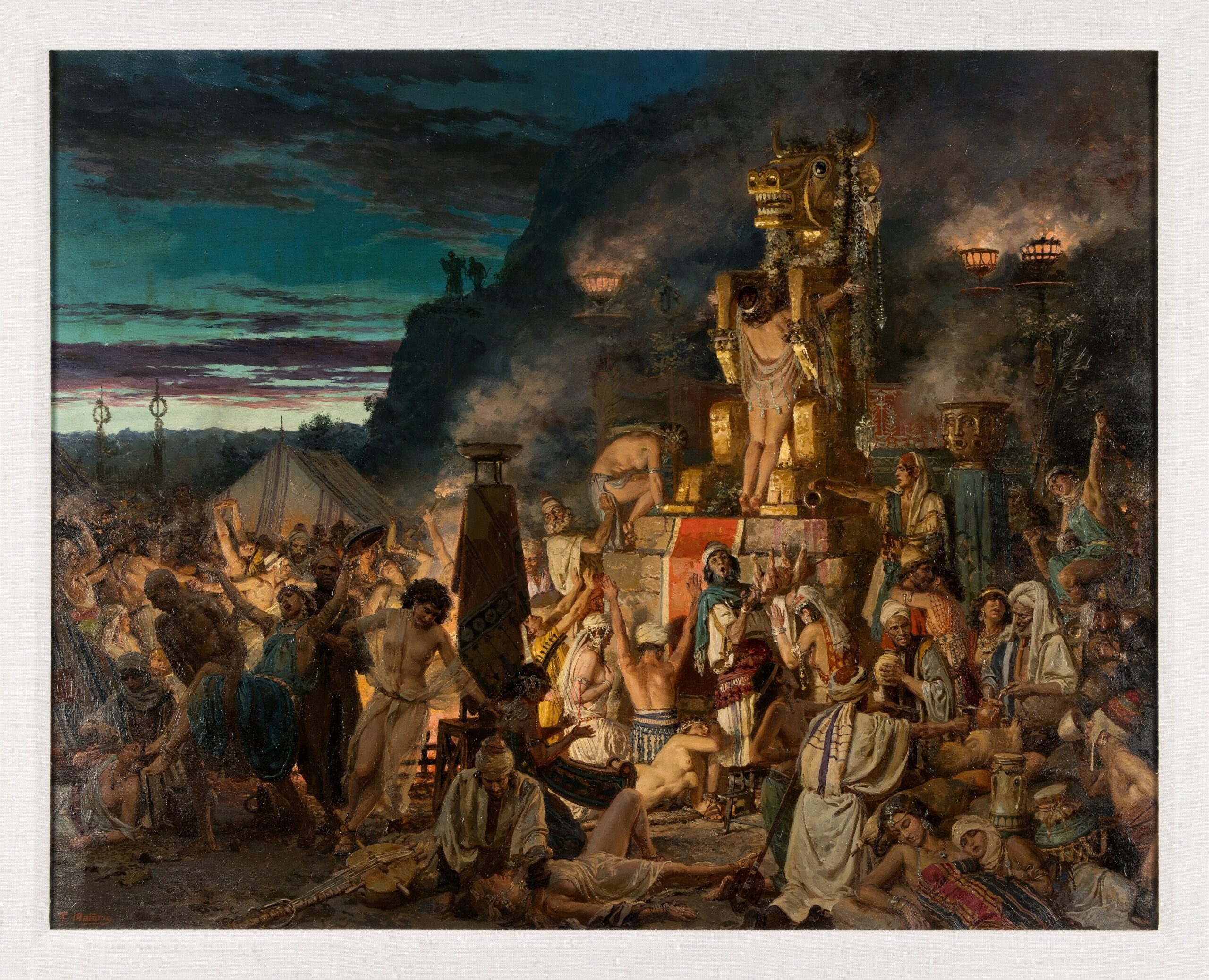
Concept artwork by Fortunino Matania
The Ten Commandments: Writing on a Classic | Making of a Masterpiece | Collectors Guide, Pt 2: Soundtrack