- Alfred Hitchcock visits the Mediterranean for classy crime caper
- The lives, loves and lies of beautiful people in the French sunshine
- Lighthearted thriller stars dream team of Cary Grant and Grace Kelly
- Screenwriter co-wrote Vertigo and thrice-filmed Hitchcock homage play
Note: this is part of an ongoing series of 150-odd Hitchcock articles; any dead links are to those not yet published. Subscribe to the email list to be notified when new ones appear.
To Catch a Thief: Writing on a Classic | Making of a Masterpiece | Collectors Guide, Pt 2: Soundtrack and audio mixes, 3: Home video, 4: 2020s revisions

2009 US poster
Contents
- Production
- It’s a Dog’s Life (1955)
- The Gazebo (1959)
- Jo (1971)
- Related articles
Production
“Le Chat caught on. A number of people saw in the story potentialities for revision, reshaping and improvement. It was condensed, boiled down, digested, redigested, reprinted, book-clubbed, synopsised, subjected to scenario treatment and ultimately blown up into a movie by Alfred Hitchcock. All that survived in the end were the title, the names of some of the characters and the copyright, which was mine.” – David Dodge, The Rich Man’s Guide to the Riviera/UK ed (1962) info
In fact, rather more of David Dodge’s original novel made it to the screen than he would have people believe. Dodge was an American accountant who had become a writer almost by accident when his wife bet him $5 that he couldn’t write a better mystery novel than the one he was reading. He won the bet and created a series of novels about San Francisco tax inspector James ‘Whit’ Whitney and subsequently, expatriate private investigator Al Colby. The latter enabled him to engage in his great love of travel: rather than travelling to find something to write about, Dodge wrote to enable him to afford the then still high cost of foreign travel. It was when his travels took him to the French Riviera that Le Chat was born.
To Catch a Thief (1952) – David Dodge | It, De, Fr | info
Published in January 1952, To Catch a Thief was partially inspired by the exploits of real-life cat-burglar Dario Sambucco. It proved an instant hit with critics and readers alike. Writing in the New York Times Book Review, Anthony Boucher applauded the “high ingenuity in plotting and suspense… It’s rumoured that the novel has been bought before publication for a film by Alfred Hitchcock; if it hasn’t, it should be.” Hitchcock had indeed bought the rights himself and put the project on the fast track to production at Paramount Studios. More than satisfied with John Michael Hayes’ work on Rear Window [followed by The Trouble with Harry and The Man Who Knew Too Much], Hitchcock hired him to adapt the novel, even sending the screenwriter and his wife to the Riviera for two weeks so that he wouldn’t have to constantly describe the locations to him!
- Writing with H: The Collaboration of AH and John Michael Hayes (2011, shorter original 2001) – Steven DeRosa | book site
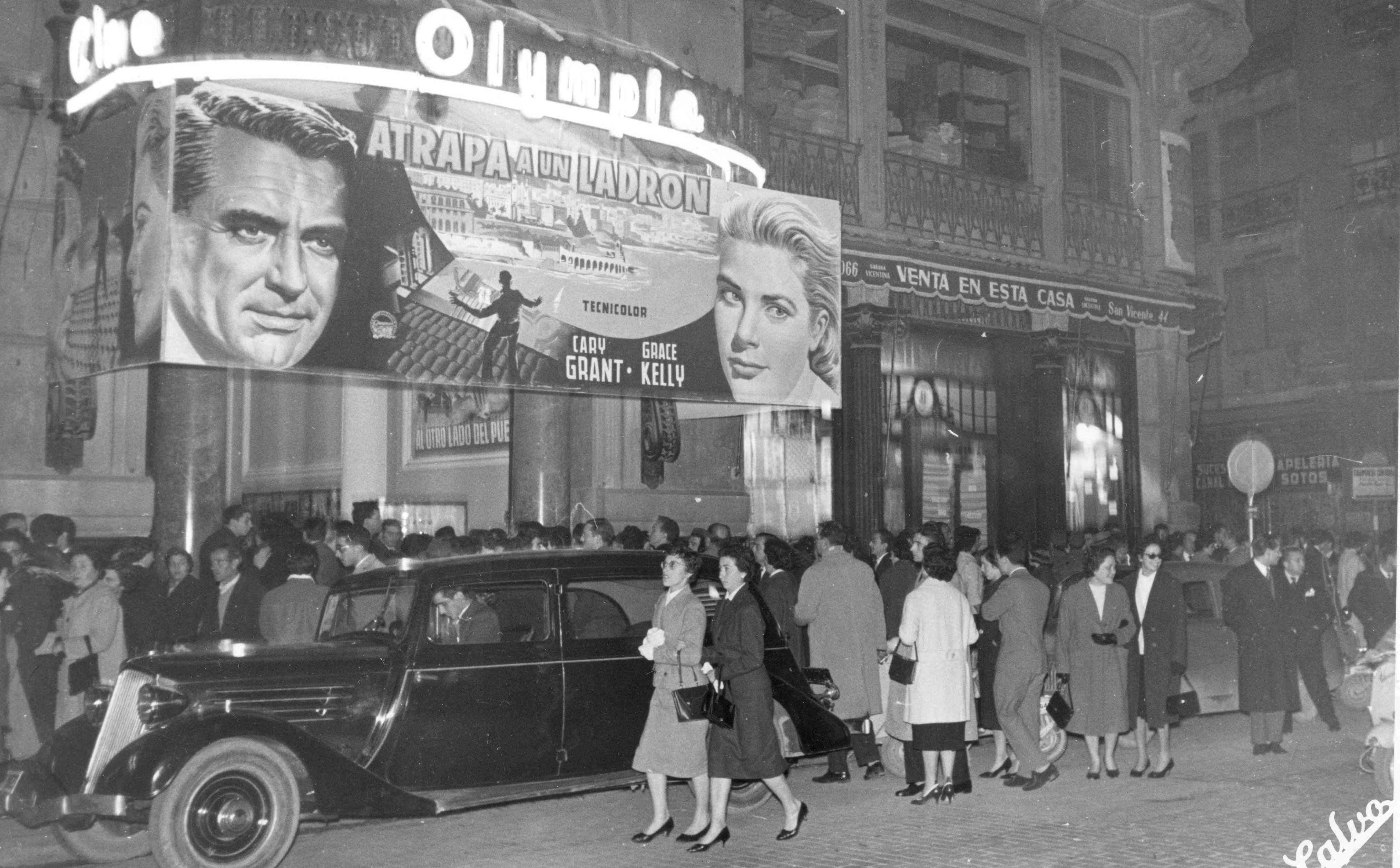
The film’s stars attended its 1958 Spanish première at Valencia’s Teatro Olympia. Spanish one sheet poster, style B.
“Set a thief…”
Hayes and Hitchcock simplified Dodge’s story somewhat, reducing the number of characters while keeping the key sequences of the novel. They also played up the novel’s moral argument: almost every character in the film is a thief, reformed or otherwise. Robie even points out that by padding out his expense account, even insurance investigator H.H. Hughson (John Williams) is a thief! Rather than suspense, the emphasis was firmly on the romantic comedy, often of the most risqué kind in the eyes of the ultra-conservative censors of the day. As Hitchcock admitted to François Truffaut, “it was a lightweight story. It wasn’t meant to be taken seriously.”
Despite its chases and burglaries, the film boasts only one major suspense set piece, the rooftop finale. For this, Hitchcock would be forced to face his own vertigo while Cary Grant and actress and acrobat Brigitte Auber scrambled across the villa rooftop set that occupied three of Paramount’s largest soundstages. His leading man felt a different kind of tension. “I dashed over sloping rooftops of four-storied French Riviera villas with no net below, while either trying to rob Grace Kelly or save her from being robbed,” observed Grant. “In North by Northwest I heroically hung both up and down on replicas of Mount Rushmore, rafter-high on the tallest soundstage of Hollywood. I’ve always felt queasily uncertain whether or not Hitchcock was pleased at seeing me survive each day’s work. I can only hope it was as great a relief to him as it was a disappointment.”
“A man of obvious good taste in everything.”
Despite having recently announced his retirement, Cary Grant was the perfect choice for The Cat. Not only was he the screen’s most debonair leading man, but in his youth he had been a music hall acrobat with Bob Pender’s comedy troupe – the perfect combination for a cat burglar moving in high society. The prospect of working with Hitchcock again after their successes with Suspicion and Notorious was appealing, and the chance to star opposite Grace Kelly proved irresistible. After their collaborations on Dial M for Murder and Rear Window, this would prove to be Kelly’s last film for Hitchcock. He had tried to lure her out of retirement for in Marnie, and also planned to work with her again on a long-planned adaptation of J.M. Barrie’s Mary Rose.

Statuesque: a publicity shot for the film (alt pose)
“I never stole from anybody who would go hungry.”
At $3 million, To Catch a Thief was one of Hitchcock’s most expensive films. Much of the cost was due to expensive location shooting, then very much a rarity that was complicated by the use of the expensive high-definition VistaVision widescreen system, which used twice as much film stock as a normal camera. There were other hiccups throughout the shoot, but these were overcome. A chase through a Nice carnival had to be dropped as the budget rose; Charles Vanel’s dialogue had to be heavily rewritten because he did not speak English (he was eventually dubbed by Jean Duval); and there were constant problems coming up with a suitable ending.
Nonetheless, To Catch a Thief proved an especially happy set. “I always went to work whistling when I worked with him, because everything on the set was just as you envisioned it would be,” recalled Grant. “Nothing ever went wrong. He was so incredibly well prepared.” Some very minor rewrites were called for when Hitchcock needed some reshoots after filming had ended. By this time Hayes was working on another picture, It’s a Dog’s Life, so Australian writer Alec Coppel was brought in. Coppel would go on to co-write Vertigo and even include an affectionate dig at Hitchcock in his play The Gazebo when his hapless hero phones Hitch to ask the best way to dispose of the body of the blackmailer he has just murdered.

“One lump or two?” Kelly, script supervisor Claire Behnke and Hitchcock during a (tea) break in filming. (B&W, source)
“Oh, Mother will love it!”
To Catch a Thief was made during a remarkably busy period for the director. Rear Window opened as filming veered to a close, while Hitchcock started The Trouble with Harry a mere three weeks after he had finished shooting. He had not intended quite such a brief gap between films, but with Thief running 22 days behind schedule and Harry dependent on starting shooting before winter set in, he had little choice. However, moving between post-production on one film and principal photography on another was less of a strain on Hitchcock than most directors. Because he ‘cut the film in the camera,’ shooting only what he knew he was going to use, the director rarely felt it necessary to spend much time in the cutting rooms until fine tuning was called for.
Curiously, the biggest post-production problem was allied to Lyn Murray’s score. He had originally scored the ‘ fireworks scene’ with a sexy, sultry saxophone solo, but this made the scene far too suggestive for the censor, who threatened to cut it entirely: it was only when Murray rescored the scene for strings that the scene was passed. Although Hitchcock was pleased with Murray’s breezy score, the compose: made the fatal error of judgement of introducing him to Bernard Herrmann when he was unable to score The Trouble with Harry. The temperamental composer of Citizen Kane and The Ghost and Mrs. Miller would go on to work on Hitchcock’s next eight pictures!
Despite the misfortune of being chosen or the Royal Command Film Performance in the UK (an event that is usually synonymous with extremely bad movies) and some generally indifferent reviews, the film proved a solid hit and has proved an enduring classic. Opening on 4th August 1955 at the Paramount Theater in New York, it went on to win an Oscar for Best Cinematography, and was also nominated for Best Art Direction and Best Costume Design, while the Writers Guild of America nominated Hayes’ screenplay as Best Comedy. – Paramount DVD (2004)
It’s a Dog’s Life (1955)
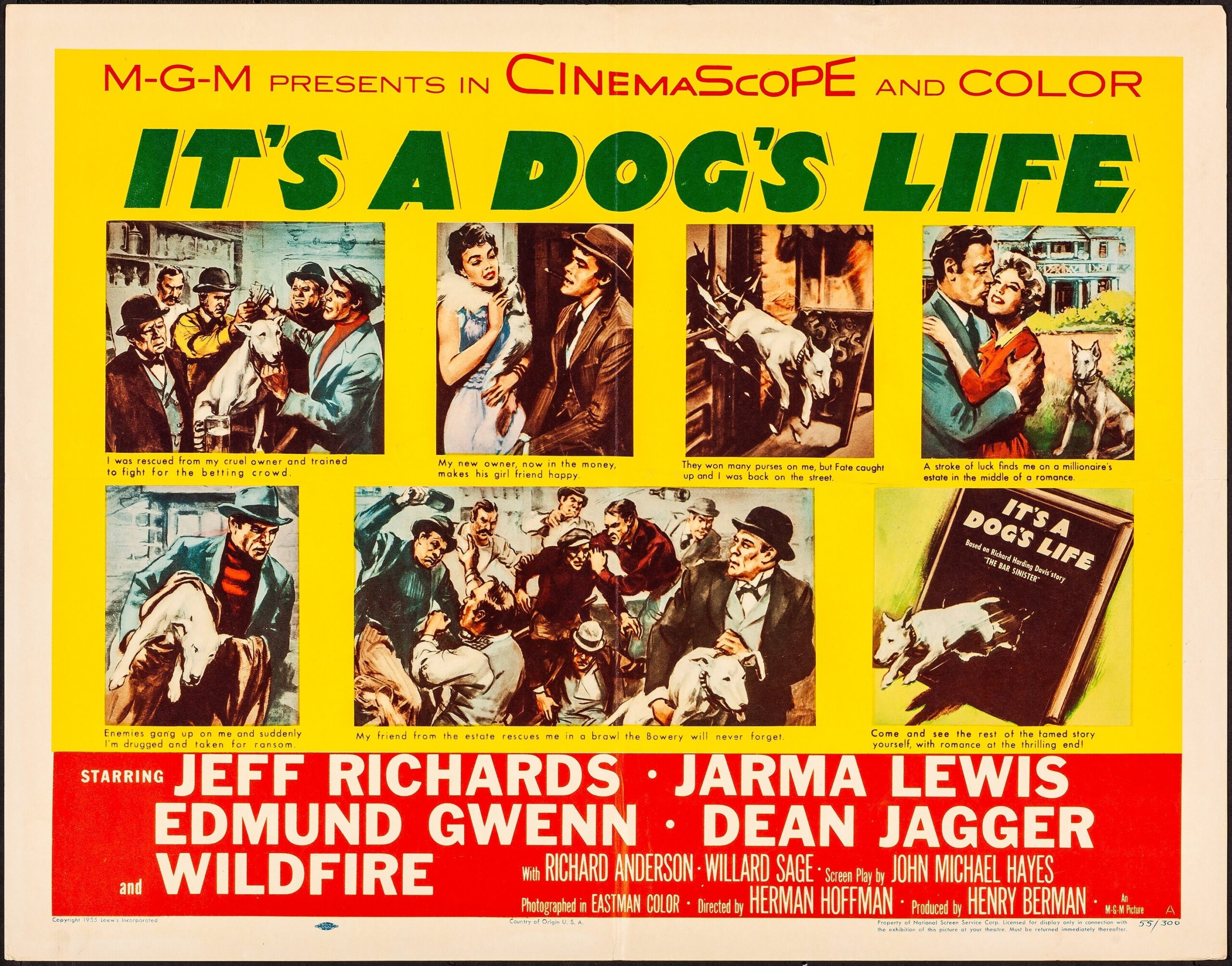
US half sheet poster
“Thoroughly delightful… Truly classic” — New York Daily News
A rugged, resourceful hero fights his way out of the gutter to the top of the heap in this colorful tale. But unlike other rags to riches stories this one features a unique leading man – a Bull Terrier named Wildfire.
On the waterfront in turn of the century New York, Wildfire and his loving mother spend their days foraging for food and eluding the dogcatcher. Separated from his mother, Wildfire falls into the clutches of Patch McGill (Jeff Richards), a Bowery rogue who promptly enlists him in back room dogfights at a local saloon. For a time McGill lives well off Wildfire’s success, but greed leads to his down-fall and nearly gets Wildfire killed. Rejected by the only friends he has known and with no place to turn, Wildfire is taken in by a kindly stableman (Edmund Gwenn), who recognizes in Wildfire the noble spirit of a true champion and is willing to risk everything he has to prove it. Dean Jagger and Richard Anderson co-star in this charming and revealing look at the world of humans through the eyes of man’s best friend. – US VHS
“A treat. Three cheers for It’s a Dog’s Life. Or better yet, maybe, Woof, woof, woof!” – The New York Times
Take a bow-wow, Wildfire. You’re the canine star of It ‘s a Dog’s Life and winner of a Patsy Award (Picture Animal Top Star of the Year). Wildfire, a white bull terrier. is also the narrator (voice by uncredited Vic Morrow) of this tale of the pup’s rise from 1890s Bowery castoff to backroom saloon brawler (the film does not revel in nor show its dog-fighting scenes in detail) to beribboned show champion to blueblood pet. Jeff Richards portrays ne’er-do-well Patch McGill, who exploits Wildfire’s fighting skill. Edmund Gwenn is compassionate stableman Jeremiah Edward Emmett Augustus Nolan. And Dean Jagger plays the upper-cruster who makes room on his estate and in his heart for the remarkable Wildfire. – US DVD
- US: MGM/UA VHS (1992)
- Warner DVD (2011)
- FSM 5-CD Lassie Come Home: The Canine Cinema Collection/alt (2010) clips
This doggy tale was also released in the US as The Bar Sinister, the title of its 1903 source novella (Internet Archive) by Richard Harding Davis. It’s a heart-warming read, with beautiful illustrations by E. M. Ashe. So far, the film’s only had two home video releases but in addition all 28½ minutes of composer Elmer Bernstein’s surviving music is collected on a superbly compiled six-hour collection, in a limited edition of 1,000.
The Gazebo (1959)
“A howling success…” – The Hollywood Reporter
In this “amusing, spirited comedy” (Los Angeles Times), Glenn Ford (The Courtship of Eddie’s Father) and Debbie Reynolds (The Unsinkable Molly Brown) discover that murder in the name of love can actually be rewarding. Broadway star Nell Nash (Reynolds) can’t help but notice her TV writer husband Elliott (Ford) is acting strange and nervous and seems oddly determined to sell their home. She has no idea he’s trying to meet the demands of a blackmailer who has nude photos of Nell taken long ago. Before Elliott realizes what he is doing, he lures the blackmailer to his home, kills him and buries the corpse under the backyard gazebo – while managing to leave just enough clues to get everyone on his case. Filled with “outlandish… fun” (New York Daily News), this romantic black comedy co-starring Carl Reiner (It’s a Mad, Mad, Mad, Mad World) is packed with running gags, wild slapstick and hilarious misunderstandings. – US VHS
“Hilarious dark comedy. Many plot twists add to the fun.” – Video Movie Guide
What would you do if a blackmailer showed up peddling nudie pictures of your sweet wife? Why, plug the scoundrel and bury him under the backyard gazebo, of course! Delightful screen farceurs Glenn Ford and Debbie Reynolds are up to their corpus delicti in laughs as a show-biz power couple with something to hide in director George Marshall’s (Destry Rides Again) sly black comedy highlighted by a meticulously plotted, hilariously botched “perfect crime.” If The Gazebo reminds you of The Trouble with Harry or Family Plot, there may be a reason: when everything is going wrong, the anxious murderer queries Alfred Hitchcock on the phone for some authoritative what-do-I-do-with-a-dead-body advice. Comedy veterans Carl Reiner, John McGiver and Doro Merande also add to the macabre merriment. – US DVD
- US: MGM/UA VHS (1994)
- Warner DVD (2011)
- Prime Video HD
This was the first film adaptation of Alec Coppel’s late 1958 play, The Gazebo (alt). Its device of Hitch inadvertently giving dead body disposal tips was earlier included in Coppel’s rejected screenplay for Vertigo. It’s only been released in the US, though note the region 0, NTSC DVD will play anywhere. Beware several bootleg DVDs from Spain (Feel Films, Resen/box set) and Italy (A&R Productions/reissue).
Jo (1971)
Jo, The Gazebo’s farcical French remake starring screen comedy icon Louis de Funès, has only been released on a few non-English-friendly releases alongside predictable bootlegs from Spain (IDA Films), Italy (Hobby & Work) and Germany (Evolution, Marketing-Film, unknown).
- Germany: Alive DVD (2019), also in 3-DVD Louis de Funès: Kult-Collection
- France: Warner DVD (2011) and BD (2025)
The Gazebo’s most recent remake to date is also French, the TV movie Une femme dans les bras, un cadavre sur le dos (A woman in his arms, a corpse on his back, 1995).
Clips/more, #2 | German trailers: original, 2019
To Catch a Thief: Writing on a Classic | Making of a Masterpiece | Collectors Guide, Pt 2: Soundtrack and audio mixes, 3: Home video, 4: 2020s revisions
Related articles
This is part of a unique, in-depth series of 150-odd Hitchcock articles.