Soundtrack
- Wartime weepie has Oscar-winning score by Hollywood music maestro Max Steiner
- Original recordings have been released in full, and plundered for various bootlegs
- Composer adapted it for first of several suites, also joined by various re-recordings
Since You Went Away: Production and home video
This US half sheet poster was copied for the CD soundtrack below and its layout for the 1948 re-release half sheet, when the film was cut down from its original 177-minute roadshow length to 130 minutes. In the UK, it was originally released at 172 minutes. Thankfully, all home video copies are uncut.
Contents
Film recordings
Disques Cinémusique MP3 Best Jennifer Jones Movie Themes (2026)
Composer Max Steiner, one of the most renowned and successful of Hollywood’s golden age, scored hundreds of classics for RKO and Warner Bros. in their heyday. He may be better known for iconic scores like King Kong, Gone with the Wind and Casablanca but his emotional opus for Since You Went Away is among his very best. Alongside The Informer and Now, Voyager, it’s one of three Oscar winners from a whopping 25 nominations. In addition to the two essays reproduced below, it’s been covered in deserving detail here:
- Great Scores: Since You Went Away – Craig Lysy/alt
- Making Music in Selznick’s Hollywood (2018) – Nathan Platte | book site, rvw
- Musical Collaboration in the Films of David O. Selznick, 1932-1957 – Platte
The association between Max Steiner and David O. Selznick was not only long and fruitful but it was an important one in the history of film music. Selznick became a producer at RKO Radio Pictures in 1932, by which time Steiner had been there two years. He was in charge of the music department but frustrated in his efforts to score their films with something more than the brief opening and closing they required. Steiner believed that underscoring would add another dimension to the effectiveness of films. Until Selznick came along, he could find no producer who would allow him to prove his point. While producing Symphony of Six Million, Steiner persuaded Selznick to let him underscore one reel of the picture to see what might be accomplished. Selznick was dubious about music in the background but he was willing to listen. What he heard convinced him that Steiner was right in his concept. And a new day for modern music was born.
Selznick remained at RKO for two years and during that time most of his important pictures had Steiner scores: Bird of Paradise, A Bill of Divorcement, Topaze, Christopher Strong, etc. He spent the following three years at MGM and was not able to hire Steiner because MGM required him to use their own composers, but in 1936 Selznick opened his own production company and there was no doubt in his mind as to the composer who would score his pictures. The first three had Steiner credits: Little Lord Fauntleroy, The Garden of Allah and A Star Is Born, and he would probably have worked on all the Selznick pictures except for a very important turn in his life – his signing of a contract with Warner Bros.
Disques Cinémusique MP3 Best Max Steiner Movie Themes (2024)
With Warners, Steiner was almost a captive for the next twenty-eight years. They did so well by him that they were understandably reluctant to avail any other studio of his services. Only a man with the persuasiveness of a Selznick could get Steiner away from Warners, although it put a great strain on the extremely busy composer. Selznick’s The Adventures of Tom Sawyer and Intermezzo had small amounts of Steiner in them but when it came to Gone with the Wind Selznick expected, and received, a very generous score. The results are far too well known to need any further comment, except possibly to point out that the more than two hours of music for GWTW happened in a year (1939) when Steiner also wrote music for ten Warner Bros. pictures.
The success of Gone with the Wind made Warners all the more eager to keep Steiner within their own camp. Selznick was able to pry him loose just once more, and only once, and that was for Since You Went Away. It had been so difficult for Selznick to get him that he had actually hired another composer and received from him a completed score. But it was not what Selznick wanted. He wanted Steiner. He felt this epic and sentimental account of life on the American home front during the second World War needed a touching, emotional score to bring out all the joy and the sorrow that Selznick, who also wrote the screenplay, had put into his story and his characters. From Steiner he received precisely what he needed, and the great effort required of Steiner to score the long film resulted in his second Oscar.

Since You Went Away deals with a year in the life of a woman (Claudette Colbert) and her two daughters (Jennifer Jones and Shirley Temple) at a time when her husband is overseas. Her spirits are buoyed up by the harmless flirtations of a naval officer (Joseph Cotten), her minister (Lionel Barrymore), her jovial housekeeper (Hattie McDaniel) and her crusty lodger, a retired colonel (Monty Woolley). The colonel’s grandson (Robert Walker) falls in love with the elder daughter but their plans for eventual marriage are cruelly crushed with his death overseas. The possibility that the head of the household may also have been lost is relieved the end of the picture, appropriately enough at Christmas time, with a telegram telling his family that he is alive and due to come home.
It is, of course, an idealized version of life but its superb cast, the tasteful direction of John Cromwell and the production finesse of Selznick made it a triumph. Running almost three hours in its original form, Steiner’s music underscores a little more than half of it. The entire score is represented in this album and edited into a continuous suite. It is due to Steiner’s innate sense of musical balance and his understanding of story line that it is possible to present the score in this form, and have it make not only delightful listening but musical sense. The main theme sweepingly sets the optimistic tone of the story and its affirmation of basic values, and there follows themes for most of the main characters – a jaunty one for the housekeeper, a sprightly one for the teenage daughter, a march for the colonel, a comical tune on the bassoon to characterize the family’s bulldog, a poignant theme for the lovers and a beautiful waltz for the mother. The waltz was one Steiner had written for A Star Is Born and Selznick liked it so much he persuaded Steiner to use it again and to develop it more fully.
The score also utilizes various pieces of source music and paraphrases the song “Together” since it is the favorite of the mother and her husband. Possibly the musical highlight is the scene in which the elder daughter sees. her soldier off at a railway station. Steiner uses the increasing speed of the locomotive to build the emotional impact of this touching sequence. Listening to the sequence in this recording makes it possible to realize just how much Steiner was able to bring to the art of scoring. Indeed, this album enables the listener to appreciate one of Steiner’s longest and most important scores from beginning to end. – Tony Thomas, US Citadel LP (1977)
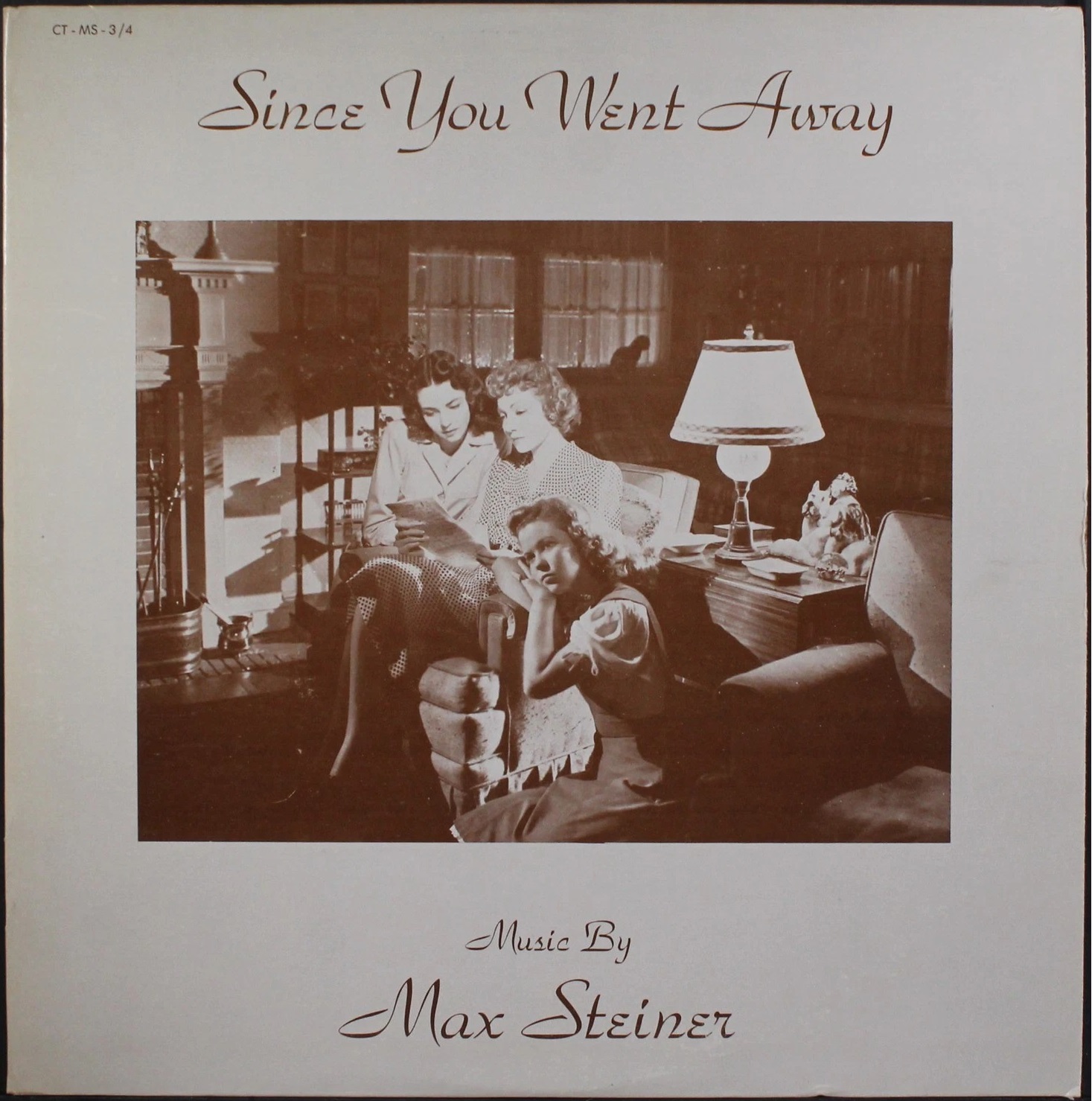
US Citadel Records LP (original photo)
The complete score was first released on a double LP in 1977 by the Max Steiner Music Society but the most significant release to date is a restored, remastered double CD taken from the composer’s personal acetates in the Max Steiner Collection (trailer) at Brigham Young University. Lovingly mastered and sounding better than ever, the set also includes a lavish 70-page booklet and a previously-unreleased promotional suite for radio originally issued on a 16″ transcription disc, though the overt source cues are MIA. It was instrumental (pun intended) in kickstarting the marketing of films with their music prior to release, commencing with the Selznick-produced Spellbound. Ray Faiola, co-producer of the set and owner of soundtrack reissue specialists Chelsea Rialto Studios, warns against purchasing woefully incomplete bootlegs, some of which are credited to “Max Steiner and the Selnick [sic] International Pictures Studio Orchestra”. These include a German CD (Membran) copied directly from the 1977 LP but only containing two thirds of its cues, its Greek CD and MP3 reissue (Tsunami), and other streaming derivatives (Amanita, Classic Film Scores, Classic Soundtracks).
Steiner suite
The Steiner-influenced “traditional” screen score often utilized a European approach rooted firmly in the tone poem. It was, and still is, a valid approach to the medium which resulted in beautiful, eminently effective, and often deeply affecting music. Steiner’s three Oscar-winning scores heard here—conducted by himself—are excellent cases in point. The three are heard in reverse chronology, Since You Went Away having been composed for the 1944 film of Selznick-International, Now, Voyager for the 1942 Warner Bros. film, and The Informer for John Ford’s 1935 film during Steiner’s tenure at RKO. Steiner had been Selznick’s favorite screen composer since Symphony for Six Million and worked on several films for him after leaving RKO. When Steiner signed with. Warners, his contract stipulated that he be permitted to accept outside assignments from Selznick, Shortly before his Warner employment, he composed for Selznick Little Lord Fauntleroy, The Garden of Allah, and A Star Is Born (the Janet Gaynor version). While at Warners, he did Selznick’s Intermezzo, Gone with the Wind, and Since You Went Away.
Most of these are outstanding among Steiner’s works. So great was Selznick’s regard, that when he was forced to use another composer, he more than once called in Steiner to add to or alter the other man’s work. Since You Went Away had been scored by the Polish composer Alexandre Tansman. Apparently dissatisfied with the results, Selznick had Steiner start afresh. In the course of the work, Selznick and Steiner came into conflict on one point. A movie of courage and steadfastness on the home front in World War 2, Since You Went Away included in its three-hour length many familiar tunes in addition to Steiner’s new music. For a scene involving a servicemen’s dance in an airplane hangar, Selznick decreed that “The Emperor Waltz” should be used. Steiner flatly refused. “The Emperor Waltz” was a Germanic tune, America was at war with the Germans, and Steiner would on no account score a German song into a film about American patriotism in wartime. So Selznick called in Franz Waxman to interpolate this single number into Steiner’s score.
Oddly enough, in 1940 Selznick had found Waxman’s music for Rebecca a trifle lacking in lyricism and had interpolated into it a Steiner melody from A Star Is Born. The same beautiful theme is heard a third time in Since You Went Away, as an underscore in several of Claudette Colbert’s scenes with Joseph Cotten. Shirley Temple’s theme in Since You Went Away also originated in the 1937 A Star Is Born, as did one or two of the musical bridges used in the newer film. Since You Went Away was adapted by Selznick himself from Margaret Buell Wilder’s book about Anne Hilton (Miss Colbert), her daughters Jane (Jennifer Jones) and Brig (Miss Temple), and the people who pass through their lives in the single year 1943 while Anne’s husband Tim is away at war. Reduced from Tim’s advertising agency salary to his monthly service allotment, they take in a crusty lodger Col. Smollett (Monty Woolley). Their housekeeper Fidelia (Hattie McDaniel) finds employment with another family, but returns to spend nights and weekends with the Hiltons, where she is one of the family.
Tim’s best man Lt. Tony Willett (Joseph Cotten) visits from time to time to carry on a harmless, bantering flirtation with Anne. Word comes that Tim is missing in action. The lodger’s grandson, Cpl. Bill Smollett (Robert Walker), is stationed nearby, falls in love with Jane, goes off to war, and is killed. Brig sells war bonds, Jane works as a nurse’s aide with the war wounded, and Anne takes a job as a welder where an immigrant woman (Nazimova) tells her what America means to her. Friend Emily Hawkins (Agnes Moorehead), however, hordes and otherwise lives selfishly as though the war didn’t exist. At Christmas, 1943, the Hiltons hold a small party for their dearest friends,. old and new. After the last guest has departed and the two girls have gone up to bed, Anne receives a call from Washington telling her that Tim is alive and on his way home.
The film is 177 minutes of chin-up anecdotes and unabashed morale-boosting. Yet, seen in its entirety three decades later, it still has an odd power to bring a lump to the throat and keep it there. John Cromwell directed tastefully, and Selznick’s production, writing and casting were shrewd. Selznick used name players in even the smallest bits: Lionel Barrymore, Albert Basserman, Lloyd Corrigan, Keenan Wynn, Addison Richards, Florence Bates, Adeline de Walt Reynolds, Warren Hymer and others. He placed eight young unknowns in small roles and, as an indication of his eye for talent, they all later had substantial film careers: Craig Stevens, Guy Madison, Andrew McLaglen, Dorothy Dandridge, Virginia Mayo, Terry Moore, Ruth Roman and Rhonda Fleming. Finally, of course, Since You Went Away had the solid advantage of Steiner’s music, an outpouring of memorable and beautiful original melodies.
Steiner’s suite begins with the opening title music, a reassuring theme of broad nobility and stature, suggesting the integrity and virtue of the American family, its women, children and old folks left at home in wartime. It is heard in the film as the credits unfold over a shot of the Hilton hearth, in which a fire burns briskly. This gives way here to Fidelia’s bluesy, jaunty theme. First muted trumpet, then clarinet, then oboe sing it over a rocking figure in the bassoons. Violins take it up, and trumpet leads it to its conclusion. Strings go into Brig’s theme—a sprightly tune for a teenage girl. The serene melody which follows, a variation of the waltz to come later in the suite, is heard under the happier moments in the Hilton household—the Colonel’s birthday party, for one. The brief, military bridge is a signature for the Colonel, and then comes Soda’s theme, a richly comical melody in the bassoon identifying the Hiltons’ stolid English bulldog.
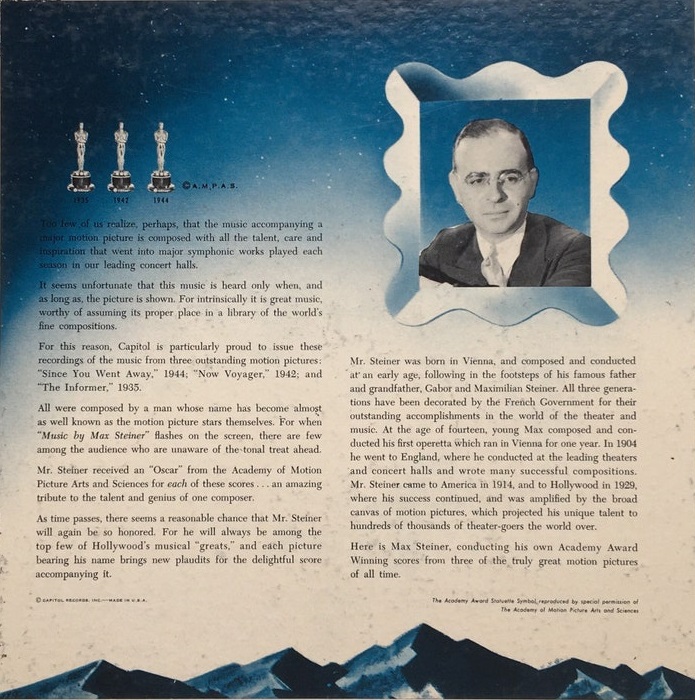
The spacious, lovely waltz Steiner originally composed for A Star Is Born is now heard, richly performed by strings. It first occurs in Since You Went Away during Anne and Lt. Willett’s jovial dinner in the steak house—where they are served wartime hash—and it recurs in subsequent scenes between them. The Colonel’s bridge and another short passage lead into Jane and Bill’s theme, music of subtle poignancy that foreshadows the tragic conclusion to their romance. Its tune is, coincidentally, reminiscent of a song that became popular during World War 2, “I’ll Be Home for Christmas.” This music provides the ending to Steiner’s suite. It builds to a climax, with ominous chords, gradually quickening tempo, and other orchestral sounds that simulate the departing train that is carrying Bill off to war—all the trains, in fact, carrying all the men and boys who went off to fight, and sometimes die, in the now faraway, gallant, bitter days of World War 2. – Rory Guy, Capitol LP (1973)
Steiner’s newly adapted suite, along with two for his other Oscar winners, was first released separately in 1950 as Music by Max Steiner and paired on an LP with Familiar Themes from Tchaikovsky. Though I can find no direct evidence of it, they were reportedly matched on another LP with Ferde Grofé’s 1950 recording of his own Grand Canyon Suite but it only appears to have been coupled with his Death Valley Suite. Finally, all three then backed Alex North’s score for A Streetcar Named Desire on an album which has been oft-reissued over the ensuing decades. Unfortunately, both sets of those recordings have also been bootlegged numerous times separately and together on CD and MP3; these are all the suites’ legit releases:
- Capitol 3-7″/10″ LP/MP3 Music by Max Steiner (1950)
- Capitol LP/CD A Streetcar Named Desire/Great Film Music (1956, reissued/alt 1973, 1990)

1973 Capitol Records LP rear
Since You Went Away: Production and home video
Related articles
- Alfred Hitchcock Collectors Guide: Shadow of a Doubt
- Alfred Hitchcock Collectors Guide: Under Capricorn
- Alfred Hitchcock Collectors Guide: Strangers on a Train
- The Incomparable Max Steiner, Father of Film Music