- Revisiting contemporary and modern critical appreciation
- One of Alfred’s five “Missing Hitchcocks”, hardly seen for three decades
- A comedy about a corpse after the third shot… who’s more alive than dead!
- Its dark humour inspired wraparound segments for Alfred Hitchcock Presents
- Shirley MacLaine’s screen début; clinched the gig with her lack of experience
- Feel the Bern: first fruit of Hitch’s iconic partnership with Bernard Herrmann
Note: this is part of an ongoing series of 150-odd Hitchcock articles; any dead links are to those not yet published. Subscribe to the email list to be notified when new ones appear.
The Trouble with Harry Collectors Guide
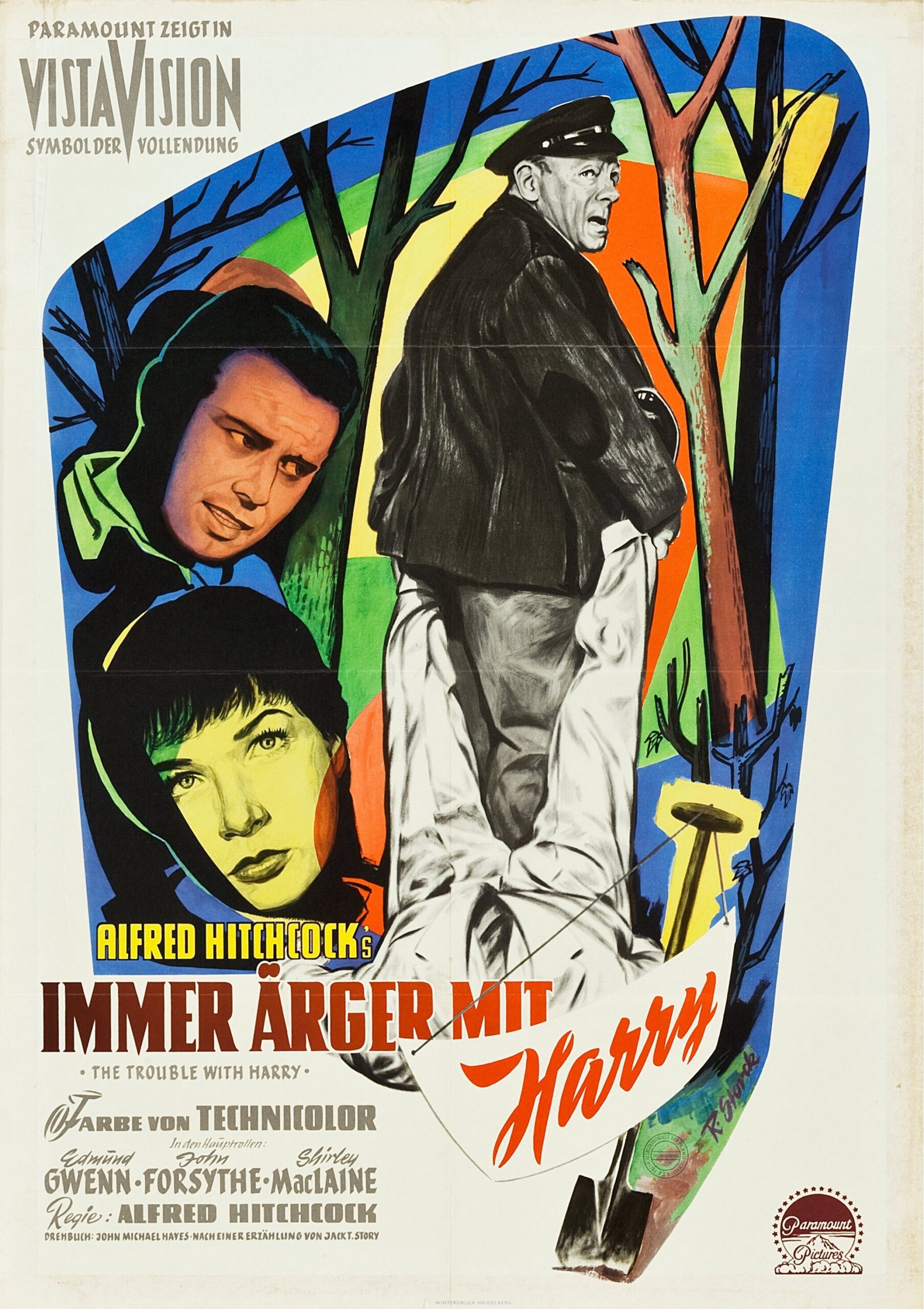
German poster
Whimsical comedy about a corpse. Alfred Hitchcock, but no suspense. A feature needing slow build-up.
This is a blithe little comedy, produced and directed with affection by Alfred Hitchcock, about a bothersome corpse that just can’t stay buried. It’s not a catch-on-quick picture that can be given the usual selling, and is likely to be as leisurely in making its mark as Hitchcock is in pacing it. At any rate, The Trouble with Harry offers Paramount some trouble in the merchandising, and just how well it will go at the box office is moot. Once carefully established for what it is—a charming comedy, despite the ghoulish subject—the response may be satisfactory.
The picture proves, if nothing else, that the American rural scene can be as inspiring as the foreign locales that have drawn so much big screen attention of late. Vermont in the autumn is a thing of beauty, dazzling in its many-hued splendor, and the VistaVision cameras are tellingly used by Robert Burks to show off every tinted vista with an almost in-person effect. If the plot and slick playing aren’t enough, then the beauty of the locale, done in Technicolor, gives the ticket buyer an edge for his money.
Edmund Gwenn is a delight as a retired “sea” captain who stumbles on Harry’s corpse while rabbit hunting. In the belief he did the killing, he decides to bury the cadaver on the spot. Harry goes in and out of the ground three or four times, is responsible for two romances and not a little consternation and physical exercise before he’s finally exhumed for proper discovery, to the relief of Gwenn and the other principals who have become involved in the amateur undertaking.
During the course of events Gwenn and Mildred Natwick, middle-aged spinster who thinks she did Harry in, find love, as do John Forsythe, local artist, and Shirley MacLaine, young widow of the in-and-out Harry. Miss Natwick pairs perfectly with Gwenn, and the John Michael Hayes script from the novel by Jack Trevor Story provides them with dialog and situations that click. Writing is exceptionally good in the words it gives the entire cast to say. That “I have a short fuse” line uttered by Miss MacLaine as she asks Forsythe to kiss her gently is a real howler. There’s a lot of other saucy talk, too.
Forsythe registers with a confident, breezy portrayal of the village artist. Miss MacLaine impresses despite the handicap of some high school, amateur mannerisms, which manage to get by here but will need correction for the future. Others doing notable work in carrying out the whimsically fey, slightly wacky, intent of the film are Mildred Dunnock, village storekeeper; Jerry Mathers, a small boy, Royal Dano, country officer of the law; Parker Fennelly, eccentric millionaire; Dwight Marfield, screwy doctor, and Barry Macollum, a tramp. Harry is unidentified.
Vermont supplied its own art direction, but what it didn’t is excellently handled by Hal Pereira and John Goodman, with set decorations by Sam Comer and Emile Kuri. Alma Macrorie did the editing and Bernard Herrmann backs the fun with a score in keeping: “Flaggin’ the Train to Tuscaloosa,” by Mack David and Raymond Scott, a catchy melody. – Neal, Variety/mini review
Hollywood looks at Vermont – Vermont Life
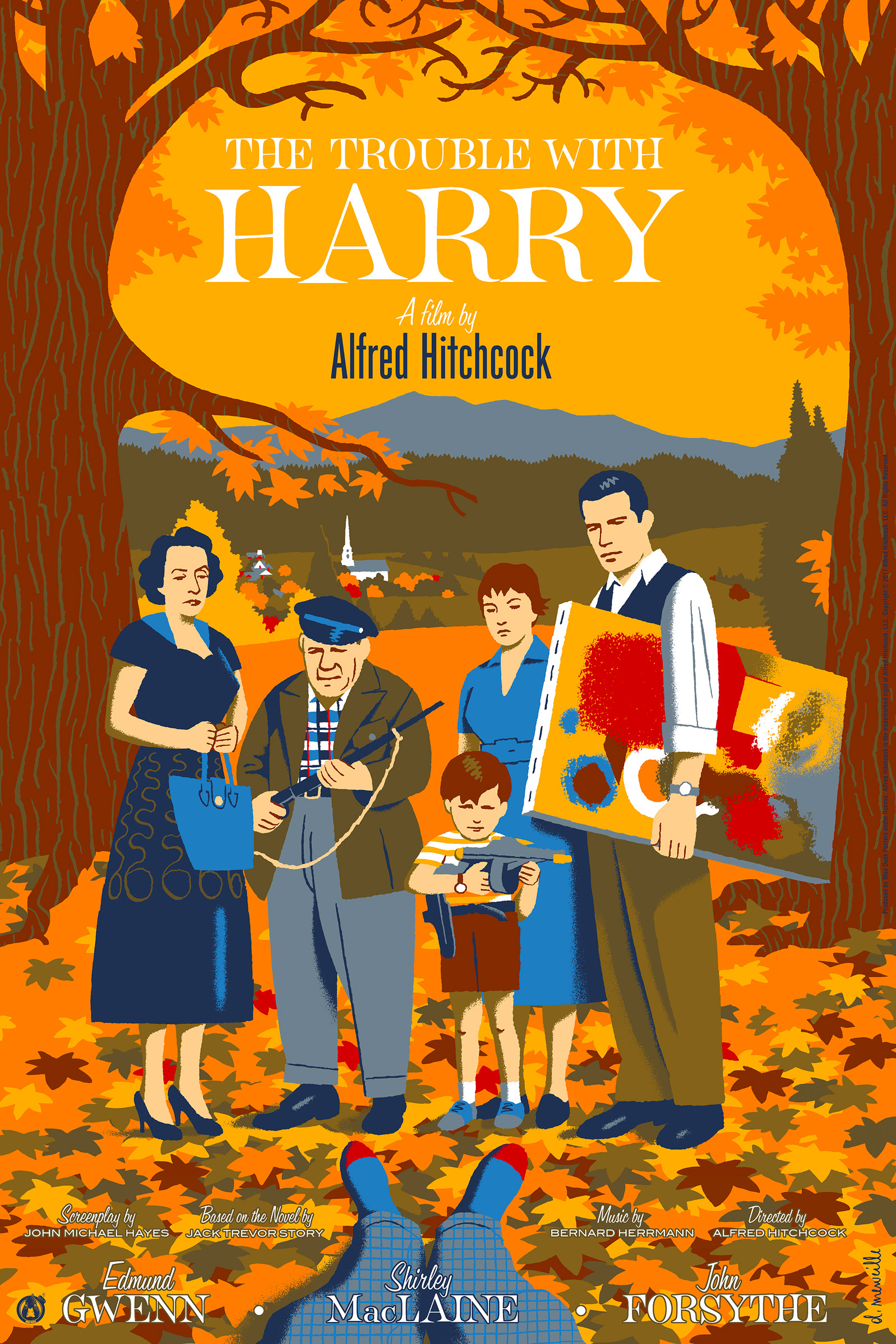
Poster by David Merveille, 2017; alt/variant/more
Hitch has done it again, with a comical corpse that’s just one big joke
Alfred Hitchcock hits the jackpot again, this time with an entrancing film called The Trouble with Harry. The trouble with Harry is that he’s a corpse and nobody wants him. Somebody killed him—and somebody has to dispose of him. To complicate matters several people feel responsible so Harry, becoming steadily scruffier in appearance, has to undergo a series of hasty burials and ends up in a bath being “tidied up” for the police.
Around this almost incredibly gruesome theme Hollywood’s master of suspense has woven bubbling gaiety that should make Harry the comedy of the month. This is a comedy completely free from tastelessness. Not even in its most morbid moments did I have the feeling that this was not the sort of thing to joke about. It could be because of the dreamlike unreality of the 24-hour-action story, beautifully set against the autumn glory of the Vermont woods. It could be the crisp callousness of the dialogue and the utter lack of personal feeling towards the corpse on the part of the actors—including Harry’s wife, who was left stranded in her négligée on their wedding night and couldn’t care less what happens to him.
The wife, by the way, is a brand-new scene-stealer introduced by Paramount called Shirley MacLaine. A deliciously impish redhead with a nonchalant naïveté of manner, she attracts stares like a magnet when she is on the screen. Not even Edmund Gwenn can really compete, though he’s delightful enough as a phoney old sea-captain—the only one of the conspirators who ever feels a twinge of real anxiety about Harry’s predicament and his own.
The introduction of a “prim spinster” is a step down from improbable comedy into rather rather trite farce, though she is charmingly played by Mildred Natwick. John Forsythe, a recent hit in Broadway’s Teahouse of the August Moon, has some of the film’s best lines to speak—and makes the most of them as the quick-talking artist. It’s the fault of the script that he suffers a quick change characterisation of halfway through to turn him from an eccentric into a romantic lead. The only actor whose performance cannot be assessed is Harry, since practically all we see of him are the soles of his feet in various stages of undress. – The Straits Times
Here’s the trouble with Harry… he’s dead (alt, colorized).

Shirley you can be serious: for once, the marketing doesn’t lie: this ad appeared in USN&WR and Life (alt).
Harry the corpse that won’t stay buried
WHOEVER would have thought that master of the macabre, Alfred Hitchcock, would one day turn chef to a Christmas cake? But there you are! “Hitch” has been and gone and done it.
Fruity offering
The Trouble with Harry, his latest production for Paramount, is a real fruity offering into which the old maestro of murder mingles mystery and merriment. What results is a rich, spicy mixture, very palatable. But because a corpse is to Hitchcock what bacon is to eggs, here too there is a body—a body that refuses to stay buried, but keeps popping in and out. Whose body is it? Well, the answer at first seems to be just everybody’s.
Actually, it’s Harry’s—the guy the girl said was just too good to live. He married her, you see, then spent his wedding night in the hotel lounge because she really was his brother’s widow. And the motive for murder has often been less. There are other candidates for the crime too. For instance, the zany painter who succumbed to the charms of Harry’s wife before he knew she was a widow. There’s the gentile spinster who met Harry in the woods and thought she was about to lose her honour. And finally there was the retired maritime captain who was out rabbit shooting and might have shot Harry by mistake. Who really did it? I don’t propose to tell you here. But with everybody fessing to the crime, Harry disappears and re-appears like a conjuror’s rabbit.
Pure delight
A cast of relatively “little names” plays this frothy comedy to its fullest. Edmund Gwenn, the veteran British actor, is pure
delight as the ancient skipper who never went to sea, and John Forsythe (who looks like Bogart before the hand of Time gave him that benevolent bloodhound appearance) stays with the eccentric artist role like paint clinging to canvas.
And I nominate as my favourite wolf whistle of the week Shirley MacLaine who had trouble with Harry before he became a trouble to everyone else. She responds to the pipes of Peter Pan Hitchcock with elfin grace, matching his Puckish humour with pixie charm.
From Hitchcock we have long come to expect the unexpected in The Trouble with Harry he not only chills you with suspense. Literally, he tickles you to death. – Doug Lackersteen, The Straits Times

UK 1949 first edition with artwork by Denis McLoughlin
Master of Suspense, Alfred Hitchcock, directs a delightful comedy-mystery set in New England It stars John Forsythe, Edmund Gwenn, Mildred Natwick, and young Jerry Mathers. In addition, it marks the noteworthy screen debut of twenty-year-old Shirley MacLaine. What is The Trouble with Harry? Well, for one thing, he’s dead; and while no one really minds very much, everybody thinks that they are responsible. It all begins on a fine autumn day in Vermont when little Arnie Rogers (Jerry Mathers) is happily roaming through the woods. Suddenly, three shots ring out and the boy finds the dead body of his father — Harry Rogers.
Now that Harry’s dead, he’s become a real problem for everyone in town. Captain Albert Wiles (Edmund Gwenn) thinks he killed Harry while out shooting. The village spinster, Miss Gravely (Mildred Natwick) thinks she’s to blame because she hit Harry on the head with a shoe to save her honor. Harry’s estranged wife, Jennifer (Shirley MacLaine), thinks she’s the culprit because she conked her husband on the head with a milk bottle when he tried to enforce his marital rights.
It takes a handsome forthright artist, Sam Marlow (John Forsythe), several attempts at digging, burying and moving the corpse, and plenty of Hitchcock-style macabre humor, before the real cause of Harry’s death is revealed. In the end, Harry’s “troubles” give everyone a happy ending. Get ready for some unusual laughter, spectacular scenery and a fun-filled romantic romp. It’s all part of this whimsical, inventive black comedy. A decidedly different movie from the Master of Suspense. – US MCA LaserDisc (1985) LDDb
UK 1955 paperback with McLoughlin artwork and the only print edition of the sequel, The Trouble with Trudy
In François Truffaut‘s book-length interview with Alfred Hitchcock, the director explained his fondness for The Trouble With Harry: “I’ve always been interested in establishing a contrast, in going against the traditional and in breaking away from clichés. With Harry I took melodrama out of the pitch-black night and brought it out in the sunshine.” Hitchcock read Jack Trevor Story’s novel, decided it would make an interesting film and gave it to writer John Michael Hayes to adapt for the screen. Story and his publisher sold the film rights for $11,000, unaware until after the deal was signed that the purchaser was Hollywood’s fabled Master of Suspense.
Herbert Coleman, the film’s associate producer, “discovered” 20-year-old Shirley MacLaine in the stage musical The Pajama Game. Coleman went backstage, introducing himself to her as a representative of Hitchcock and Paramount. The very next day, Coleman was arranging for MacLaine to screen-test for Harry, her first film. Coleman went location-scouting in New England, looking for an area with both colour and scenic vistas. He found it in the vicinity of Stowe, Vermont. Unfortunately, heavy rainstorms hampered the moviemakers. Shooting interior scenes on sets built in a school gymnasium was also difficult because of the sound of rain on the tin roof.
Hitchcock told a 1955 interviewer that Harry was a “test film” to help determine if he was correct that American audiences were ready for humour less obvious than the sort it was usually offered. He was confident that audiences would respond to new or oblique ideas if they were presented through understandable characters. Besides testing audience response to unusual humor, Harry was also an experiment in presenting a film not built around a Hollywood star. Hitchcock felt that a “name” star would have thrown the story out of kilter. Harry’s world première was also in Vermont. Première proceeds went to victims of a recent flood. The Trouble with Harry features twenty-year-old Shirley MacLaine in her first film role. Upon learning that MacLaine had never acted in a movie before, Hitchcock reportedly told the young actress, “I shall have fewer knots to untie. You are hired.” – Universal DVDs (2001)
German herald, pressbook, Illustrierte Film-Bühne, Film und Frau

German newspaper advert: “Hitchcock’s subtly humorous hit! Clever, subtle, well worth watching!” (orig photo, Italian poster/alt)
The Trouble with Harry Collectors Guide
Related articles
This is part of a unique, in-depth series of 150-odd Hitchcock articles.