- Revisiting contemporary and modern critical appreciation
- Back with a bang: Hitchcock back on top after string of box office flops
- Edge of your train seat: dark heart of this film noir still has power to shock
Note: this is part of an ongoing series of 150-odd Hitchcock articles; any dead links are to those not yet published. Subscribe to the email list to be notified when new ones appear.
Strangers on a Train: Writing on a Classic | Collectors Guide, Pt 2: Home video and remakes
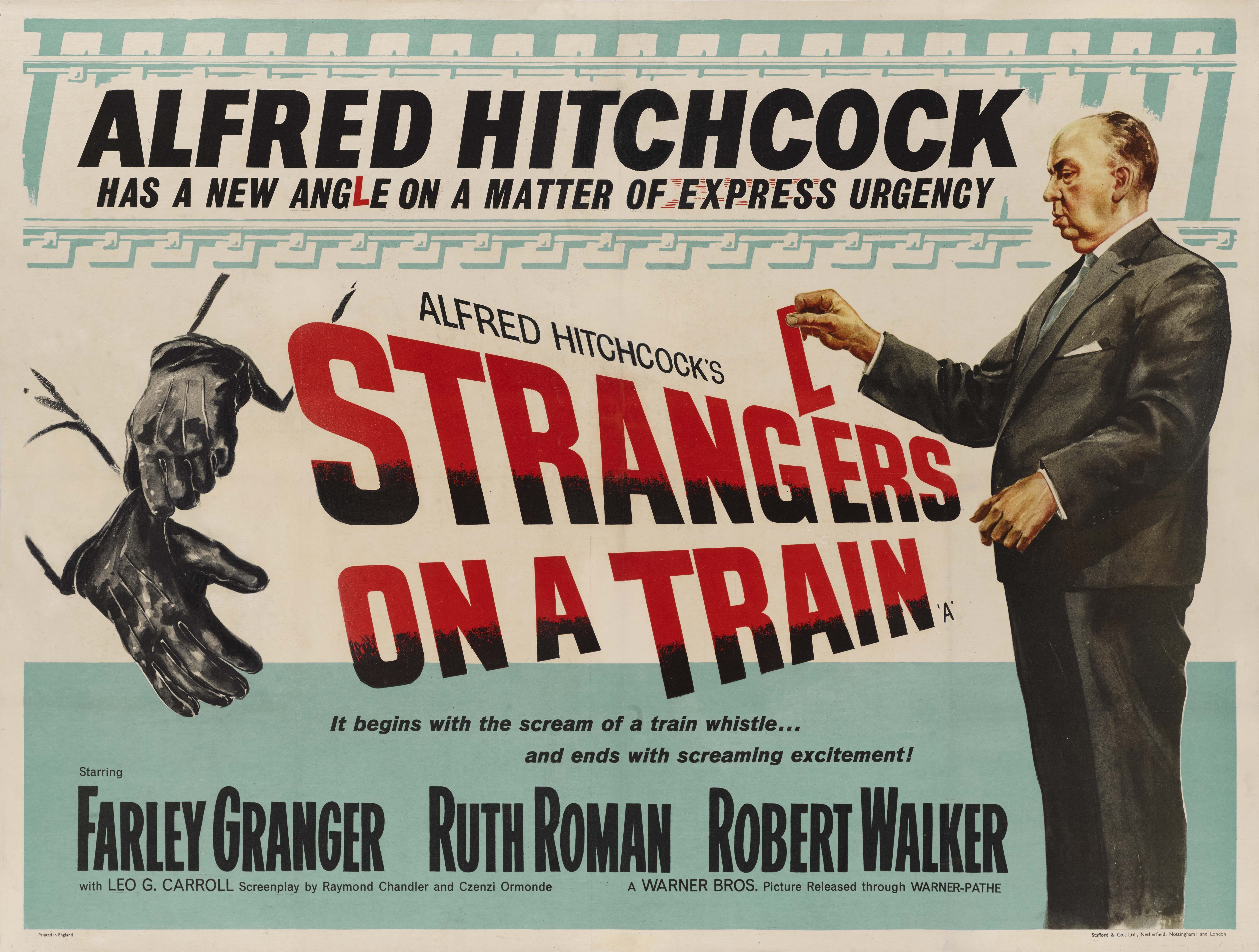
UK 1958 re-release quad poster by Stafford & Co. Nottingham, complete with inventive spoiler. The variant version has no tracks and a different strapline; more info in the entry for Suspicion.
The Current Cinema: Hitchcock Serving
The characters in Strangers on a Train, Alfred Hitchcock’s latest movie, are all travelling light, which is probably a good thing, since the plot is too shaky to support any substantial load. However, it does afford Mr. Hitchcock a chance to spread himself in several directions, and before he pulls up winded at the conclusion of the picture, he has briefly explored such disparate matters as murder, merry-go-rounds, tennis, and nymphomania. As adapted from a febrile novel by Patricia Highsmith, Strangers on a Train has to do with a pair of young gentlemen, one of whom is a tennis player fast of foot and slow of brain and the other a lunatic who cherishes such projects as smelling flowers on Mars by remote control. Despite the latter’s dishevelled state of mind, he doesn’t have much trouble cultivating the acquaintance of the athlete when he happens upon him in a Pullman.
The muscular lad is feeling a bit broody at the time, because he is journeying to his home town to arrange for a divorce from a bespectacled wife who has so thoroughly refuted the Dorothy Parker dictum about girls who wear glasses that she has become pregnant in the course of a spot of adultery. The lunatic, who has read about his companion’s marital woes in the newspapers, tries to cheer him up by offering to kill his wife. All he wants in return for the favor is to have the sportsman do in his father—a fair exchange, as he sees it. Although the tennis player shudders at this suggestion, the madman assumes that the deal is all set, and a short while later he tracks down the errant wife and strangles her. Then he calls on his new friend to stick to his part of the bargain. Instead of whistling up a policeman, the athlete, fearful that his schizoid pal will somehow involve him with the law, keeps shilly-shallying about the matter, which gives Mr. Hitchcock plenty of opportunity to play tricks with his camera.
The pictorial legerdemain finally winds up in a rooty-tooty fashion, with our two young gentlemen engaged in a death grapple on a runaway carrousel. Even though Mr. Hitchcock’s fancy shots are familiar, there’s nothing boring about them, but the foolishness of the film’s theme keeps obtruding until the spectator damned near loses patience with the whole affair. As the addled killer, Robert Walker struck me as being a trifle too twinkly to be convincing, and Farley Granger seemed to bring more vacuity to the role of the tennis player than was entirely called for. Ruth Roman, Leo G. Carroll, Laura Elliott, and Mr. Hitchcock’s daughter, Patricia, round out the cast. – John McCarten, The New Yorker
Reviews: Guardian/#2, Harrison’s Reports, Hollywood Reporter, Independent, NY Times, Sight and Sound, Times/#2, Washington Blade
The above is actually a 2010 fan edit by the late Cameron Arrigoni; more: 2012, 2018, 2021, 2023, 2025, 2026
Strangers on a Train presents director Alfred Hitchcock in the familiar mood of his earlier suspense thrillers. While the new film doesn’t bear mention in the same bated breath with his The 39 Steps and The Lady Vanishes, even a minor work by the old Master of Melodrama is a guarantee of an original brand of excitement.
Based on Patricia Highsmith’s novel, the Raymond Chandler-Czenzi Ormonde screenplay introduces its load of mischief with a highly novel gambit that involves two men who meet on a train. One is Guy Haines (Farley Granger), a first-flight tennis player who is in love with Senator Morton’s daughter (Ruth Roman) but is unable to divorce his indifferent and adulterous wife (Laura Elliott). The other stranger is Bruno Anthony (Robert Walker), a spoiled and palpably neurotic young man who hates his wealthy father with murderous intensity. Speaking of murder, Bruno tells his bored and slightly irritated companion the only way to get away with it is to kill without apparent motive. Thus, if he kills Guy’s wife for him and Guy murders Bruno’s father in exchange, both would be achieving their ends without any danger of discovery.

Granger vs. Walker: A straightaway chase winds up on a merry-go-round (alt)
When they part Guy treats the proposal as a distasteful and macabre joke, but Bruno coolly proceeds to locate the erring wife in her home town on Long Island, follow her to an amusement park, and strangle her expeditiously on an island stopover in the “Tunnel of Love” concession. Then he reports to Washington, D.C., where Guy works for Senator Morton and demands that the horrified widower fulfill his part of the bargain by polishing off Bruno’s father.
This is one of those tangled webs that would fall apart at the nexus if the victim had sense enough to loop off to the nearest police station on the chance that truth would prevail. And like his screen writers, Hitchcock does a bit of far-fetching himself in creating the suspenseful stratagems that play hob with the spectator’s spine. Some of the business involved in Bruno’s attempt to stick Guy with his wife’s murder fails completely in its purpose, and the climactic free-for-all aboard a runaway carrousel is a triumph of noise and confusion over legitimate melodrama. On the other hand, the use of a Forest Hills tennis match as a delaying device while time runs out on the hero is worthy of the Hitchcock imagination.
None of this calls for any special effort on the part of Hitchcock’s generally capable cast. However, Walker succeeds in making the unbalanced killer something special in the way of menace, and the director’s 22-year-old daughter Patricia—cast as Miss Roman’s spectacled and wide-eyed kid sister—does nicely with her first important screen role. – Newsweek

Strangers on a Train: Gripping suspense melodrama in the Hitchcock manner. For top bookings, good b.o. prospects.
This is suspense melodrama of the thriller variety, strongly sold in an imaginative Alfred Hitchcock presentation. In its class it is topnotch entertainment that should rate a good boxoffice reaction in key dates and elsewhere. From star names of Farley Granger, Ruth Roman and Robert Walker, on down, Hitchcock has cast his characters with his usual care to add interest even in bit spots. Given a good basis for a thriller in the Patricia Highsmith novel, a first-rate script by Raymond Chandler and Czenzi Ormonde. Hitchcock embroiders the plot into a gripping, palm-sweating piece of suspense the likes of which haven’t been seen of late. It’s his best in some time.
Story offers a fresh situation for murder. Two strangers meet on a train. One is Granger, separated from his tramp wife, Laura Elliott, and in love with Miss Roman. The other is Walker, a neurotic playboy who hates his rich father. Walker proposes that he will kill Miss Elliott if Granger will do away with the father. Granger treats the proposal as a bad joke but Walker is serious. Latter stalks down Miss Elliott an amusement park and strangles her. He then starts chasing Granger to make him fulfill the other end of the bargain. Granger, suspected by the police, avoids Walker as much as possible but latter’s cunning enables him to insinuate himself into such unlikely spots as a senator’s party, tennis tournaments and other places where Granger appears.
Miss Roman, aware that something is troubling Granger, learns the truth one night at a party when Walker nearly strangles a dowager while demonstrating how a murder can be committed. Patricia Hitchcock, Miss Roman’s younger sister, who is similar in appearance to Walker’s first victim, brings on the attack. Granger, by, now desperate, seeks to confess the scheme to Walker’s father, but the killer prevents this and promises to pin the wife’s murder on him. Finale comes with a wallop as Granger chases Walker to the amusement park to prevent him planting the evidence.
Hitchcock uses the merry-go-round device to climax the tale of murder and terror with smashing effect, high-pointing the trail of suspense along which he has led an audience. Another top scene is the amusement park killing of Miss Elliott, and there is hair-raising tension in the sequence that has Granger stealthily entering Walker’s home during the night to expose the killer to his father. Hitchcock weaves the story against backgrounds and sounds that add to the unrelenting suspense.
Performance-wise, the cast comes through strongly. Granger is excellent at the harassed young man innocently involved in murder. Miss Roman’s role of a nice, understanding girl is a switch for her, and she makes it warmly effective. Walker’s role has extreme color, and he projects it deftly. Miss Elliott stands out briefly as the victim, and Miss Hitchcock (the director’s daughter) also registers. Among those shaping impressive smaller roles are Leo G. Carroll, Marion Lorne, Norma Varden and Robert Gist. Helping to further the mood of the film is Dimitri Tiomkin’s music and Robert Burks’ photography. Other technical assists are good. – Brog., Variety
Murder on the Merry-Go-Round – Life
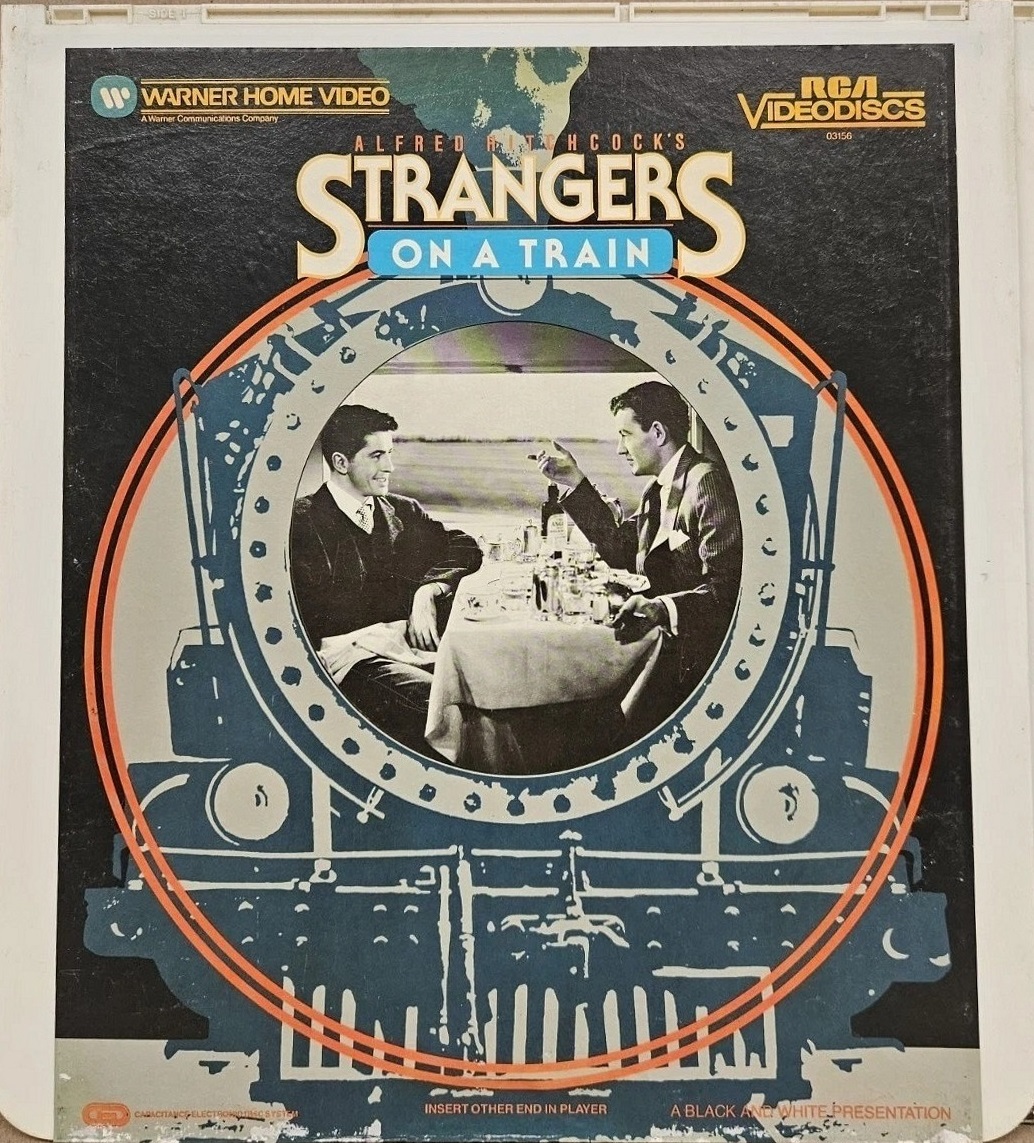
From the Master who brought you Psycho, North by Northwest, and The Birds, Strangers on a Train is one of Alfred Hitchcock’s most sinister and gripping thrillers. This psychological shocker makes everyday situations dangerous; even an amusement park becomes a frightening and forbidding place.
The suspense begins aboard a train from Washington to New York. Two strangers strike up an innocent conversation. At first, Bruno Antony (Robert Walker) seems just talkative and mildly annoying to tennis star Guy Haines (Farley Granger). But soon, Guy finds himself drawn into a bizarre bargain to swap murders. Aware that Guy has a marriage he can’t wait to dissolve and a girlfriend he can’t wait to wed, Bruno offers to dispose of the unwanted wife. In return, he suggests Guy can do him a similar favor—rid him of the father he loathes. Fascinated but repelled by such a pact, Guy never agrees. Bruno, however, sets out to seal the bargain and railroad his reluctant accomplice into partnership.
Robert Walker gives the performance of his career as the edgy psychotic with the ingenious plan to get away with murder. He sets in motion a chilling crescendo of cat-and-mouse terror, that will keep you guessing who the real victim actually is. – US CED (1983)
Locations: AFI, Hitchcock Zone, IMDb
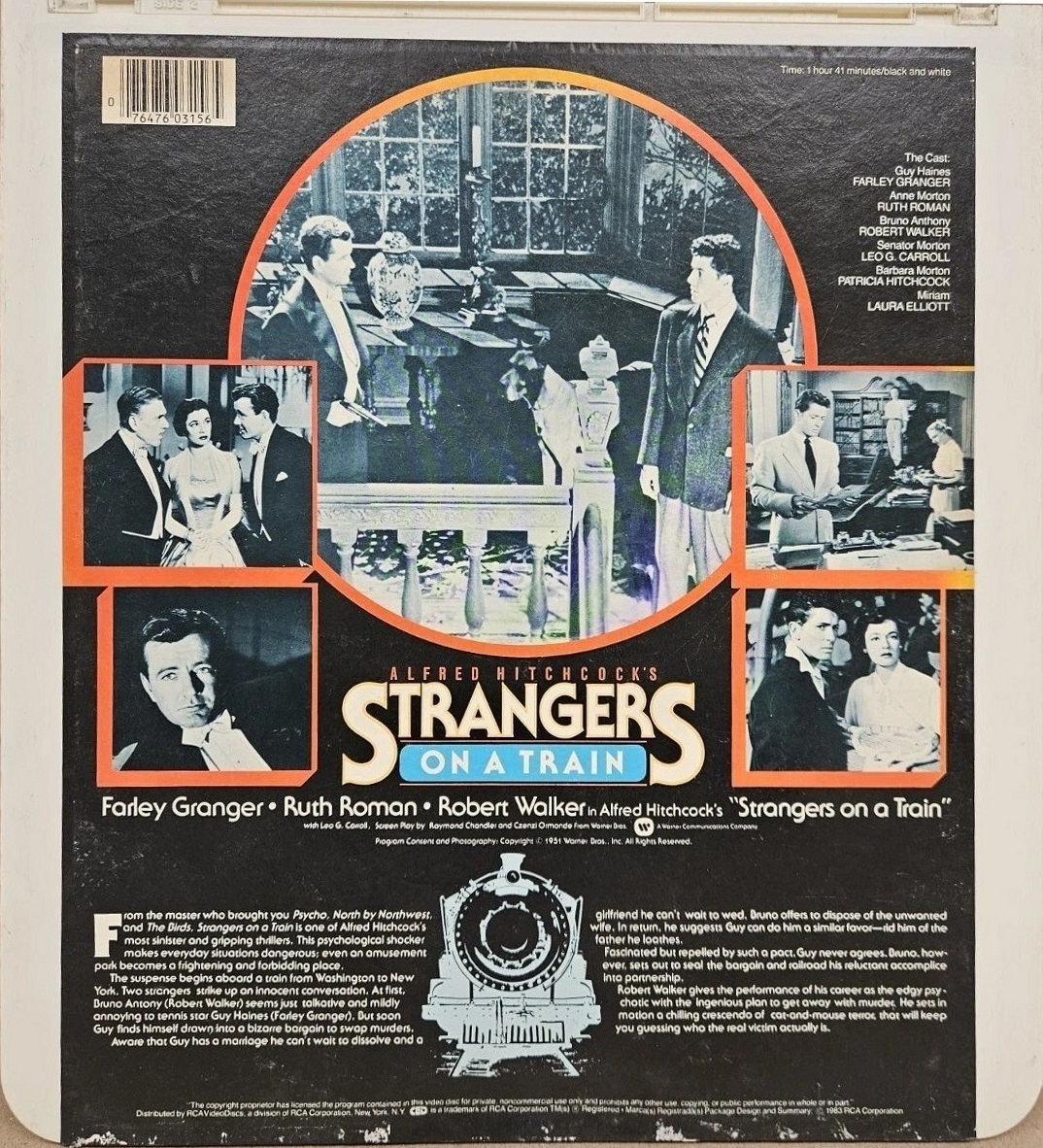
US CED rear
A strange meeting that leads to violence… and death
While on a journey from Washington to New York, Guy Haines, a champion tennis player, and Bruno Anthony meet, quite accidentally, as strangers on a train. Bruno, it transpires, knows all the details of Guy’s public and personal lives – including the fact that his desire to marry a senator’s daughter is being prevented by his wife’s refusal to to give him a divorce. Bruno casually suggests a solution to Guy’s problems: he will Guy’s wife if Guy, in return, will kill his hated father. Both crimes, assures Bruno, can be committed with impunity, for neither will appear have a motive. Guy indignantly rejects the insane proposal but Bruno, disregarding the rebuff, goes ahead with his part of the plan by strangling Guy’s wife to death in a fairground. It is now Guy’s turn to carry out his part of the so-called bargain – and Bruno is determined to see that he does.
Based on a novel by Patricia Highsmith, Strangers on a Train – directed by Alfred Hitchcock, the world’s greatest maestro of suspense – will enthrall you from its intriguing opening scene to its justly celebrated climax. A vintage thriller. – US VHS and Japan LaserDisc (1986)

Spanish poster
A tennis star plays a match with murder!
Isn’t there someone, somewhere, you sometimes wish were dead? Someone who beat you, or betrayed you, or made you mad enough to kill? You wouldn’t do it, of course. It’s just a figure of speech. But suppose you met a stranger who offered to do your killing for you? Alfred Hitchcock, the master craftsman of our darkest fantasies, explores this nightmarish possibility in Strangers on a Train – and the perfect crime turns into a trap with no escape.
Farley Granger plays Guy Haines, a tennis star who hates his estranged wife and wants to be free to marry another woman. On a train, he meets Bruno Anthony (Robert Walker), who hates his father. Bruno has a chillingly simple plan: each could kill the other’s victim. No motive, no clues, nothing to link Guy and Bruno but a casual meeting of strangers on a train… and both of their problems would be solved. Guy laughs it off. Bruno can’t really be serious. But suddenly, horribly, Guy’s wife is murdered. And Bruno turns up to demand that Guy keep his part of their bargain.
Strangers on a Train is one of Hitchcock’s most diabolical thrillers, a tale of dreadful possibilities twisted tightly with nerve-wracking suspense and the macabre humor which is always the master director’s trademark. Working from a screenplay by mystery writers Raymond Chandler and Czenzi Ormonde, adapted from the 1950 novel by Patricia Highsmith, Hitchcock creates a gallery of classic scenes: the murder of Guy’s wife in an amusement park, a heart-stopping tennis match when time is running out, and Bruno’s murderous game is brought to a spectacular conclusion aboard a merry-go-round spinning wildly out of control. Nobody does it like Hitchcock – and Strangers on a Train will carry you on one of the most frightening rides of your life. – US VHS/Beta (1985) and VHS/LD (1987) LDDb

Strangers on a Train: Writing on a Classic | Collectors Guide, Pt 2: Home video and remakes
Related articles
This is part of a unique, in-depth series of 150-odd Hitchcock articles.