- Ingenious mixed-up killer plot: “Swap murders?” “Your wife. My father. Criss-cross.”
- Master of Suspense plunges headlong back into film noir territory with this dark thriller
- Rich and Stranger on a Train: fateful journey for ‘chance’ encounter with relentless nemesis
- Not sporting: ace tennis player is no match for his underhanded doubles partner from hell
- Based on troubled Ripley novelist Patrica Highsmith’s other famous psychopathic creation
- Tragic coda to the brief but glittering career of a wronged actor with so much more to give
- Hollywood maestro Dimitri Tiomkin provides propulsive score for second of four Hitchcocks
Note: this is part of an ongoing series of 150-odd Hitchcock articles; any dead links are to those not yet published. Subscribe to the email list to be notified when new ones appear.
Strangers on a Train: Writing on a Classic | Collectors Guide, Pt 2: Home video and remakes

Contents
Production
Clips, more, dark | gallery, #2
“A timeless treat, a marvelous display of Hitchcock’s absolute mastery of his medium and a deliciously dark comedy as well.” – Kevin Thomas, LA Times
Strange thing about this trip. So much occurs in pairs. Tennis star Guy (Farley Granger) hates his unfaithful wife. Mysterious Bruno (Robert Walker) hates his father. How perfect for a playful proposal: I’ll kill yours, you kill mine. Now look at how Alfred Hitchcock reinforces the duality of human nature. The more you watch, the more you’ll see. “Isn’t it a fascinating design?” the Master of Suspense often asked.
Actually, it’s doubly fascinating. For Hitchcock left behind two versions of Strangers on a Train. The original version is an all-time thriller classic. A recently found longer pre-release British print offers “a notable amplification of Walker’s charming flamboyance, psychotic personality and homoerotic attraction to Granger” (Bill Desowitz, LA Times). The laying bare of Bruno’s hidden nature, along with the great set pieces (head-turning tennis match, disintegrating carousel) and suspense as only Hitchcock can deliver, makes for a first-class trip. – Warner DVD (1997/2001)
“Intensely enjoyable. In many ways the best of Hitchcock’s American films.” – Pauline Kael, 5001 Nights at the Movies (1982)
Before anyone thought of “throwing Momma from the train,” the idea of a double “crisscross” murder had already been hatched. Or “hitched,” as in Alfred Hitchcock’s Strangers on a Train. Tennis star Guy Haines (Farley Granger) half-jokingly muses about killing his wife with a stranger he meets on a train, unhinged playboy Bruno Anthony (Robert Walker), who’d prefer his father be deceased. In theory, each could murder the other’s victim. Crisscross. No motive. No clues. No problem… except: Bruno takes the idea seriously, with deadly consequences. Whether you’re a fan of Hitchcock or just brilliant filmmaking, this diabolical tale of twisting suspense and macabre humor, co-starring Ruth Roman and Hitchcock stalwarts Leo G. Carroll and the director’s daughter, Patricia Hitchcock, is your ideal carnival ride. – Warner BD (2012)
The film has a very cleverly constructed screenplay in which Bruno subtly but inexorably moves closer to the centre of Guy’s life and loved ones with each appearance. It’s based on the eponymous 1950 novel by Patricia Highsmith, whose other most famous creation was the “Ripliad” series of five novels commencing with 1955’s The Talented Mr. Ripley. It could just as easily have been titled Misadventures of a Charming Psychopath, and many of Highsmith’s violent crime novels were centred on such characters. But even so, none of them were more bizarre or unbalanced than their deeply troubled author. She was a self-avowed alcoholic, sex addict, racist, “Jew hater” (her words), animal abuser, and on. And on. Well, they do say write what you know.
Hitch bought Strangers’ source novel “outright for $7,500 [a very tidy sum indeed], with 10% of that to Highsmith’s agent.” “She talked to Hitchcock only once, on the phone, and she never met Raymond Chandler.” As was par for the course, there are many changes betwixt source and screenplay. Most notably, Guy doesn’t do the deed, circumventing censorship; and the film’s celebrated merry-go-round climax was lifted, wholesale and uncredited, from the ending of Edmund Crispin’s 1946 novel The Moving Toyshop. Strangers features many of Hitch’s favourite motifs throughout, including a Wrong Man on the Run in a double chase and, especially, trains. Speaking of which, its ending is also very reminiscent of the train crash closing Secret Agent, especially in its framing of an onscreen death.
In 1995, Highsmith’s novel was adapted as a critically acclaimed and subsequently much-performed stage play by Craig Warner, who also penned an abbreviated version for BBC Radio. By the way, contrary to rumour, the author does not have a cameo in Hitch’s film. Like many in Hollywood, Hitch hated powerful producer David O. Selznick with a passion and doubtless cast Walker in the lead as a favour after the ruthless mogul had stolen Walker’s wife, Jennifer Jones, and broken up his family and life. But Hitch always kept his art uppermost in his thoughts and knew Walker was the right man for the job. And how: Walker delivers in spades.
Farley Granger, Kate Micucci | TCM
This marked the first of 12 films renowned cinematographer Robert Burks lensed for the Master, netting him three of his four Oscar nominations including a win a for To Catch a Thief. He was ably assisted by Leonard South as camera operator, who filled a similar role on 14 or 15 Hitchcocks and was interviewed for Rear Window’s DVD documentary. The director has a near-customary cameo in Strangers, and even two more of sorts. His most widely known is carrying a bulky cello case onto the train as Guy Haines alights, but prior to that Hitch is seen briefly on the rear of a Hitch anthology Guy’s reading, and Bruno also rests his feet on another. The first is Alfred Hitchcock’s Fireside Book of Suspense (1947) and the second is the 1947 reprint of Suspense Stories Collected by Alfred Hitchcock (1945). The former was recently discussed by academic David Bordwell but they were first brought to light by critic and scholar D. A. Miller in his painstakingly researched essay:
- Hitchcock’s Hidden Pictures – D. A. Miller, Hidden Hitchcock (2016) | interview | review/#2/#3
Iconic entertainer Carol Burnett, a lifelong fan of Hitch, Robert Walker and Strangers on a Train in particular, tells a wonderful story of how her Hollywood Walk of Fame star came to be placed directly outside the Warner Bros. Theatre. She also sends up the overbearing manager responsible in “Cavender Is Coming“, her sole episode of The Twilight Zone.
Essays, etc

Criss-Cross: The Making of Strangers on a Train (2025) – Stephen Rebello
- Strangers on a Train – ZC
- “Criss-Cross“/orig – Ken Mogg
- Strangers on a Train – Steve-O
- Digging Hitchcock – Ben Lieber
- Strangers on a Train – Joe Valdez
- Strangers on a Train – Roger Ebert
- Strangers on a Train – David Keyes
- Strangers on a Train – Tony McRae
- The Art of Murder – Iain Morrisson
- Strangers on a Train – Steven Shaltiel
- Strangers on a Train – Rob Nixon and Jeff Stafford
- Double, Double: Toil and Trouble – Barbara M. Bannon
- Identity Politics in Strangers on a Train Philip McGowan
- Figures of Style in Strangers on a Train – Peter J. Dellolio
- Raymond Chandler: The World You Live In – Paul Jensen
- Greek Mythology in Strangers on a Train – Carter Thallon
- Identity Politics in Strangers on a Train – Philip McGowan
- Life with Video: Strangers on Which Train? – Bill Desowitz
- Inoculative Identification in Strangers on a Train – Neil Maizels
- My Favourite Hitchcock: Strangers on a Train – Catherine Shoard
- American Friends and Strangers on Trains – J. Yellowlees Douglas
- Gay Coding in Hitchcock Films – Scott Badman and Connie Hosier
- Tone and Style: The Opening of Strangers on a Train – Douglas Pye
- Expressionist Themes in Strangers on a Train/orig – Peter J. Dellolio
- Stranger and Stranger: Hitchcock and Male Envy – Mervyn Nicholson
- Collaboration and Concepts of Authorship/reply – Robert L. Carringer
- Re-Visiting the Double: Rope and Strangers on a Train – David Humbert
- Strangers on a Train: “Strange” Desire and Framing Murder – Sam Shuler
- Not ‘so’ strangers. Highsmith according to Hitchcock – Jorge Luis Peralta
- Symbolism in SoaT/SoaT and North by Northwest – Rebecca Franklin-Landi
- Shadow, Rope and Strangers: Hitchcock’s Strangler Trilogy – Team Ruthless
- The Catholic Hitchcock: A Director’s Sense of Good & Evil – Richard Alleva
- Early Cahiers and Hitchcock: Godard on Strangers on a Train – David Davidson
- Stranger in a Studio/orig – Frank MacShane, The Life of Raymond Chandler (1976)
- Strangers on a Train: Literary Symbols, Demigods and a Cigarette Lighter – Joel Gunz
- Black and White and Sinful All Over: Moral Complexity in Strangers on a Train – Danielle Rico
- Costume as a Storytelling Tool in Stage Fright and Strangers on a Train – Bridget Alana Shields
- Re-Visiting the Double: Rope and Strangers on a Train – David Humbert, Violence in the Films of AH (2017)
- Daddy’s Girl: The Knowing Innocent in Strangers on a Train – Brian Walter, Children in the Films of AH (2014)
Soundtrack
A quartet of Hitchcock films would be scored by Russian-born, four-time Oscar-winner Dimitri Tiomkin, whose Hollywood credits include Lost Horizon, It’s a Wonderful Life, High Noon, and Giant. His most acclaimed teaming with Hitchcock was 1951’s Strangers on a Train, which explored a favorite obsession of the filmmaker: sinister doppelgängers. Robert Walker gave his final completed screen performance as Bruno Anthony, a rich psychopath who entraps tennis star Guy Haines (Farley Granger) in a “criss-cross” murder scheme, in which each man would kill a problematic person in the other’s life.
By nature an outsized dramatist whose style bordered on bombast, Tiomkin composed a score that contains some of his most effective music. After a jaunty promenade that introduces the two characters with little hint of the danger to follow, Tiomkin creates an eerie theme for Bruno employing high violin harmonics, and a more passive theme for the helpless Guy. The themes are imaginatively combined in an urgent fugue which underscores the nationally broadcast tennis match Guy struggles to complete, before racing to stop Bruno’s final crime at a popular amusement park; their final battle on an out-of-control merry-go-round filled with screaming children remains one of Hitchcock’s most surreal and terrifying set pieces. – Steven C. Smith, author of A Heart at Fire’s Center: Bernard Herrmann (1991) and Hitchcock and Herrmann: The Friendship and Film Scores (2025)
The opening credits music, along with a few cues lifted directly from the film soundtrack itself – with sound effects and all – appear on a stack of LP, CD and MP3 bootlegs; far too many to name here. But there are a few official releases:
- Museum Music CD AH: Music from His Films (1999) | bootleg
- él/Cherry Red CD Music from the Films of AH (2010)
- Milan 2-CD–alt/MP3 Alfred Hitchcock and His Music (2013)
- Cinezik 2-LP Best Scores from Alfred Hitchcock’s Films/alt (2020)
- Acrobat 2-CD Movie Music of Dimitri Tiomkin 1937-62 (2022)
- DC MP3 Best… Music from 1950s Thriller Movies/Dimitri Tiomkin Movie Themes, Vol 2 (2024)
The two composers who worked the most frequently with Hitchcock in Hollywood after Herrmann were Dimitri Tiomkin (Shadow of a Doubt, Strangers on a Train, I Confess, Dial M for Murder) and Franz Waxman (Rebecca, Suspicion, The Paradine Case, Rear Window). In Strangers on a Train, Tiomkin’s pronouncedly individual style, with its rhythmic punch, opaque rough-edged sonorities and recognizably Russian inflections, stand in marked contrast to[, say,] that of John Williams [for Family Plot]. In this Hitchcock thriller, Farley Granger portrays Guy, a champion tennis player approached by psychopath Bruno (Robert Walker) who proposes an exchange of killings: Guy will murder Bruno’s over-dominant father, Bruno [will kill] Guy’s unsympathetic and unwanted wife.
Guy’s theme, and the music which accompanies him throughout the score, faithfully reflects the somewhat passive character as played by Granger. As for Bruno, Tiomkin always associates his mania with a specific tone color as well as a theme, namely the glassy, ghostly sound of high violin harmonics. These two themes (both heard in the Main Title) are alternated to spectacular effect in the tennis-match scene, in which Guy has to race against time to finish his game and prevent Bruno from planting some falsely incriminating evidence in the form of a cigarette lighter.
Here the music not only increases the excitement and and suspense but supplies continuity to the constant intercutting between the two characters. A rather similar case occurs at the beginning of the picture (Approach to the Train), with its alternating shots of pairs of legs walking towards each other. For this Tiomkin invented a rather catchy rising-and-falling motif for which subsequent plot developments did not permit him to find another use. – Christopher Palmer, Music from Four Hitchcock Films (1985)
There are several specially adapted suites, including an excellent 1995 recording from Silva Screen on perhaps the ultimate Hitch soundtrack compilation, and another recorded live by the London Symphony Orchestra in October 2011 which also comprises themes from Dial M for Murder.
- Varèse Sarabande LP/CD–alt/MP3 Music from Four AH Films (1985) Utah Symphony Orchestra cond. Charles Ketcham (16:04)
- Silva Screen 2-CD/MP3 Psycho: The Essential AH (1999) City of Prague Philharmonic Orchestra cond. Paul Bateman (7:45)
- LSO Live CD/MP3 Greatest Film Scores of Dimitri Tiomkin (2012) London Symphony Orchestra cond. Richard Kaufman (5:24)
- Toccata CD/MP3 Music for AH (2014) Danish National Symphony Orchestra cond. John Mauceri (8:44) review
- Intrada CD/MP3 Dial M for Murder (2019) Royal Scottish National Orchestra cond. William Stromberg (8:17) | review, vid
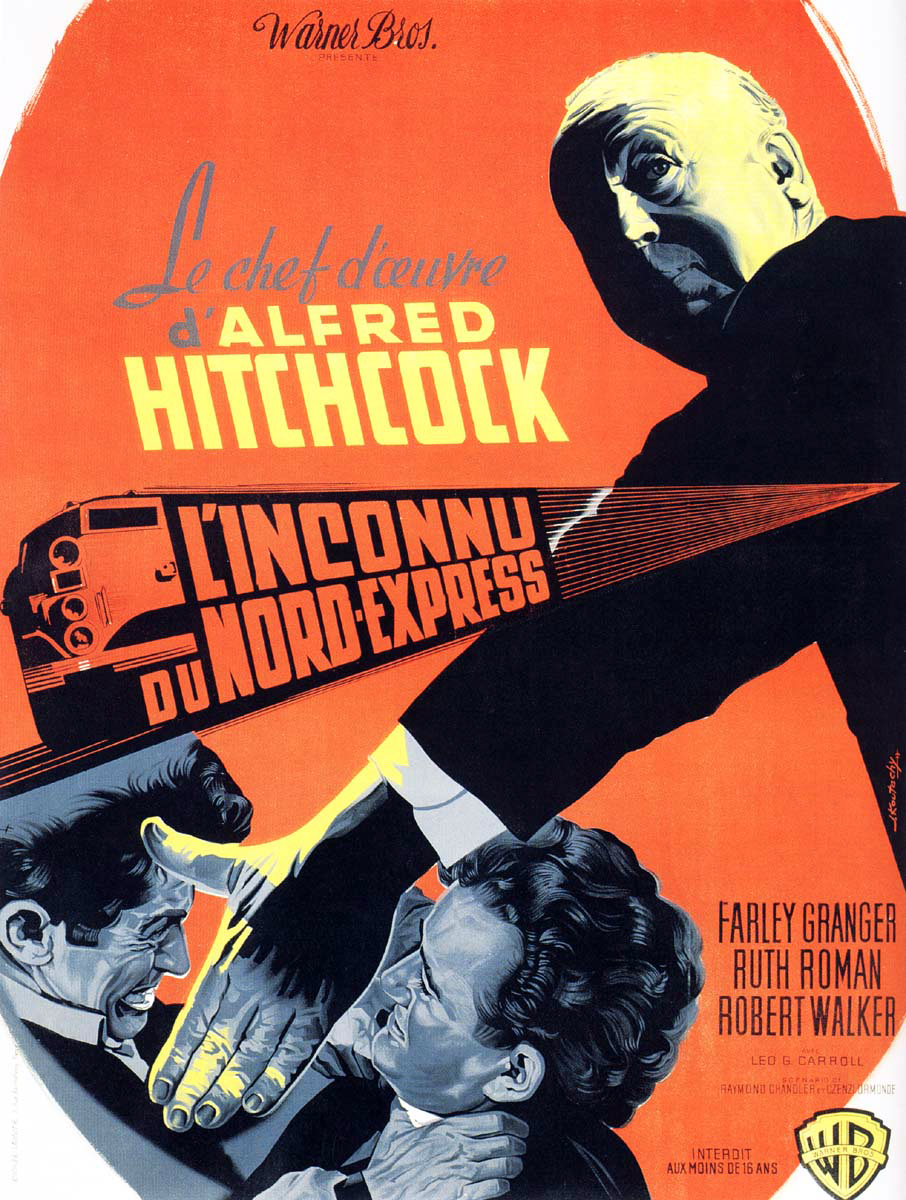
French poster (alt)
Strangers on a Train: Writing on a Classic | Collectors Guide, Pt 2: Home video and remakes
Related articles
This is part of a unique, in-depth series of 150-odd Hitchcock articles.