- Revisiting contemporary and modern critical appreciation
- Frederick Knott’s transatlantic hit play gets Alfred Hitchcock adaptation
- First of three classics with Oscar-winning blonde and future royal Grace Kelly
- Director meticulously planned its execution in 3D but few saw it that way
- Dual-projection system proved a real headache for theatre owners
- Dial “2” for 2D: after a few weeks it was shown flat for six decades
Note: this is part of an ongoing series of 150-odd Hitchcock articles; any dead links are to those not yet published. Subscribe to the email list to be notified when new ones appear.
Dial M for Murder: Writing on a Classic, Part 2 | Collectors Guide, Part 2: Home video and soundtrack

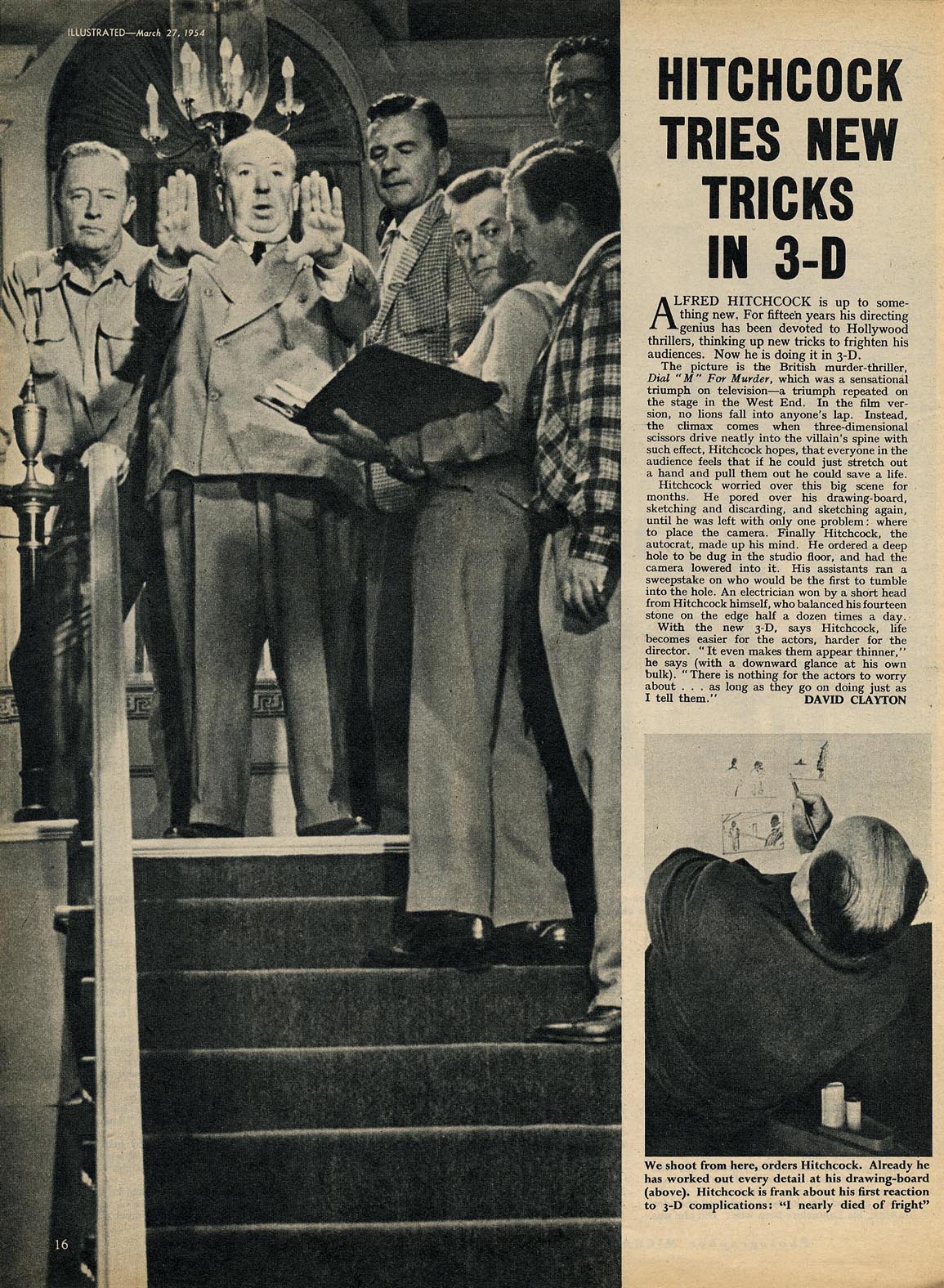
3-D Spells ‘Murder’ for Alfred Hitchcock
Hollywood.
Ever since the first three-dimensional picture hit Hollywood and the world—was it only short months ago?—the cry has gone up for a new approach to the bewildering medium. Away with the phony excitement, out with the flying daggers, down with second-rate theatricalism; on with the accomplished directors, bring on the real actors, set the writers to work.
Last month, then, at Warner Brothers studio, the first attempt to get the baby out of the playpen and make him scamper across the room on his own speed, was made when Alfred Hitchcock set about to direct his first 3-D picture. An expensive property—Dial ‘M’ for Murder, an international stage hit for which the studio had paid a parcel—was put at his disposal, and an Academy Award winner, Ray Milland, was assigned to star. Okay—the master was at work, and the world rubbed its hands together gleefully in anticipation of being scared to 3-D death.
Shock
First thing that happened, though, was that Hitchcock almost died of fright. “It was those early rushes,” he shudders even now. “They looked so odd—skimpy, unfinished—.” And Hitchcock, who received his first screen credit thirty years ago as an art director, started to sketch one of the first scenes on an old envelope.
“See here—” he explained,— “these spaces on the sides—do you notice how empty they are—how bare? Well—it took me days to discover just what was wrong.” He continues to sketch. “Look at this—this is the flat picture—the way I used to prepare a scene. If I had three people in a scene, one up front, one slightly back, and one seated in a chair in the back of the frame, in the finished shot they’d all be up front anyway. You got no illusion of depth. Now, of course, with this 3-D thing, you have to watch out for that or you get what I got at first—lots of waste space on the sides, on the top, all around.”
New Start
After Hitchcock’s first shock of discovery, the early rushes were destroyed and he started all over again. “Tremendous new problems with this medium,” he convinced me. “And most of them in the hands of the director. Don’t let any of these actors tell you it’s difficult—different. It isn’t—not for them. In fact, 3-D even makes them look thinner!”
The studio has provided him with a brand new and improved kind of three-dimensional camera for which he has great respect, but, no sense of esthetic appreciation. “It’s a big. gross, hulking monster,” he says. “It’s heavy and immobile and frightening. Why—for one of my best scenes—where one of the leading players falls on a pair of scissors and kills himself—I couldn’t even get this—this—thing under the scissors to create the illusion of the audience falling on those scissors itself. But we licked it. We built a big hole right under the stage and submerged the camera—so even though there will be no rocks thrown out of the screen I don’t think anybody will go home disappointed.”
To Hitchcock, who once shot a whole picture in a small boat (Lifeboat), and another in one continuous flow of action (Rope) to everyone’s dismay and dire predictions of disaster, the hole in the stage proved the perfect solution. But to the crew, responsible for building the pit, no such fond regard for the big idea was held. With cables, people, sound equipment and deck chairs already littering the stage, the hole in the middle added nothing but a fourth dimension to their misery. One carpenter, who tripped and fell into the pit the first day, was brought up muttering, “It had to be someone—I knew it would be me—.”
In the Act
As he has in all his previous pictures, Hitchcock plans to make a brief appearance in this latest one, but such a quick glimpse that the flow of suspense will not be disrupted. This time the director will try to lose himself in a graduation picture which will take only a moment on the screen and will defy anyone’s efforts at identification.
Review audiences are not the only ones he shakes his head over. The American audience, as a whole, he feels is a frustrating influence over any approach to suspense. “Everything must be so logical,’ he complains. “All the ends must be neatly tied up, every move must be explained—why, it’s almost impossible to sustain suspense under these conditions. All the fine old ones—The Lady Vanishes, The 39 Steps—they’d never be accepted today. They dealt with fantasy, with the imagination—your audiences will not take that now. Do you realize that the old lady in Lady Vanishes was chased up and down Europe by everyone in the picture and nobody thought to ask why? What was her secret—what was she hiding? Of course it was fantastic—but wasn’t it fun? Today, the picture wouldn’t be allowed to run for five minutes without the questions being asked, the search for logic breaking in—. A pity.” – Barbara Berch Jamison, New York Times
Dial Ham for Murder – Life

Cummings, Kelly, and Williams tangle with a sinister tennis player
Dial ‘M’ for Murder is Alfred Hitchcock’s filming of Frederick Knott’s stage play about ghastly errors that can crop up in the planning of a “perfect murder.” Writing his own script, Knott has kept the drama to something of a stage piece, but Hitchcock can work indoors as well as out, and the results are ingenious and gruesome. Grace Kelly, the fast-rising young beauty from the Philadelphia Main Line, plays the London wife of a former tennis star (Ray Milland). He suavely conceals his outrage at her affair with an American writer (Robert Cummings); it should be added that the tennis player is the beneficiary of his wife’s substantial will. When he runs across an old college chum (Anthony Dawson), who is vulnerable on a number of criminal counts, the tennis player blackmails him into agreeing to murder Miss Kelly. This is to be done by strangulation, when she answers a certain telephone call.
Through circumstances it would be ungracious to reveal, it is the would-be assassin who is killed, in the course of Miss Kelly’s self-defense. The jury will not believe her pleas that he was the attacker, her husband keeps mum, and she is condemned to be hanged. At this point the real skills of the Scotland Yard chief inspector begin to be evident. The performance of this role by John Williams is—in Hollywood as it was on Broadway—a masterpiece of arch British gentlemanliness, of the lifted eyebrow that can vault the direst of pitfalls. The film is in WarnerColor, which is all to Miss Kelly’s blond advantage, and in 3-D, which would seem to have been needless save for one singularly Hitchcockian horror. Summing Up: Criminology, neatly and handsomely negotiated. – Newsweek
The Kellys’ Cool Film Beauty – Newsweek | cover, p. 17/50

Familiar names. with Hitchcock reputation for mellers [melodramas] help this film version of the legit hit rate attention.
The melodramatics in Frederick Knott’s legit hit, Dial M for Murder, have been transferred to the screen virtually intact, but they are not as impressive on film as they are behind the footlights. However, Alfred Hitchcock’s reputation for screen suspense and the familiar name of Ray Milland as the chief exponent of suave evil sharpen the possibilities for the Warner Bros. release. Picture was filmed in 3-D and WarnerColor. The tints are good, adding to production values, but the depth treatment is a distraction that contributes little to the meller mood. It can be shown in regular widescreen 2-D, perhaps the more acceptable projection method for the majority of its playdate prospects. Knott adapted and scripted his play for the Hitchcock film presentation, but neglected, as did the director, to take full advantage of the screen’s expansive powers. As a result, Dial M remains more of a filmed play than a motion picture, unfortunately, revealed as a conversation piece about murder which talks up much more suspense than it actually delivers. The camera’s probing eye also discloses that there’s very little, that’s new in the Knott plotting or in the situations which he uses to play it off over a rather long 105 minutes.
Co-starring with Milland are Grace Kelly, his wife and the intended murder victim; and Robert Cummings, her lover, who has a rather fruitless part in the resolution of the melodramatics. They make up a very able trio, and within the limitations imposed by the screenplay turn in excellent performances. Hitchcock’s direction makes good use of Robert Burks’ mobile cameras to suggest movement and action through varying lensing angles. The scene rarely shifts from the Milland-Kelly London apartment, and it is within the confines of its walls that the principals talk out the story action. Milland plots his wife’s death, figuring on using Anthony Dawson for the actual killing while he has an alibi established elsewhere. The scheme goes awry. Miss Kelly kills Dawson, whom she believes to be a housebreaker, and Milland twists facts to make it appear she committed murder to stop blackmail. Just as it seems he will get away with his new plot, John Williams, playing the inspector, tricks Milland into giving away the entire scheme, thus saving Miss Kelly from a hanging to which she had already been sentenced.
There are a number of basic weaknesses in the setup that keep the picture from being a good suspense show for any but the most gullible. Via the performances and several suspense tricks expected of Hitchcock, the weaknesses are glossed over to some extent, but not enough to rate the film a cinch winner. Dawson and Williams, both from the legit cast of the play, repeat their characters here. Dawson registers much the best on the screen, having fewer of the stagey posturings that Williams displays. As noted, Burks’ color photography is good, especially when seen flat (as was the latter part of the picture at the [4.27.54] preview when the 3-D went bad). An unobtrusive background score by Dimitri Tiomkin supports the melodrama. – Brog, Variety

German 1960 re-release poster by Rolf Goetze
Dial M for Murder: Writing on a Classic, Part 2 | Collectors Guide, Part 2: Home video and soundtrack
Related articles
This is part of a unique, in-depth series of 150-odd Hitchcock articles.