- One of the most reissued films ever made, both theatrically and on home video
- But its original, Oscar-nominated sound design hasn’t been heard since the 1970s
- Audio that helped make it eighth highest-grossing film ever is now judged inadequate
- Owners Paramount have a long track record of revising their classics for modern audiences
- Ungodly metamorphosis: four different transfers and six soundtracks forced on the biblical epic
- Clearing up confusion: soundtrack albums much-misunderstood and misattributed over the years
The Ten Commandments: Writing on a Classic | Making of a Masterpiece | Collectors Guide, Pt 2: Soundtrack
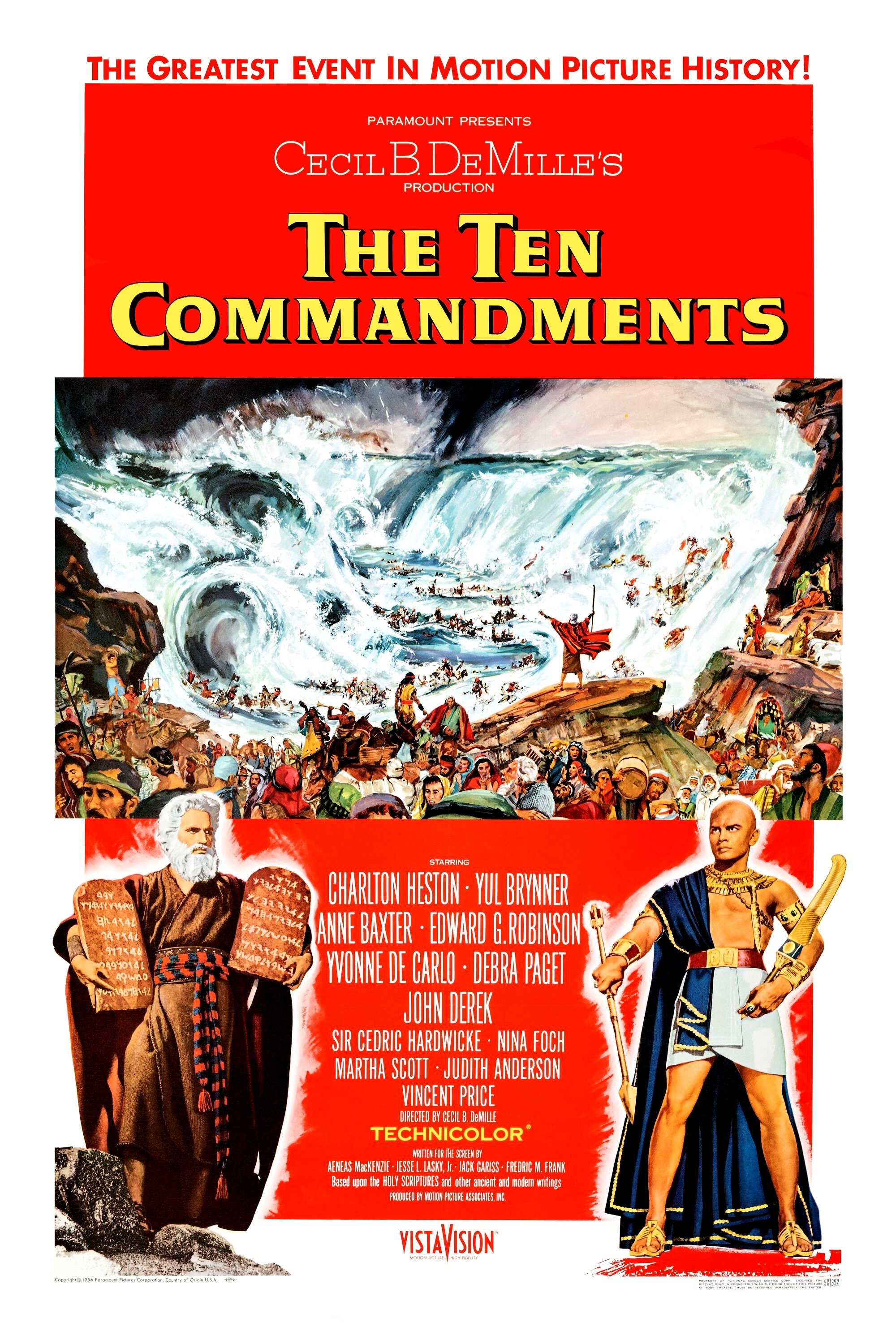
US one sheet poster
Contents
Production
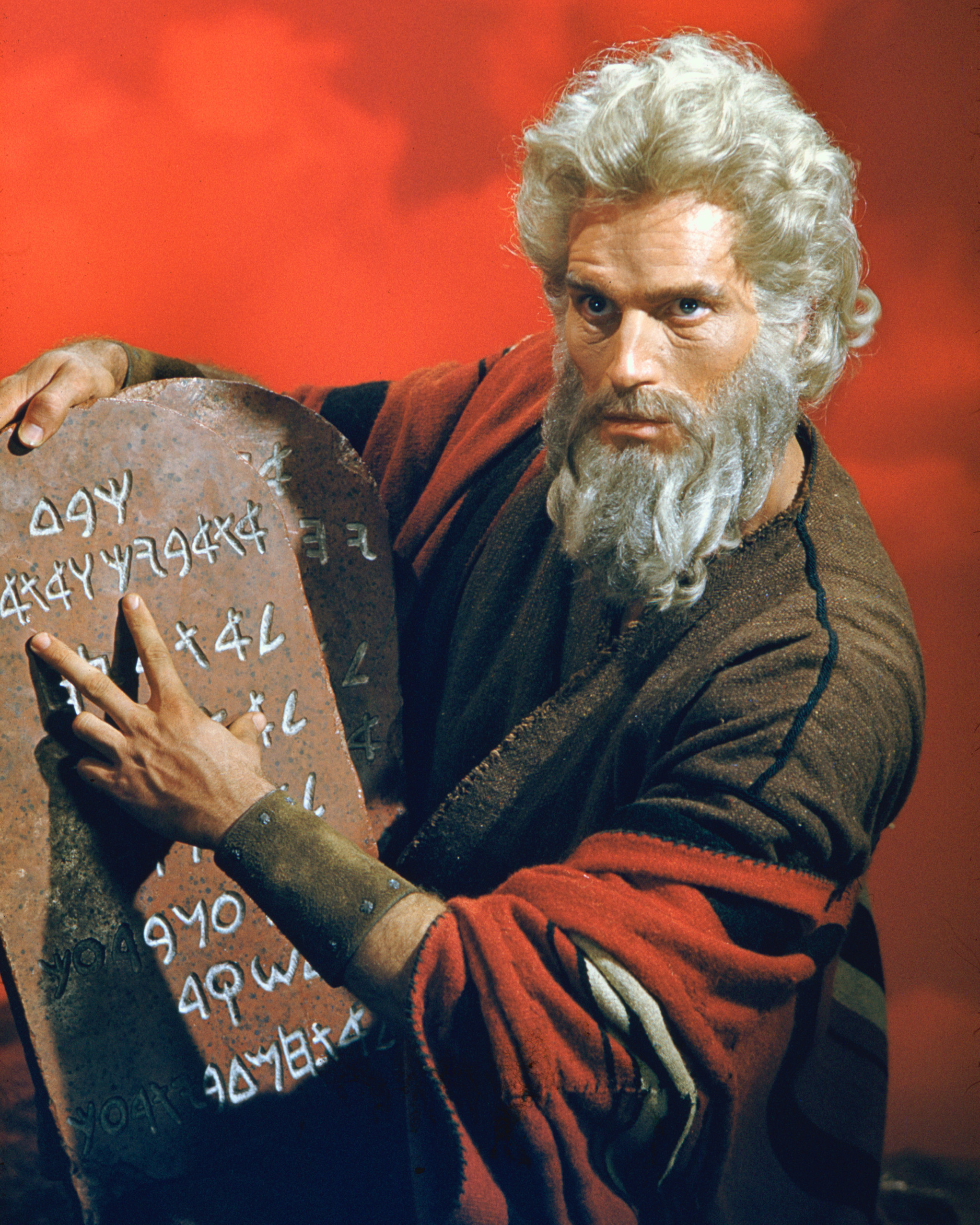
Heston as Moses
Cecil B. DeMille’s most spectacular spectacular—and his last one—is the epic retelling of the Biblical story of Moses. A glittering all-star extravaganza that was nominated for seven Academy Awards including Best Picture of the Year, it remains a permanent legacy of the master filmmaker at his peak. It follows Moses’ life from birth and abandonment in the Nile bulrushes through manhood, slavery and his trials in leading his people out of Egypt, his confrontation with God in the burning bush, the devastating plagues he brings down on the Pharaoh and his subjects, the unforgettable exodus sequence, the awesome parting of the Red Sea—one of the screen’s most celebrated special effects achievements, the orgy of the Golden Calf, the writing of the Commandments in the stone of Sinai, the forty-year search for the promised land, and the deliverance of the Israelites.
The vast DeMille canvas is peopled with, literally, a cast of thousands, headed by Charlton Heston in his larger-than-life portrayal of Moses; Yul Brynner as Rameses, the mighty Pharaoh; Anne Baxter as the seductive, strong-willed Queen Nefretiri; Edward G. Robinson as the treacherous Dathan, overseer of the slaves: Yvonne De Carlo as Moses’ wife, Sephora; John Carradine as his brother Aaron; John Derek (long before Bo came along) as his protégé, Joshua; Debra Paget as Joshua’s love, Lilia; and Vincent Price as Baka, builder of the Pharaoh’s treasure city.
DeMille’s first screen version of The Ten Commandments in 1923 set box-office records playing for two years in New York alone. That one cost $1.4 million to make. The extraordinary Red Sea episode in DeMille’s fabulous remake alone cost nearly as much and took three years to execute. The special effects wizardry involved in this sequence—2,300 technicians, artisans and special effects experts were assembled by DeMille for the movie—was one of the factors that helped earn an Oscar in this department for The Ten Commandments. – US Paramount CED (1981, 219:00)
Audio mixes
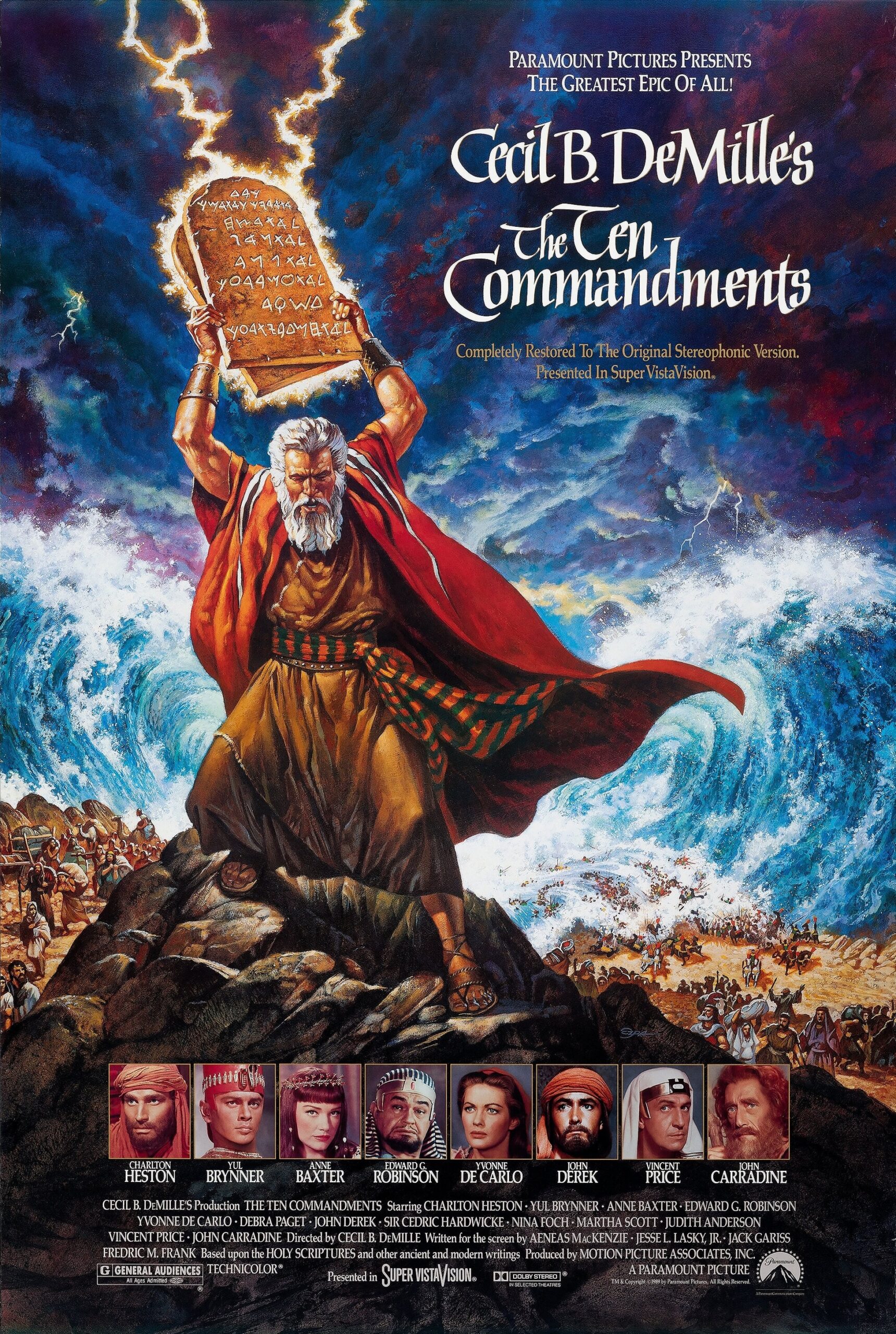
US 1989 re-release one sheet poster; textless
In 1923, Cecil B. DeMille enthralled moviegoers with his silent screen classic, The Ten Commandments. Thirty-three years later, DeMille remade this epic in one of the greatest film achievements of all time. With its all-star cast, lavish sets and breathtaking VistaVision format, DeMille’s 1956 version of The Ten Commandments was the grandest spectacle that had ever been presented on the big screen, the crowning triumph of the famed producer’s legendary career. Presenting the 35th Anniversary Collector’s Edition of Cecil B. DeMille’s 1956 version of The Ten Commandments, restored to its original widescreen format and enhanced in spectacular Dolby Surround stereo. – 1992 VHS sets
Impressively mounted but with a hefty dash of near-school nativity naïveté, Cecil B. DeMille’s biblical epic trails Gone With the Wind as the second-oldest top 10-grosser ever. Bible-based films such as this were immensely popular during the silent and early sound eras but DeMille, already one of the genre’s most successful proponents, ushered in a renaissance with the December 1949 release of Samson and Delilah, which went on to become 1950’s biggest smash. Naturally, most of the new wave were in colour and all but three of the big-budget, widescreen American epics were primarily presented in three, four or six-track stereo, while the numerous European productions were often in black and white, and all were mono.
The mono American exceptions are Day of Triumph (1954), The Story of Ruth (1960), and The Ten Commandments which was originally produced in VistaVision with a 1.85:1 theatrical aspect ratio. Following a 1960 re-release, further outings in 1966, 1972 and 1989 were on 35mm and 70mm prints which cropped the top and bottom of the image to a narrower 2.39:1 and 2.20:1 respectively. The latter re-release was successful but, like similarly butchered revivals of Gone with the Wind, rightly drew criticism from more discerning moviegoers. At the same time, the soundtrack was also comprehensively remixed for surround playback but Paramount’s revisionism of their flagship feature’s audio began well before that.
The original mono audio, which earned an Academy Award nomination for Best Sound Recording and made it one of the most successful films ever, has been suppressed since the end of the 1970s. At best, it was last heard on the initial wave of edited VHS, Betamax and LaserDisc releases from 1980–1986. All have a tube TV-filling, 1.33:1 aspect ratio and either English mono or 2.0 “Hi-Fi Stereo” soundtracks; the latter has “panned dialogue, music rechannelled for fake stereo, and sounds terrible.” Though most have the mono, it’s most likely a fold-down of the stereo track – unless someone who owns both permutations weighs in to say otherwise.
↑2011 Blu-ray trailer | TCM, fan | clips | Leonard Maltin
When it was subsequently remixed to six-track stereo for the 1989 theatrical re-release, publicity trumpeted the lie, “Completely restored to the original stereophonic version.” Which never existed. Nor did it with any VistaVision production, as they were all natively mono, but that hasn’t stopped Paramount creating a Frankensteinian hybrid as they have with the previous year’s VistaVision-lensed To Catch a Thief. The same fate also befell Alfred Hitchcock’s Vertigo (Universal) and North by Northwest (Warner Bros.), among too many others. The six-track mix was also folded down to 2.0 Dolby Surround stereo, appearing on the first widescreen videos: a US VHS and Beta/max set in 1988, followed by “35th Anniversary” VHS and LaserDisc sets in 1992.
It was then reconfigured to 5.1 surround for the 1998 US LaserDisc and that’s the default audio on every release to the present day including all 5″ discs, DCP, TV and streaming. Its 2.0 variant is now included as secondary audio on every North American DVD and the identical US, UK and Australian BDs. Revising the original soundtrack is fine but coming at the expense of its wholesale suppression is just adding insult to injury. However, every one of those who should know better, including so-called expert reviewers, has blithely accepted this state of affairs. Meanwhile, the unsuspecting general public are completely unaware of what’s being foisted upon them and are being deliberately misled. Summing up:
- 1956–1979: original mono
- 1980–1987: remixed 2.0 “Hi-Fi Stereo” and original mono or remix fold-down
- 1988–1997: remixed six-track and 2.0 Dolby Surround stereo
- 1998-present: remixed 5.1 surround and optional remixed 2.0 Dolby Surround stereo on disc
As is par for the course, the remixes feature replacement stereo music and effects but, as with War of the Worlds and its various remixed soundtracks, online discourse generally fails to take the variants into account, leading to endless confusion as to ‘the’ (singular) soundtrack’s exact provenance. Lastly, rumours persist of a few rare original stereo prints, for which the music was especially re-recorded in undocumented stereo soon after the original sessions; the only problem is that said recordings, prints and any attendant publicity materials or any other tangible proof, has all been “lost”… The same rumours have long swirled around similarly-produced The Big Country; take both with a large pillar of salt.
Home video
↑2021 4K trailer/upscaled
Early home video releases and most TV broadcasts omit some or all elements of the film: DeMille’s opening prologue, the overture, intermission, entr’acte and exit music; but since the introduction of DVD all are the complete roadshow version, running at 231:36. Following the 1998 photochemical restoration and its release on DVD, the film had a digital restoration in 2010, first released on BD the following year. The same base scan was then remastered a decade later for the latest UHD release. But through it all, not even minimal space has ever been allocated for the original mono English soundtrack alongside the omnipresent, multiple ersatz remixes. At least the film’s eight original mono dubs – French, German, Italian, Japanese, Mandarin, Portuguese, Spanish (Castilian and Latin) – have never been altered and appear on various physical releases as appropriate.
- US: 2-DVD/alt (2004) and 3-DVD (2006)
- Canada: 2-DVD (2004) and 3-DVD/alt (2006)
- UK: 2-DVD (2004) and 3-DVD (2006, reissued 2009)
- Italy: 2-DVD (2004) and 3-DVD (2006)
- Germany: 2-DVD (2004) and 3-DVD (2006)
- France: 2-DVD/alt (2004) and 3-DVD (2006)
- Spain: 2-DVD/alt (2004) and 3-DVD (2006, reissued 2008)
“As part of the restoration done in 2010, the film was scanned in 6K and those files were the basis for this brand new Dolby Vision version, which shows off the full beauty of the original VistaVision negative. The VistaVision format used special cameras to feed 35mm film into the camera horizontally in order to capture a wider image spread over two 35mm film frames, giving VistaVision twice the resolution of regular 35mm film. In addition, Paramount spent well over 150 hours doing new color work and clean-up on the scan. The move to Dolby Vision created the opportunity to further improve the look of the film: blacks are enhanced and improvements were made to smooth out special effects mattes to create the most vibrant and pristine image possible.”
- US: 2-BD/alt (2011, reissued 2012, 2021), 2-BD/2-DVD, 3-BD Digibook, 3-BD/3-DVD set/reissue/alt and 4-BD w/Ben-Hur (1959)
- Canada: 2-BD (2011, reissued 2017), 3-BD Digibook, 3-BD/3-DVD set and 4-BD w/Ben-Hur
- UK: 2-BD (2013) and 3-BD (2018)
- Italy: 2-BD (2012, Digipak 2013, steelbook 2021) and 2-BD/2-DVD Digipak
- Germany: 2-BD (2012, Digibook 2013)
- France: 2-BD and steelbook (2012, Digibook 2013), 3-BD Digibook and 4-BD w/Ben-Hur
- Spain: 2-BD (2012, Digipak 2013, reissued 2018, 2021, steelbook 2021)
They forgot to mention it now has added tealing. Nonetheless, it’s all well and good but typical for Paramount that they can manage three major image restorations within two decades but not a single one for the original soundtrack in seven. Utterly shameful. Nonetheless, here are all the main North American and European releases to date; at least all are in the perfectly acceptable ratio of 1.78:1 and are the full-length roadshow version (231:36), complete with entr’acte, intermission and exit music:
- Prime Video HD | YouTube
- US: UHD-BD/2-BD and UHD-BD/3-BD steelbook (2021)
- Canada: UHD-BD/2-BD and UHD-BD/3-BD steelbook (2021)
- UK: UHD-BD/2-BD and UHD-BD/3-BD steelbook (2021)
- Italy: UHD-BD/2-BD steelbook (2025)
- Germany: UHD-BD/2-BD and UHD-BD/2-BD steelbook (2021)
- France: UHD-BD/2-BD and UHD-BD/3-BD steelbook (2021)
- Spain: UHD-BD/2-BD and UHD-BD/3-BD steelbook (2025)
Screenshots: Caps-a-holic, DVD/BD/4K, BD/4K, BD/4K, BD/4K
Extras
The 1923 version was restored in 2002 and is included on all the 3-DVD and 3-BD sets, with a Wurlitzer organ score by Gaylord Carter that first appeared on the 1987 US VHS (info) and Betamax. Note its bonus hand-tinted footage is longer on the BDs; and all extras, including the original film, are in HD. While the initial 1999 DVDs only included three of the official trailers, increasing amounts of extras were added to subsequent Special, Collector’s and (3-disc) Anniversary Editions. Confusingly, all four permutations are still issued today; see DVDCompare for their exact distribution. Of those listed here, the 3-DVD and 3-BD sets contain both versions and all their extras bar the shorter 2006 documentary which is only on the 2-DVD sets. Made in standard definition, its interviews are partly repurposed for 2011’s much longer, otherwise HD doc. Just avoid the 1923’s Spanish BD-R and DVD-R from bootleggers Efrojim, and the 1956’s Chinese knock-off BD-R from Bit Wel.
- Audio commentaries for both versions by Katherine Orrison
- “The Making of The Ten Commandments” featurette (2006, 37:36) – DVD only
- The Ten Commandments: Making Miracles documentary (2011, 73:14) – BD and 6-disc LE DVD only
- New York première newsreel footage (2:23)
- 1956 “Making of” trailer (10:01) open matte
- “1966” trailer (0:55) – actually 1972; see below
- 1989 trailer (1:43) alt
- 1923 and 1956 film photo galleries – BD only
- The Ten Commandments (1923, 136:12) 2020 score
- Hand-tinted footage of Exodus and Parting of the Red Sea (14:58/21:05)
- Two-Color Technicolor segment (8:43) – BD only
- 12-page essay booklet – non-US SCE DVDs, and Digibook BDs
- Written in Stone: Making Cecil B. DeMille’s Epic The Ten Commandments (1999) – Katherine Orrison; 6-disc LE only
The 4K UHD-BDs have no extras, save for film historian Katherine Orrison’s commentary. Incidentally, her dedicated book and commentary are exhaustive accounts of the remake’s inception and reception but, as is typical in film studies, there’s no mention whatsoever of the re-releases or myriad permutations of its visuals, soundtrack and music – which prompted these articles in the first place.
This trailer is from the 1966 re-release, as evidenced by its repetition of the attendant publicity’s taglines: “Continuous performances! Popular prices!” Though reduced to black and white, it’s full-frame, briefly exposing the top edge of the soundstage at 0:28. The “1966” trailer available on all 5″ disc formats is actually for the 1972 re-release, and also foregrounds the commensurate publicity’s quote: “The parting of the Red Sea. The single most spectacular scene ever filmed.”
↑1966 re-release trailer | US pressbooks: 1960, 1966 | The Ten Commandments – Matt Page
The Ten Commandments: Writing on a Classic | Making of a Masterpiece | Collectors Guide, Pt 2: Soundtrack