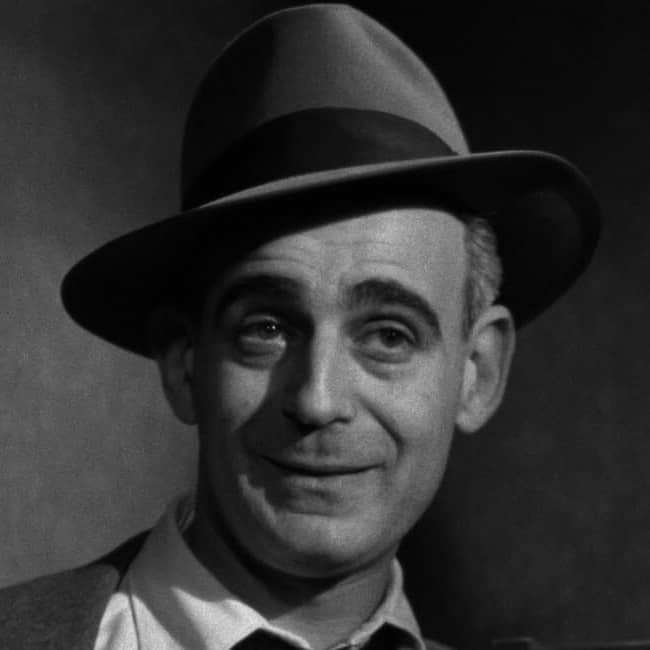
- The little film that could: B-movie that became a surprise blockbuster
- Based on a short story from writer of Rear Window – with a similar premise
- Shelved and forgotten about due to political prejudice before belated release
- Rapturous reception from critics and audiences alike resulted in major awards
The Window: Film Noir Terror Through the Eyes of a Child | Film Noir File: Cast and Crew, Part 2 | Collectors Guide
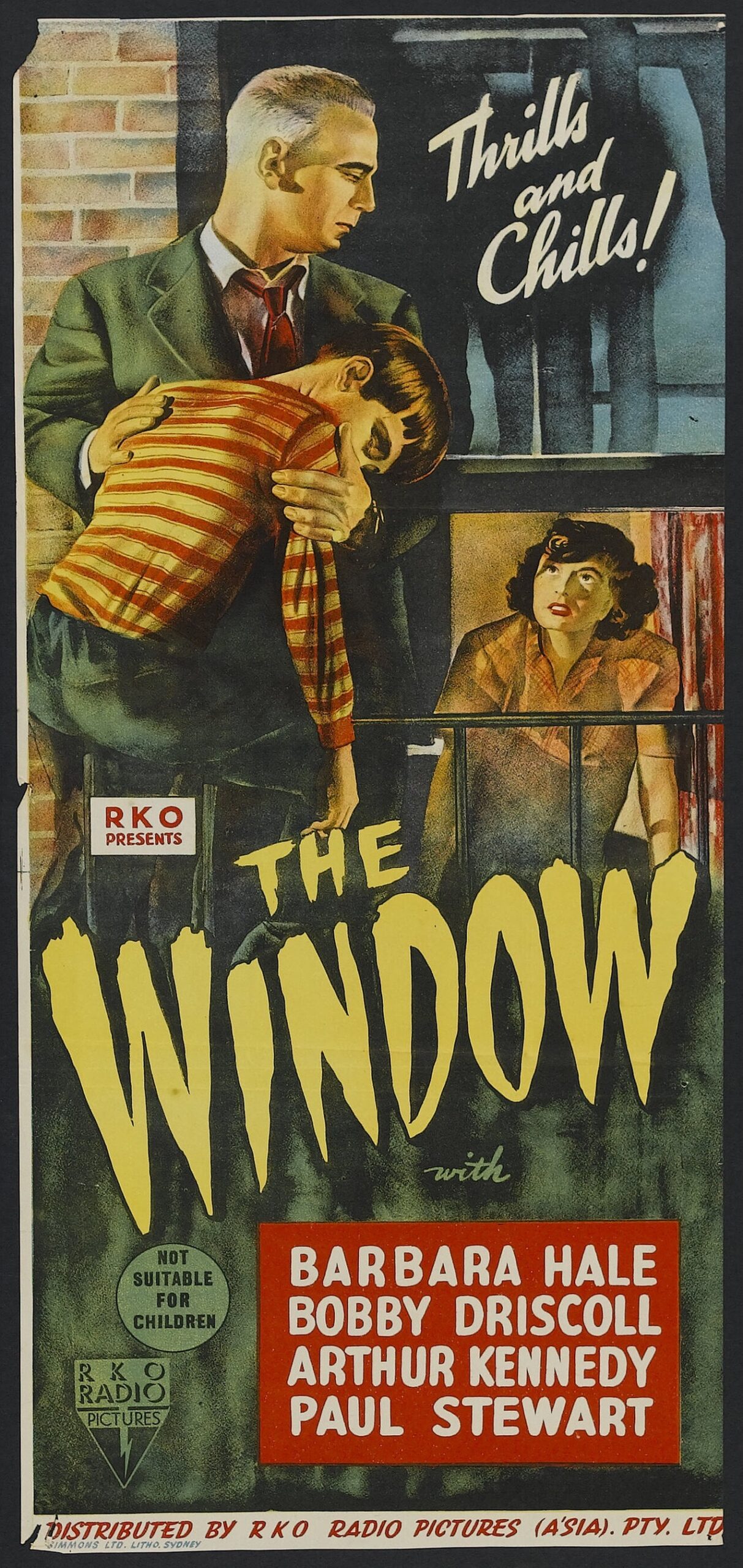
Australian daybill poster
Bobby Driscoll (Treasure Island, (1950) and Barbara Hale (Perry Mason) star in one of the very best RKO film noir crime thrillers ever made! Little Tommy Woodry (Driscoll) is a bright kid with a vivid imagination. He’s always telling tall tales. Then, one night, he witnesses a brutal murder committed by his seemingly normal neighbours, the Kellersons. When Tommy tells his parents, they think it’s just his over-active imagination. When he tells the police, they don’t believe him either. Only the Kellersons believe Tommy. And now they’re coming to get him. A masterpiece of suspense, packed with gripping plot twists, The Window was a big box office hit. The film won both the 1950 BAFTA Best Film Award and the Edgar Allan Poe Best Picture Award the same year, while Bobby Driscoll received a special Oscar as “the outstanding juvenile actor of 1949”.
“Making a child die in a picture… comes close to an abuse of cinematic power” – Hitchcock/Truffaut
Sometimes in Hollywood, everything comes together just right. Casablanca is a perfect example. Although it was an A movie (and not a B movie as many people believe) with a budget approaching a million dollars, no one expected it to be anything out of the ordinary. But everything came together just right. The Window is another example. Shot on a very modest budget of just $210,000, this was most definitely intended as a B movie. A filler. This was a film that RKO expected to – at best – make a very modest return. It had no big stars – and no big name director. And yet it became one of the Top 10 US Box Office hits of 1949 and RKO’s Number One film of the year. 1940s audiences were stunned by it – and they told their friends. There was no big promotional campaign. Word of mouth made it a must-see movie – and that’s the best kind of recommendation… By any standards, The Window was a huge hit – and yet RKO came very close to shelving it and never releasing it.
Unlike Casablanca, The Window has now largely been forgotten – except by diehard fans of film noir. If you’ve already watched the movie, you’ll know that it’s been unjustly forgotten. It stands the test of time extremely well, and is still capable of utterly enthralling a modem audience. High up in the perilous rafters of condemned tenements, the decades just fall away. Everything about The Window still works – and it works thanks to everything coming together just right. The film is based on a short story by Cornell Woolrich, “The Boy Cried Murder” (also known as “Fire-Escape” [when anthologised]). The story had first appeared in Mystery Book Magazine for March 1947. Basically, it’s Aesop’s The Boy Who Cried Wolf and the film even acknowledges it as such.
What makes the difference is that Woolrich was a deeply disturbed individual whose writing took urban paranoia to new and previously unexplored heights. Woolrich was a frightened man. He saw the modern city as full of danger. Neighbours were strangers, terrible things happened to good people and there were vicious traps everywhere. There are times when watching The Window when you are reminded of Jack Finney’s [1954 source novel for] Invasion of the Body Snatchers (1956). That theme of neighbours who want to kill you was earlier brought to vivid life in Richard Matheson’s hugely influential science fiction/horror novel I Am Legend (1954). Both works have been read simplistically as merely reflections of the ‘Reds Under the Beds ’ paranoia of the era. They’re something much more – as Woolrich and his scriptwriter amply demonstrate in The Window. They play on a raw terror of anyone who is not yourself. “Hell,” said Jean Paul Sartre, “is other people…”
Woolrich’s story was adapted for the screen by Mel Dinelli. Dinelli was a relative newcomer to the business. In fact, The Window was only his second script to go into production. However, his first had been RKO’s highly rated thriller The Spiral Staircase (1945), which he worked on with RKO producer Dore Schary, who thought him the natural choice for another story of terror and suspense. Schary had started his Hollywood career as a scriptwriter so – unlike many executives – he could appreciate good writing. His own writing credits were impressive and included both Big City (1937) and Broadway Melody of 1940. In 1939, he’d won an Oscar for his work on Spencer Tracy’s Boys Town (1938) and had been Oscar nominated again for Edison, The Man (1940). You weren’t going to slip a sub-par script past this man. Schary had only started as a producer in the early 1940s, but his credits already included Bataan (1943) and Lassie Come Home (1943).
Schary was effectively in charge of the production for RKO and you can just glimpse a credit for him at the beginning of the movie. General producer’s duties fell to Frederic Ullman Jr, whose last picture this was and who received the official producer’s credit. Ullman Jr’s career had been largely spent producing short films and documentaries (for which he’d been nominated for three Oscars). No doubt, Schary wanted Ullman Jr to help bring some of that documentary feel to The Window. Dore Schary fought long and hard during pre-production to make full use of a New York location and real-life New York tenement buildings. He understood that a conventional studio approach could very easily ruin the film.
The voice of direction for The Window is fascinating. Ted Tetzlaff was known around Hollywood as one of its very best cinematographers, not as a director. This would be only his fourth film as director (and the others hadn’t exactly set the world alight). He had recently completed work on Alfred Hitchcock’s Notorious (1946), where he served as Hitch’s Director of Photography, and he had evidently learned a thing or two about creating onscreen suspense straight from the master. A thing or two he was now eager to put into practice in The Window. Although by all accounts he and Hitchcock got along really well on the set of Notorious; the experience seemed to spark a competitive streak in Tetzlaff and you can see in his direction of The Window an attempt to out-Hitchcock Hitchcock. (The ever playful Hitchcock would later directly answer Tetzlaff’s challenge with Rear Window (1954), another film based on a work by Cornell Woolrich and containing many of the same themes).
Just as Head Producer Dore Schary understood scriptwriting, so Ted Tetzlaff understood cinematography and was therefore able to get the very best from his two cinematographers, Robert de Grasse and William Steiner. Because union rules forbade the use of a Hollywood cinematographer to be used on a production where more than two thirds of the film was to be shot in New York, RKO brought in William Steiner as Director of Photography for a New York Shoot. Robert de Grasse handled the shooting in Los Angeles. Robert de Grasse’s credits included the horror classic The Leopard Man (1943), Tall In The Saddle (1944) and a film in RKO’s highly popular Falcon series, A Date With The Falcon (1942), In 1939, he had been nominated for the Best Cinematography Oscar for his work on Vivacious Lady (1938) starring Ginger Rogers and James Stewart. William Steiner had a strong background in short films and especially documentaries – just what Dore Schary would have been looking for to capture the realities of New York tenement life.

Uncredited, Anthony Ross and Bobby Driscoll
The casting is interesting in that it mostly avoids star faces, helping to add to the realism and the semi-documentary feel of the film. As Tommy’s father, Arthur Kennedy was a well known and much admired character actor but not a leading man. The same is true of Barbara Hale, playing Tommy’s mother. There has been much debate about the way the parents are written and portrayed in The Window – and it raises issues that need answering – or in some cases rebutting. Some commentators have called The Woodrys ‘monsters’ – but this is manifestly unfair. They are shown as good people, struggling with money and family worries while bringing up a son in a rough and poor part of town. The father works a night job – something not usually known for being well paid. The mother is desperately worried about a relative’s health. In one sequence, they are shown as being fearful of losing their home thanks to Tommy’s lies. However, they do not beat him or try to break him with threats of violence.
Corporal punishment would almost have been the norm at the time. Tommy could have been spanked or ‘paddled’ or ‘strapped’ for the trouble he causes without troubling the cinema audience – but he’s not. Instead, the Woodrys try to reason with him, telling him that they want to be able to believe him and to be proud of him. They try to instil good manners in him (most memorably in the sequence where Tommy is forced to apologise to his murderous neighbours). It’s evident they love him and do their best for him even as they struggle with their daily lives. The film would have been very different were this not the case and there could have been no happy ending if Tommy had been merely returned to indifferent or hateful parents. It’s guesswork, but one suspects that Paul Stewart and Ruth Roman were cast as the murderous Kellersons because they looked like villains. Roman is every inch the low-rent femme fatale while Stewart has those incredibly cold dark eyes. Stewart’s looks were to blight his career, and he found himself constantly cast as a villain while he dreamed of being the hero.
The real triumph of casting though was Bobby Driscoll as Tommy. Around Hollywood, Bobby was being referred to as ‘The Wonder Child’ and was on a long term contract with Disney. Disney had a good working relationship with RKO and were happy to loan him out to the studio for the project. Audiences knew Bobby from such films as Song of the South (1946) and to see a Disney icon in such peril would have been bewildering and extra chilling to a contemporary audience. The casting was a big gamble. Bobby, who was around 11 at the time, could have delivered a jarring Disney-style performance. He could have been far too saccharine – but he wasn’t. Instead, whether by direction or by his own talent, his performance is spot on. And when Bobby Driscoll knocks the ball out of the park with his interpretation of the role, everything is finally complete. Everything comes together just right.
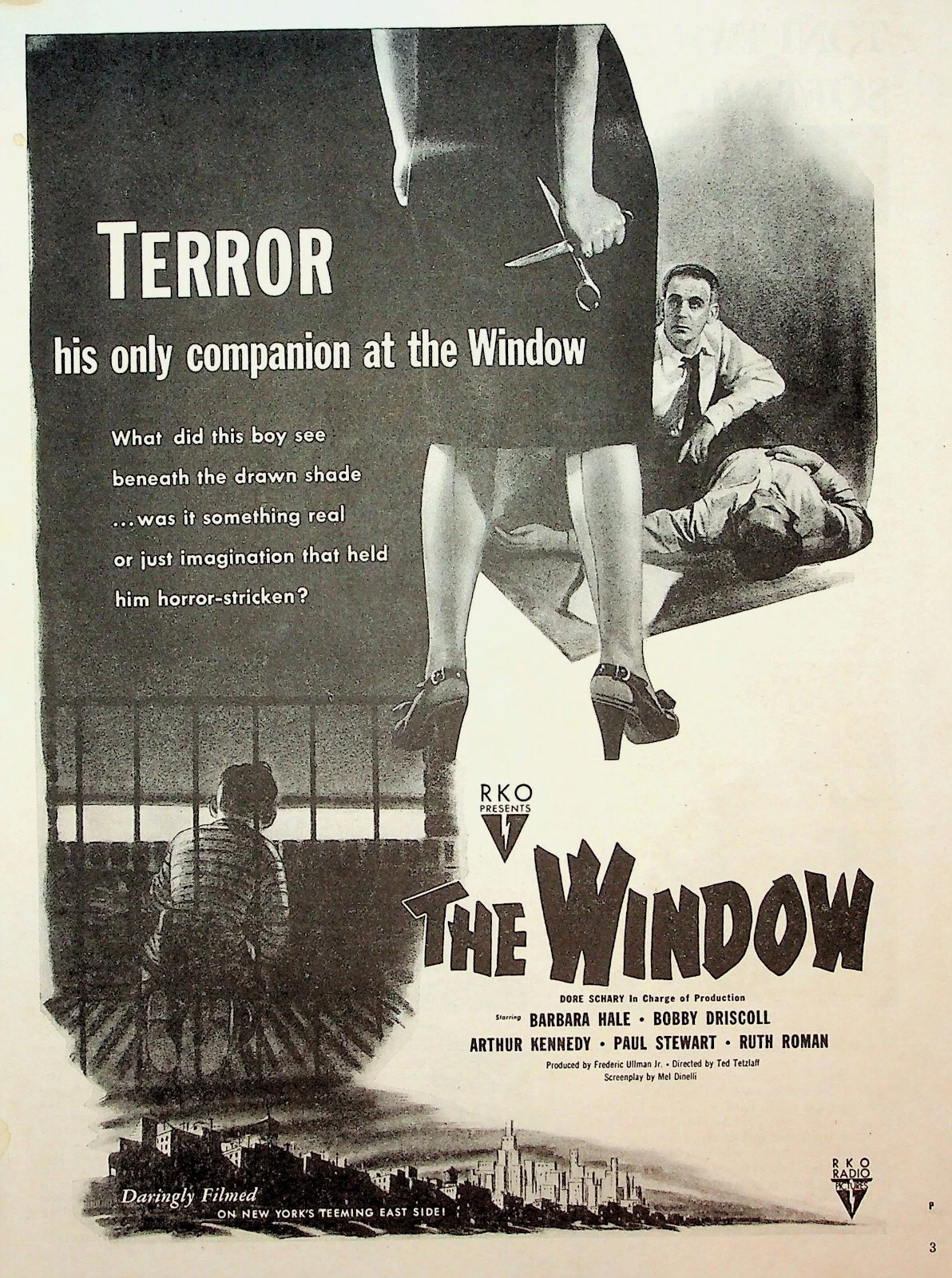
Life magazine ad
There was a little chatter about The Window before it went into production. On 28th October 1947, Hedda Hopper reported in her Looking at Hollywood column in the Chicago Tribune:
“Hollywood, Oct 27—Arthur Kennedy—and not Bill Williams—will play opposite Barbara Hale in The Window. Paul Stewart plays the heavy. Mel Dinelli did the screen play, which is taken from the story, “The Boy Who Cried Murder.” Director Ted Tetzlaff and Producer Fred Ullman Jr are already in New York, where the entire picture will be made. The film will be given a documentary treatment and 90 per cent of it will be shot on the streets of the big city…”
Shooting began in late 1947 under the working title The Boy Cried Murder [sic.]. In large, the film was made at RKO-Pathe’s new studios in East Harlem, in New York City between 12th November and December 1947, and in abandoned tenement buildings on 105th and 116th Street on the Lower East Side. Production returned to RKO’s studios in Los Angeles early the next year to shoot interiors. And then it was shelved. In the spring of 1948, RKO Studios was purchased by Howard Hughes. Virtually the first thing he did at RKO was to fire Dore Schary because of his liberal leanings and his defence of fellow Hollywood directors and staff against HUAC. Hughes declared that Schary’s latest project The Window was “worthless garbage”, said he hated Bobby Driscoll’s performance in it and ordered it to be shelved.
And there it sat until 1949. The Window finally got released only when a floundering RKO found itself short of forthcoming releases and someone was brave enough to persuade Hughes to let it go. The Window premiered in Los Angeles on 17th May 1949 and in New York City on 6th August 1949. The New York Times said:
“The striking force and terrifying impact of this RKO melodrama is chiefly due to Bobby’s brilliant acting or the whole effect would have been lost were there any suspicion of doubt about the credibility of this pivotal character… The Window is Bobby Driscoll’s picture, make no mistake about it…”
No one was more surprised that Howard Hughes when the film proved a blockbuster hit. Despite its commercial success, The Window received only one Oscar nomination and that was for editing (Frederic Knudtson). However, little Bobby Driscoll was awarded a special Oscar for being ‘The Outstanding Juvenile Actor of 1949’. It did win the Edgar Allen Poe Award for Best Motion Picture. Writer Mel Dinelli found himself nominated for Best Written American Drama by the Writers Guild of America, while in Britain it was nominated for the 1950 BAFTA Award for Best Film From Any Source. One foreign territory was more hostile to the film though. The violence was considered so shocking that it was actually banned in Finland in 1966. Cornell’s original short story was remade in Britain as The Boy Cried Murder. The Window was remade again in 1984 as Cloak & Dagger. – UK Odeon DVD (2012)
The Window: Film Noir Terror Through the Eyes of a Child | Film Noir File: Cast and Crew, Part 2 | Collectors Guide
Related articles
- Alfred Hitchcock Collectors Guide: Rear Window
- François Truffaut Collectors Guide: The Bride Wore Black