- Master of Suspense takes his macabre brand of humour to sunny New England
- Shirley MacLaine’s film début; she later graced another Hitchcockian howdunit
- Incognito: Philip Truex as titular star is completely uncredited in his final outing
- Hitchcock/Herrmann: first in famed musical collaboration with composer Bernard
- In just 10 years they created some of the finest music and imagery in cinema history
- Original soundtrack sadly unreleased but three fine British recordings compensate
- Provided inspiration for recent original British black comedy in suburban setting
Note: this is part of an ongoing series of 150-odd Hitchcock articles; any dead links are to those not yet published. Subscribe to the email list to be notified when new ones appear.
Writing on a Classic: The Trouble with Harry
US one sheet poster
Contents
Production
TCM, Sharon Stone | trailers: German, fan
In the New England woods, guilt [at Harry’s death] gives cause to several people finding and burying the same body. Was it Captain Albert Wiles (Edmund Gwenn) whilst rabbit hunting, was it the victim’s estranged wife or was it simply an “Act of God”? Alfred Hitchcock’s masterful black comedy is notable not only for its wickedly funny screenplay; but also because it marks Shirley MacLaine’s screen debut for which she won an Academy Award. The autumnal backgrounds, stunningly photographed by Robert Burks, provide the perfect backdrop for this macabre comedy. – Australian CIC VHS (198-)
- The Universal Hitchcock, The Trouble with Harry, The Absurd in Hitchcock and Dark and Droll Humour – Ken Mogg
- Renegotiating Romanticism and the All-American Boy Child – Adrian Schober, Children in the Films of Hitchcock (2014)
Though something of a lighthearted anomaly in the director’s oeuvre, with The New Yorker cartoonist Saul Steinberg’s opening credits drawings setting the scene, this lands right in the middle of Hitch’s 1950s purple patch. As with Rebecca, the film’s titular star, played in this case by Philip Truex in his last onscreen appearance, is completely uncredited. It’s also the second Hitchcock in which the title character dies in the first scene, following The Farmer’s Wife. Cited by the director as the favourite of his own films and scores, he even instructed his long-time comedy writer James B. Allardyce to replicate its idiosyncratic, understated humour for his wraparound segments in Alfred Hitchcock Presents.
Harry was based on Jack Trevor Story’s eponymous 1949 novel but Hitch was typically more generous with his praise than the contents of his wallet. He bought its film rights anonymously through an intermediary, MCA agent Herman Citron, for only £11,000 (circa137,500 in 2026), then sold them on to Paramount for $78,000. Despite the film’s immediate and perennial success, the aggrieved author claimed he only ever received $500 from his own agent and reportedly never saw another cent. It was adapted by radio, film and TV scriptwriter John Michael Hayes, and was his second of four successive films with the director. It was joined by Rear Window, To Catch a Thief and The Man Who Knew Too Much; all are covered extensively in Steven DeRosa’s excellent book.
- Writing with H: The Collaboration of AH and John Michael Hayes (2011, shorter original 2001) – Steven DeRosa | book site
Full interview | Shirley MacLaine, 2013/2016
- The Trouble with Harry – Joe Valdez
- The Trouble with Harry – Paul Tatara
- A Domestic Trilogy – Robert K. Lightning
- Hitchcock’s Lost Masterpiece – Peter Bradshaw
- Close-Up on The Trouble with Harry – Jeremy Carr
The film stars Edmund Gwenn in his final Hitchcock, following The Skin Game, Waltzes from Vienna, Foreign Correspondent and the Hitch-involved Forever and a Day; though he would go on to star in “Father and Son”, the S2:E36 installment of Alfred Hitchcock Presents. Second-billed is John Forsyth, who later appeared in Topaz and in between featured in two especially acclaimed episodes of Presents: “Premonition” and “I Saw the Whole Thing”. Joining them is a 20-year-old Shirley MacLaine who netted the Golden Globe Award for Most Promising Newcomer: Female but is sadly closing out a stellar career by really going off the deep end in recent years, possibly the consequence of one too many facelifts or her wig being on too tight. On a brighter note, 10 years after Harry, she starred in the highly entertaining, Hitchcockian comedy-heist thriller Gambit.
- The filming of Harry – Robert Kiener
- Hitchcock came to Barre? – Paul Heller
- The Trouble with Vermont – Nathalie Morris
- 2003 Vermont Location Trip – Nándor Bokor
Hitch went straight into production on Harry once To Catch a Thief had wrapped, as he was keen to film Vermont’s famed sunny, colourful autumnal vistas but instead was often thwarted by very unseasonal torrential rain. Hitch and his cast returned to the filming location of Barre, Vermont for the film’s flood relief benefit première at the extant Paramount Theater on Friday September 30, 1955, after which it enjoyed a ‘soft’ arthouse rollout. Screenings were reportedly preceded by the Hitch-directed “Vermont the Beautiful”, a long-unseen three-minute promo extolling the state’s touristic virtues, which served as a companion piece to his feature in Vermont Life magazine. Does anyone know of the former’s whereabouts?
Boxoffice, Christian Science Monitor, Independent Film Journal, Motion Picture Exhibitor/photos, Motion Picture Herald
More recently, Harry has been adapted as a 2024 stage play by Noel Butcher Hanley and Josh Hitchens for a so-far, one-off Philadelphia run; note it’s not to be confused for the unrelated eponymous, frequently-performed 2014 play by Lachlan Philpott.
Home video
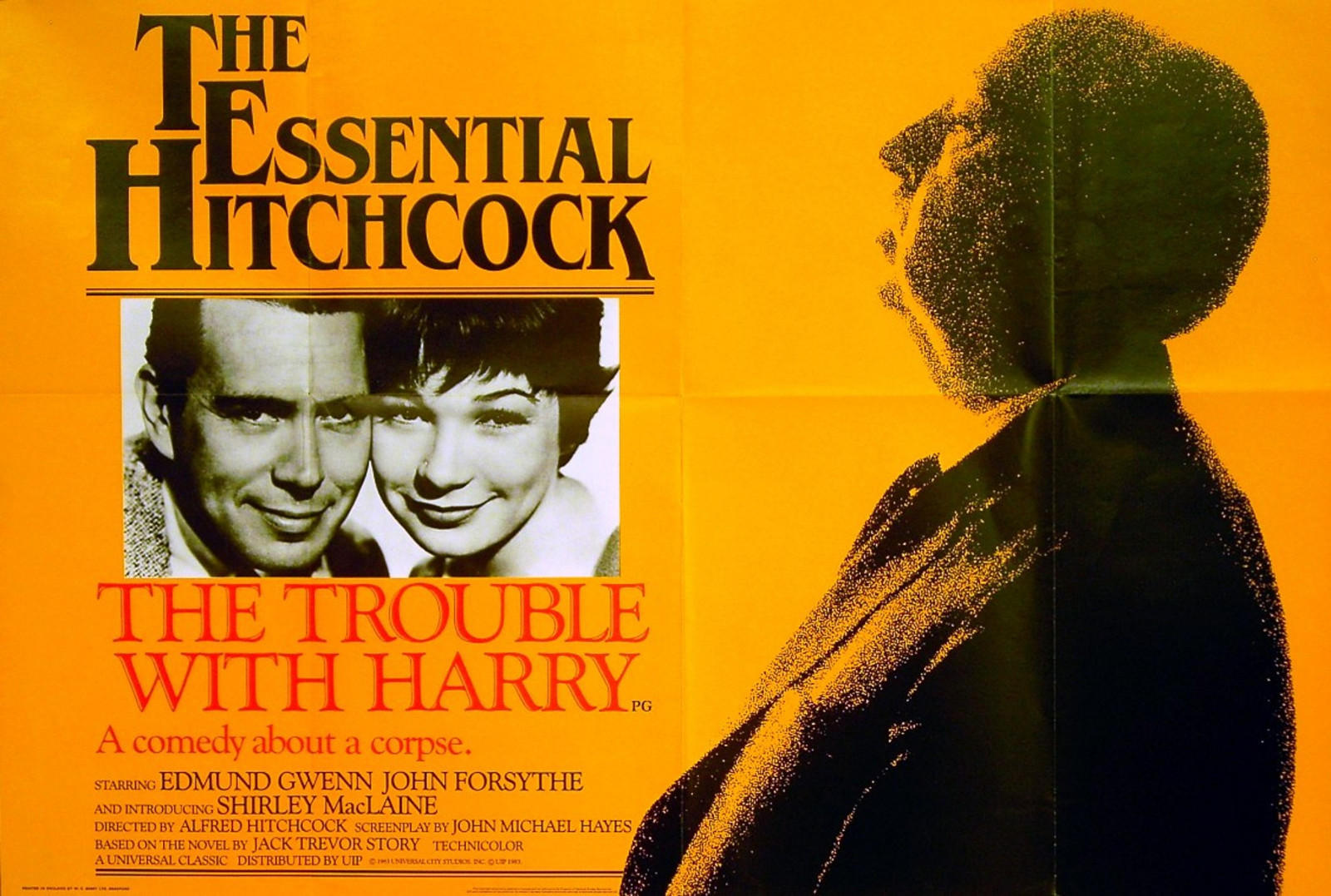
UK 1983 re-release quad poster by Lonsdale & Bartholomew Ltd., Nottingham; see the entry for Suspicion. US posters were the basis for the first domestic VHS, Betamax and LaserDisc sleeves.
This is one of the five “Missing Hitchcocks” which were owned by his estate and largely withdrawn from circulation from 1967–1983. Their newly struck but fairly average-looking 35mm theatrical re-release prints, complete with cue blips and open matte aspect ratios, were also used for the first home video releases from 1984 onwards. In addition to mono audio, the film originally screened in some suitably equipped cinemas with Perspecta “Stereophonic” Sound. A lower budget alternative to true stereo, it was also featured on To Catch a Thief and The Man Who Knew Too Much but only the latter has ever seen it released on home video. Among the host of foreign dubs, thankfully all in original mono as overseen by Hitch himself, are two in German; one from its initial release in 1956 and another recorded for the 1984 re-release which also has been the de facto ever since.
Preserved transfer
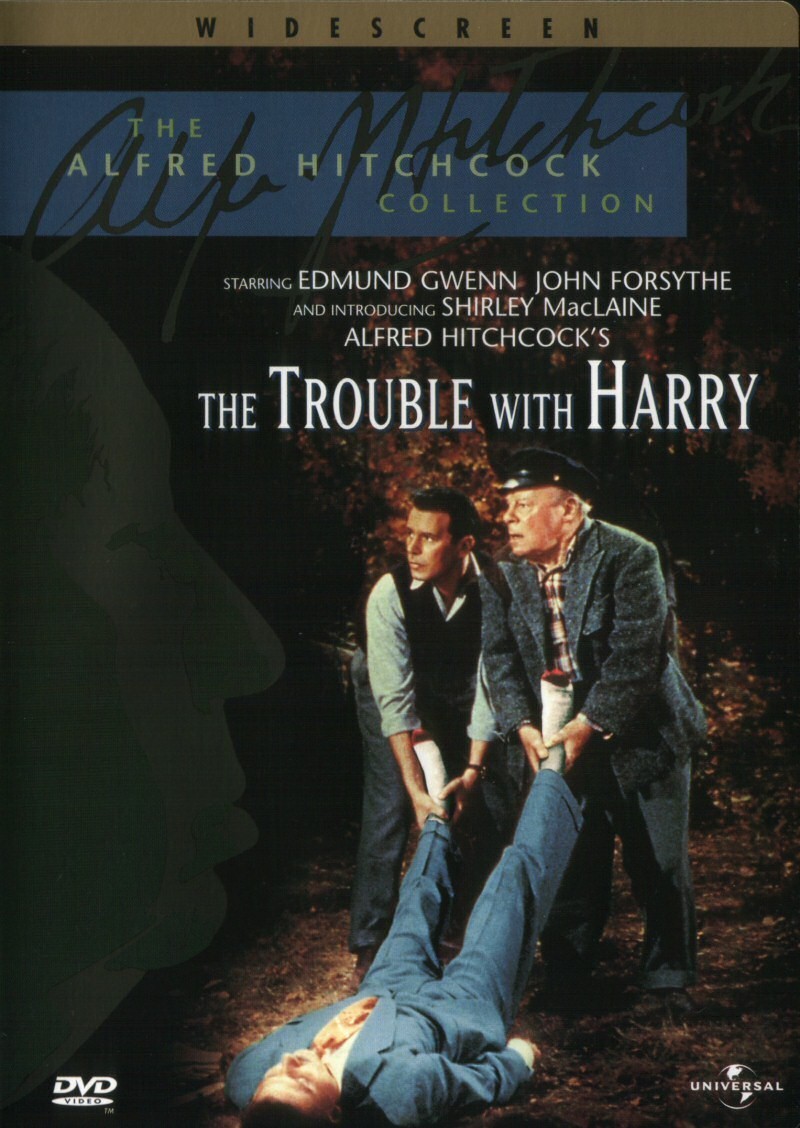
- US/Canada: DVD (2001)
- UK: DVD (2005)
- Italy: DVD/alt (2001, reissued 2005, 2015)
- Germany: DVD (2001, reissued 2006)
- France: DVD (2001, reissued 2017)
- Spain: DVD/alt (2001, reissued 2013)
Thankfully, all formats from DVD onwards have been transferred in the original 1.85: theatrical aspect ratio, with the first and widest round of DVDs featuring an excellent condition preserved transfer. On the other hand, the primary trailer above is only available open matte. The same extras appear on all discs until the present day: “The Trouble with Harry Isn’t Over” featurette (32:06, with at least one error), photo gallery (6:20) and the theatrical trailer (2:26). PAL DVDs additionally include the 1983 re-release trailer. Bootlegs are anything not from Universal, eg those from Chile (Cinematekka/box/box) and South Korea (Cine Korea, Cleo Entertainment).
2005 remaster
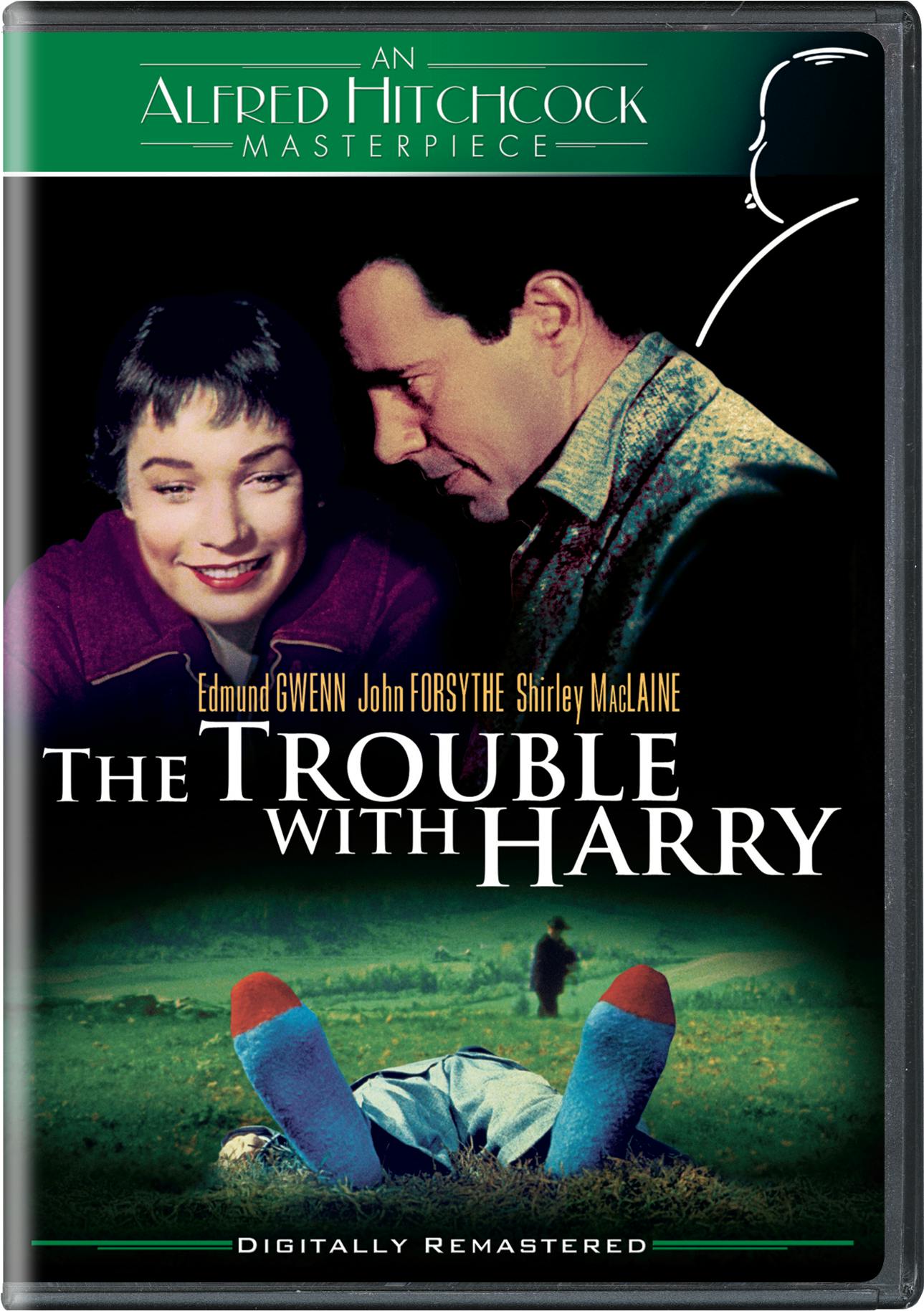
US DVD (artwork)
- US/Canada: DVD (2006), also in these box sets
This transfer, a notable upgrade on the previous disc, was only ever issued in North America and is the best available on DVD.
2012 restoration
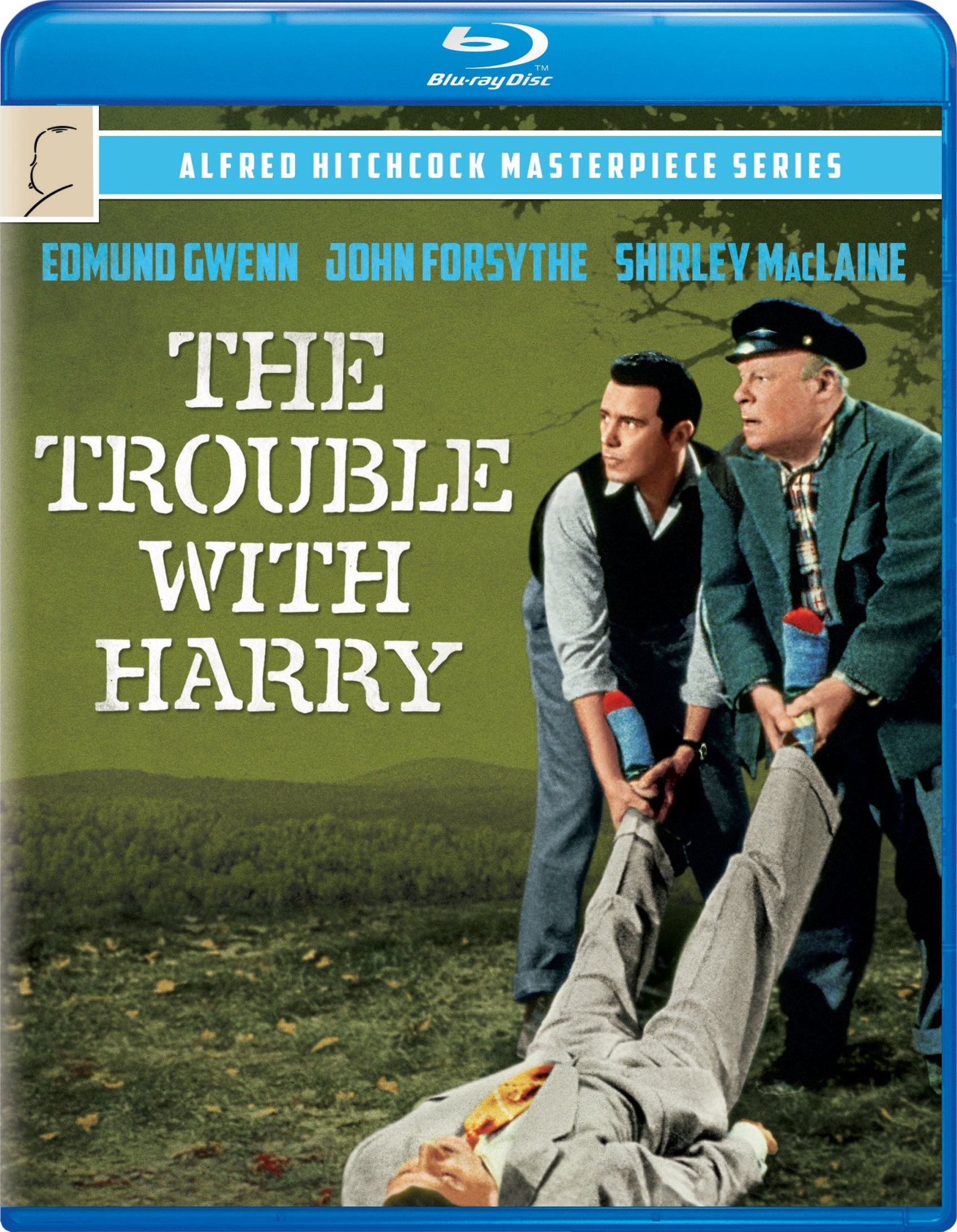
US BD
This fully-digital restoration finally presents Vermont’s autumnal splendour in all its glory, and is almost as good as it gets…
2022 remaster

US set
- Prime Video HD | YouTube
- US: UHD-BD/BD
- Canada: UHD-BD/BD
- France: UHD-BD/BD
- Scandinavia: UHD-BD/BD
- Japan: UHD-BD/BD (2023)
The film’s latest makeover, a 4K remaster of the previous restoration’s base scan, is likely the final word from Harry and only available on UHD-BD and streaming.
Screenshots
In addition to these video slideshows, there are comparative screenshots at Caps-a-holic and the Hitchcock Zone.
Soundtrack
Harry marked the beginning of the nine-film partnership between Hitch and Bernard Herrmann , one of the most renowned director-composer pairings in all of cinema, which also took in 19 episodes of The Alfred Hitchcock Hour. Some of Harry’s score was borrowed from music Herrmann had recently written for Crime Classics, a radio series that aired for a year prior to the film’s release. The only recording of the original film scoring sessions to be released separately is the opening’s segued Overture and Autumn Theme cues, lifted from the mixed soundtrack itself, for several official and bootleg compilations.
- él/Cherry Red CD Music from the Films of AH (2010)
- Cinezik 2-LP Best Scores from Alfred Hitchcock’s Films/alt (2020)
- DC MP3 Best Music from 1950s Thriller Movies (2024)
Some tie-in pop songs were inspired by the film, but with no direct relation to Herrmann’s music. First was “Flaggin’ the Train to Tuscaloosa”, sung early on in the proceedings by Barry Macollum as a tramp but re-recorded by Ray McKinley and His Orchestra for a US 7”, and released a year before the film itself. The second was an eponymous single performed by Ross Bagdasarian, who played the struggling songwriter in Rear Window, but released under the wafer-thin pseudonym of “Alfi and Harry”. It was quickly covered for a single B-side by Les Baxter and His Orchestra, and though neither hit big both have been much-reissued ever since.
- Film Score Rundowns: The Trouble with Harry/videos – Bill Wrobel
- Herrmann’s A Portrait of Hitch and The Trouble with Harry – David Neumeyer
- Herrmann, Hitchcock, and the Music of the Irrational/alt – Royal S. Brown, updated in…
- Overtones and Undertones: Reading Film Music (1994)
- Alfred Hitchcock’s Psycho: A Casebook (2004) – ed. Robert Kolker
Re-recordings

Original LP sleeve
This record presents a musical anthology of the scores I composed for various films of Alfred Hitchcock. With the exception of Vertigo, all of them are here presented for the first time on record. Most people think of Hitchcock as a master of mystery and suspense. Although this is fundamentally true, he is also a great romantic director, his films allowing enormous scope for sensual and lyrical musical treatment. This record displays many of his diversified talents, and in presenting these excerpts I hope to achieve a twofold purpose—to evoke the images of the films, and also to bring an enjoyment that is purely musical.
Beginning with Psycho, Hitchcock’s supreme achievement in suspense, the music is in the form of a narrative describing the action of the film. From the first high-driven rhythms, the tension is built through the various moods of the story, including the ghastly murder episodes and the hair-raising finale. In using only strings, I felt that I was able to complement the black and white photography of the film with a black and white sound. I believe this Is the only time in films that a purely string orchestra has been used. [performance notes]
From the film Marnie, the first excerpt depicts the emotional states of the heroine, her fears. her neurotic obsession with the color red, her love for her horse, and her kleptomania. The second is the music of the hunting scene in which her horse runs away with her, his subsequent death, and Marnie’s sorrow. [performance notes]
North by Northwest was the forerunner of all the James Bond films, and its overture is a rapid kaleidoscopic virtuoso orchestral fandango designed to kick off the exciting rout that follows. [performance notes]
From the haunting film Vertigo, three selections are included. The opening depicts the mystery and yearning of the film itself; then come the terrifying rhythms of the recurring nightmares and seizures of vertigo. The love music is a long crescendo of emotional fulfillment; it is unique in that practically the entire sequence is without any spoken dialogue and its effect is dependent on the fusion of image and sound.
Everyone must be aware that Alfred Hitchcock appears in all his films, it only momentarily, and his caricature of himself is well known. With this in mind. I was inspired to compose for this record a musical portrait of Hitchcock. The music I wrote for The Trouble with Harry furnished the Ideal motifs and tunes for this piece. The film is in many ways the most personal and the most humorous of Hitchcock’s entire output. It is gay, funny, macabre, tender and with an abundance of his sardonic wit, and I hope that my interpretation of these moods will in turn be transformed into a portrait of “Hitch.” – Bernard Herrmann, Music from the Great Movie Thrillers (1969)
Anglophile Herrmann always considered Britain his second (and eventually permanent) home, making frequent trips here for radio and concert appearances, and recording sessions for various London-based record labels. Most notably, he cut ten classical and film score LPs for Decca’s Phase 4 Stereo series, with the first and most successful fruit of his endeavours being this essential album, recorded on 11-12 December 1968. Its closing “Portrait of Hitch” suite of themes from The Trouble with Harry is an affectionate tribute, with the whole seen by many as something of an (ultimately futile) olive branch to his former collaborator, after they famously fell out over the direction of Torn Curtain’s score.
“It’s hard to talk about Hitchcock. It was a collaboration which I no longer have for many different reasons—none of them personal. The people who produce his films feel that he should use a kind of pop music and I don’t agree with that, so I prefer not to bother. I think that Hitchcock’s films depend enormously on music to build his nutcracker of suspense, and to impose on him a kind of pop culture is to deprive him of one of the greatest weapons in his arsenal. However, it’s not for me to say…” – Bernard Herrmann, Sight and Sound
The album’s been perennially reissued ever since its first release, although always on Decca or London Records, and occasionally under different titles and with extra related tracks, but these are all the main editions:
- Decca/London LP/CD/MP3 Music from the Great Movie Thrillers (1969) London Philharmonic Orchestra cond. Herrmann (46:45)
- Decca/MHS LP/CD Music from Hitchcock Films (1987)
- London CD/MP3 Psycho: Great Hitchcock Movie Thrillers (1992) w/2 extra tracks
- Decca 7-CD BH: The Film Scores on Phase 4 (2021) BH on Phase 4 | review/#2
- Decca 41-CD Phase 4 Stereo Concert Series (2014) trailer
A second recording of A Portrait of Hitch, also laid down in London in 1995, is available on a handful of compilations including a comprehensive a double album. Saving the best for last, Herrmann’s entire was recorded at City Halls, Glasgow, Scotland, on 29 April 1998.
- Silval Screen 2-CD/MP3 Psycho: The Essential AH (1999) City of Prague Philharmonic Orchestra cond. Paul Bateman (8:49)
- Varèse Sarabande CD/MP3 The Trouble With Harry (1998) Joel McNeely cond. Royal Scottish National Orchestra (40:51) booklet | review/#2
- Interviews with Robert Townson, soundtrack producer: The 7th Voyage of Sinbad/The Trouble with Harry
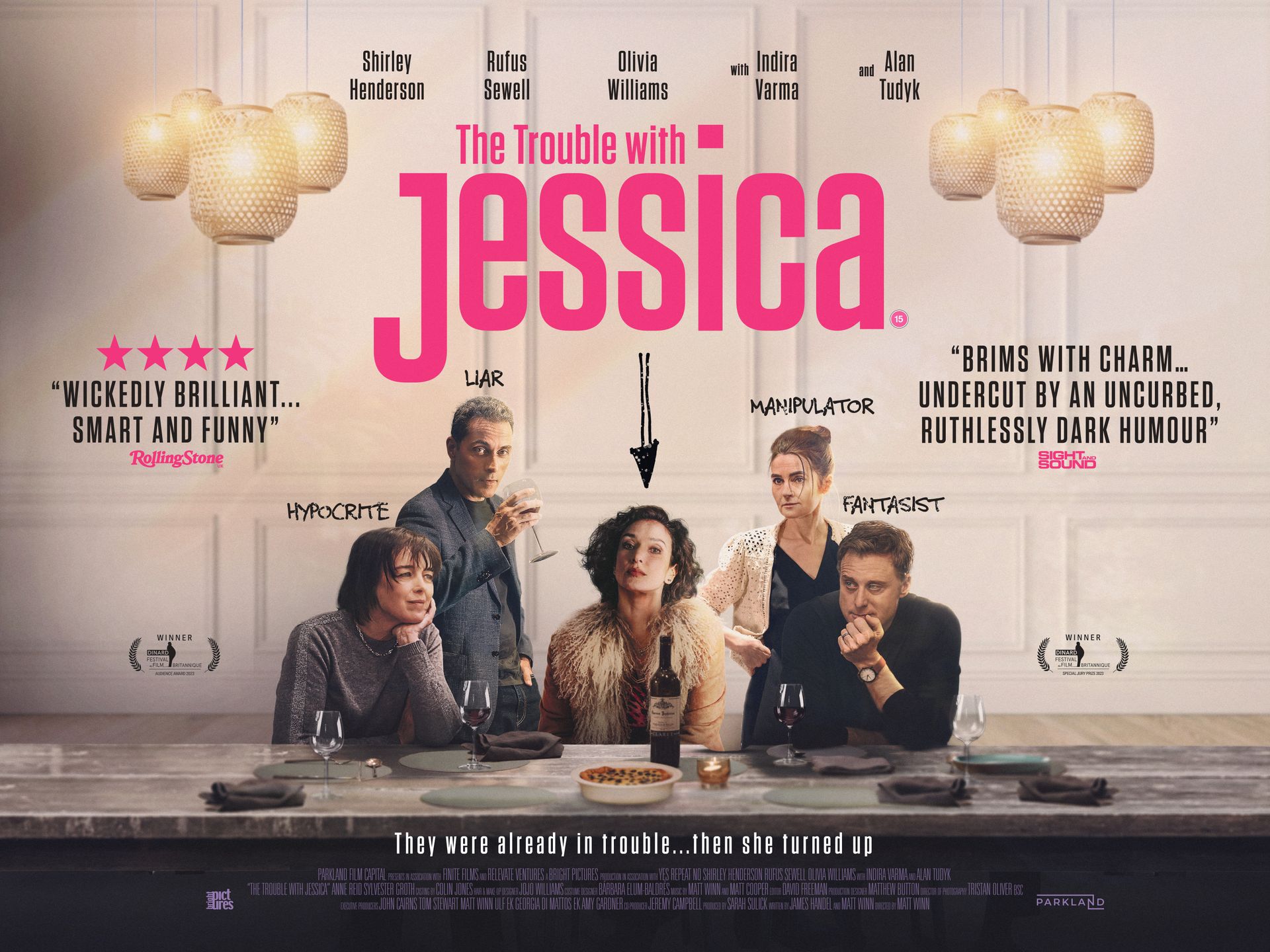
The Trouble with Jessica (2023)
- Prime Video HD | YouTube
- US: Music Box DVD (2025)
- UK: BFI Player
- Germany: Prime Video HD
- France: Blaq Out DVD/alt/alt (2024)
“Wickedly brilliant… smart and funny” – Rolling Stone
“A masterclass… funny, sharp and devastating” – Roger Ebert
On the brink of losing everything, Sarah (Shirley Henderson) and Tom (Alan Tudyk) have found a rich buyer for their stylish London home at the eleventh hour. When their old friends Richard (Rufus Sewell) and Beth (Olivia Williams) arrive for a send-off dinner, they also bring along a surprise guest: the group’s complicated school friend Jessica (Indira Varma). After a seemingly trivial argument at dinner, Jessica excuses herself, only to be found minutes later having hung herself in the back garden. With the vital house sale on the line, how can the group work together to resolve such an inconvenience? The knives come out and explosive secrets are revealed in this laugh-out-loud black comedy that skewers the British middle-class, and boasts phenomenal performances from a starry ensemble cast. – US DVD
This highly entertaining black comedy takes Harry’s basic premise and spins it into a grimly farcical comedy of errors with a bunch of suburbanites, that fans of the original should check out.
Clips, interviews, etc | German, French, Russian
Writing on a Classic: The Trouble with Harry
Related articles
This is part of a unique, in-depth series of 150-odd Hitchcock articles.