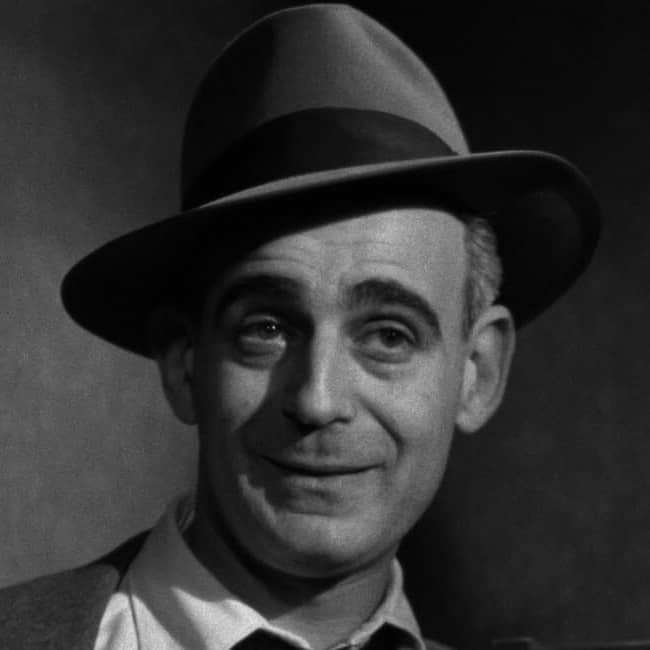
- Leading pulp fiction source author led a life as sad and lonely as any of his characters
- Productive: his writings inspired well over 100 screen works, more than any other noirist
- Screenwriter’s relatively small but perfectly-formed résumé includes many other noir classics
- Leading cinematographer-turned-director one of the golden age of Hollywood’s best in both fields
- Possibly best role for Disney’s first contracted child star – but he too had a far from happy ending
The Window: Film Noir Terror Through the Eyes of a Child | Film Noir File: Cast and Crew, Part 2 | Collectors Guide
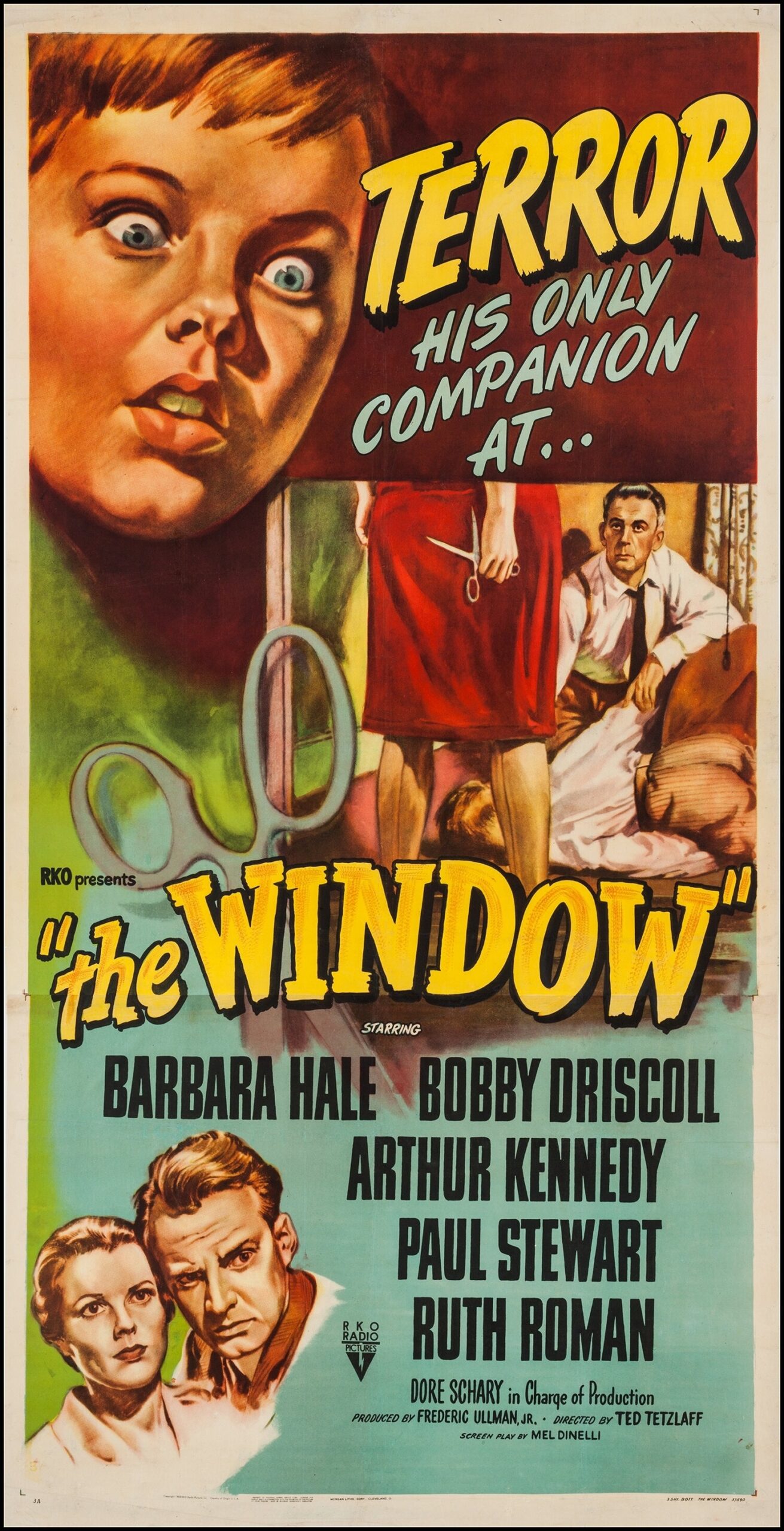
US three sheet poster; half sheet, lobby cards
Contents
- Cornell Woolrich – Original Story Writer
- Mel Dinelli – Screenplay
- Ted Tetzlaff – Director
- Bobby Driscoll – Tommy Woodry
- Related articles
Cornell Woolrich – Original Story Writer
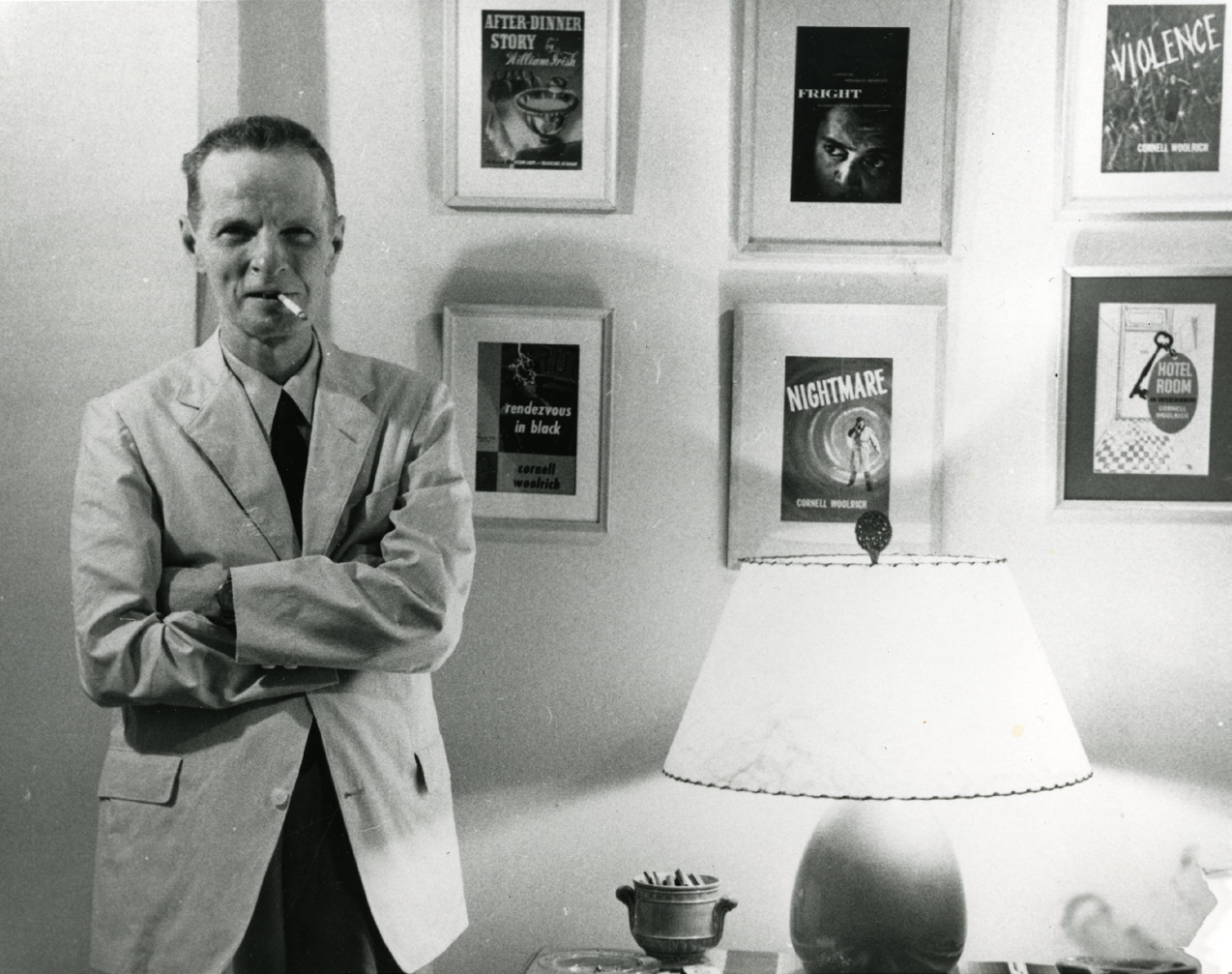
“I had that trapped feeling like some sort of a poor insect that you’ve put inside a downturned glass, and it tries to climb up the sides, and it can’t, and it can’t, and it can’t.” – Cornell Woolrich
And that’s Cornell Woolrich. A man full of terrors – terrors he shared with an ever more appreciative audience, especially during the 1940s. His biographer and literary executor, Frances Nevins Jr., has rated Woolrich as the fourth best crime writer of his day (behind Dashiell Hammett, Erle Stanley Gardner and Raymond Chandler). Today, unless you’re a hardcore crime literature enthusiast , you may very well never have heard of him – unlike Chandler and, perhaps, Hammett. One of the reasons is that he didn’t go in for reoccurring characters. He left us nothing in the way of a Mike Hammer or a Philip Marlowe. Instead what he bequeathed us is some of the best, most twisted and paranoid thriller fiction ever produced. At the height of his career, they were calling him “The Edgar Allen Poe of the 20th Century”. They said he had invented a whole new sub genre – “Paranoid Noir”. They even called him “The Father of Noir”. And there’s some truth in it. More film noir movies were based on Woolrich stories than any other mystery writer.
- CW: First You Dream, Then You Die (1988) – Francis M. Nevins Jr.
- Blues of a Lifetime: The Autobiography of Cornell Woolrich (1991) – ed. Mark T. Bassett
- CW from Pulp Noir to Film Noir (2006) – Thomas C. Renzi
- CW and the Tough-Man Tradition of American Crime Fiction/alt (2015) – Christine Photinos
So who was he? Cornell Woolrich was born in New York in 1903. When his parents split up, he first lived in Mexico with his father in his youth and then returned to live with his mother Claire in New York, where he attended Cornell University which was just a few blocks from his mother’s house. It was the start of a long, complicated love-hate relationship with his mother which was to dominate his life – and his fiction. In his terror, he clung to her, knowing all the time that she was destroying him. While still at university, Woolrich started out writing novels heavily influenced by F.Scott Fitzgerald. In total, he completed six. He was invited out to Hollywood to adapt one of them and managed to tear himself away from his mother for one of the few times in his life. Unfortunately, he didn’t like Hollywood – and Hollywood didn’t like him back. Cornell was a difficult man to be around – cold, unfriendly, snide and even vicious. If you complimented him, you were as likely to get a mouthful of abuse as you were a ‘thank you’.
While in Hollywood, he did however marry movie producer’s daughter Gloria [Violet Virginia] Blackton. The marriage was never consummated and lasted just months before the couple separated and Woolrich fled back to New York to live with his mother in a seedy New York hotel. Back in Hollywood, Woolrich’s wife found a diary in which her husband had chronicled – very graphically – his many homosexual experiences. In the same diary, he had written, “it might be a really good joke to marry this Gloria Blackton.” She also discovered a large trunk. Inside she found an authentic sailor suit, which Woolrich would put it on before going down to the docks in search of rough trade…
2019 Kit Film Noir Festival | Columbia News | YouTube
Now in New York, Woolrich was happily bashing away at his typewriter in the corner of his hotel room while his mother looked on. At first, he sold hard-hitting detective stories in the racy pulp magazines, often under the pseudonyms of William Irish or George Hopley. In the 1940s, his style changed. He became more of a thriller writer. On the publication of his first crime novel in 1940, one reviewer wrote:
“If you can imagine Alfred Hitchcock writing a novel the way he directs a movie, then you have some idea of the drama and breathless suspense of The Bride Wore Black.” [Filmed by Hitchcock acolyte François Truffaut in 1968.]
In total, Woolrich wrote around two dozen novels and over 200 short stories, many of which were adapted for radio and television as well as for the movies. He tried leaving his mother just once:
“I tried to move out in 1942, I lived in a hotel room for three weeks and then one night she called me and said, ‘I can’t live without you, I must live with you, I need you,’ and I put down the phone and I packed and I went back to that place for the rest of my life, I never spent a night away from her, not one. I don’t care what they thought of me, what they said about me but I just didn’t care. I don’t regret it and I’ll never regret it as long as I live.”
Aside from his mother, Woolrich had very few friends or even associates. He dedicated his novel The Bride Wore Black to his typewriter… As his mother’s health deteriorated, Woolrich devoted more time to nursing her and progressively abandoned writing. She died in 1957. He then became even more reclusive, drank and smoked heavily and had to have a leg amputated. He lived with an aunt for a time and then alone in a hotel room. When he died, from a stroke in September 1968, he weighed just 89 lbs. Virtually no one attended his funeral.
“First you dream, then you die.” – Cornell Woolrich.
- Black Window: CW/orig – Jonathan Rosenbaum
- Cinema Gris: Woolrich/Neil’s Black Angel – Donald Phelps
- Writing in the Darkness: The World of CW – Eddie Duggan
Mel Dinelli – Screenplay
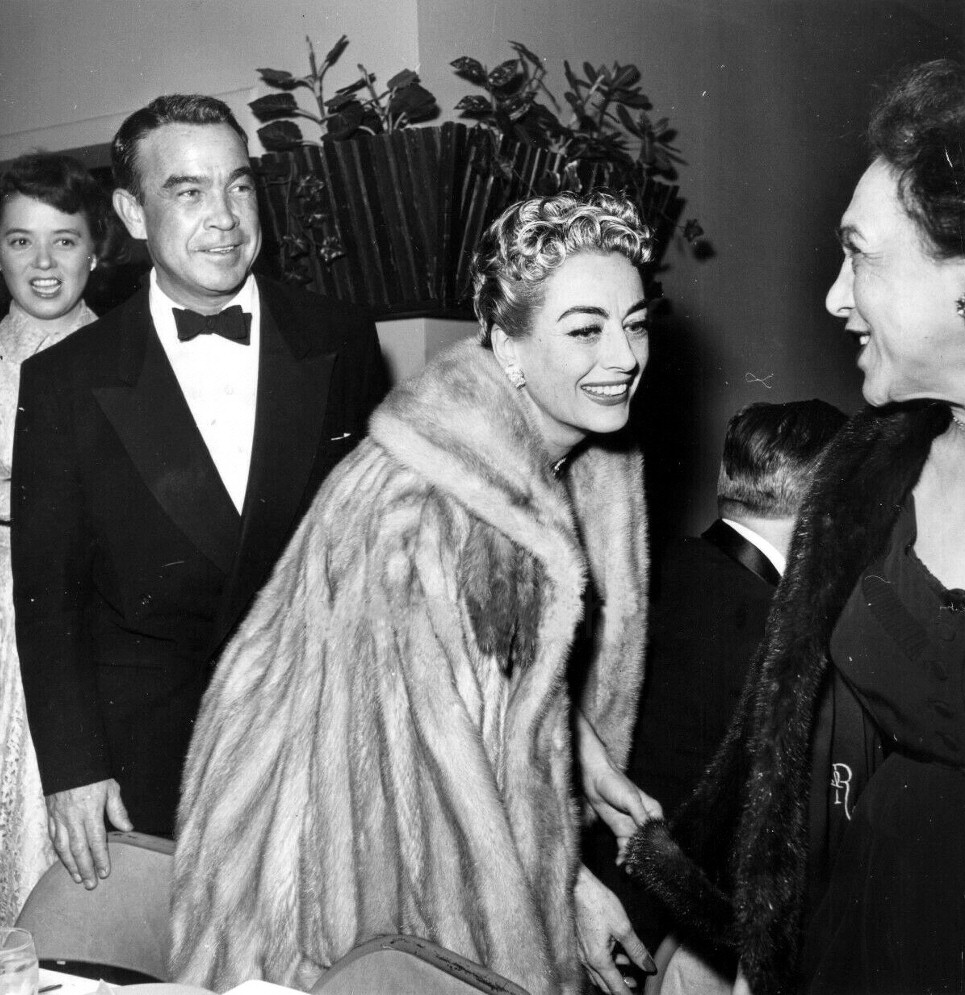
Mel Dinelli and Joan Crawford, 1953. The pair enjoyed a personal and professional relationship for many years.
Sadly, screenwriter Mel Dinelli never really fulfilled the early promise demonstrated by The Spiral Staircase (1945) or The Window. Born Amelio Dinelli in New Mexico in October 1912, Dinelli’s Hollywood career began on a high with the screenplay for Robert Siodmak’s thriller The Spiral Staircase on the strength of which he was given the scripting job on The Window. During this time he also adapted some thrillers for radio including Suspense! And The Adventures of Philip Marlowe. In 1950, he had a play produced on Broadway. Typically, it was a suspense thriller. The Man starred Dorothy Gish as a housewife taken prisoner by a killer and ran from January through to April that year. This was later adapted to film by Dinelli as Beware My Lovely (1952) with Robert Ryan and Ida Lupino. “Trapped by a man beyond control” shouted the posters.
- Shubert Alley: A Play for Women (1943) – Mel Dinelli
- The Man (1950)– Dinelli
- US: Kino 3-BD Film Noir: The Dark Side of Cinema XIX (2024)
- Australia: Via Vision 2on1 BD (2023) w/Jennifer (1953), also in 4-BD/5-film Essential Film Noir Collection 4
- Italy DVDs: A&R , Sinister Film – bootlegs
- Suspense: To Find Help, January 18, 1945 – Frank Sinatra and Agnes Moorehead
- Suspense: To Find Help, January 6, 1949 – Gene Kelly and Ethel Barrymore
Specialising in noir thrillers, he produced scripts for Fritz Lang’s House By The River (1950), Cause For Alarm (1951) with Loretta Young, and – most notably – John Sturges’ Jeopardy (1953). The latter was no easy task considering the original source material was a short radio play, “A Question of Time” by Maurice Zimm. Dinelli had to expand the material to three times its original length to make it a feature. As the 1950s progressed, Dinelli moved more into television and contributed scripts to such TV shows as Climax!, General Electric Theatre, The 20Th Century Fox Hour and Alfred Hitchcock Presents. He returned to cinema with two lesser known moves Lizzie (1957) and Step Down to Terror (1958) but did little else of note and it is believed that his 1964 Italian TV film, L’uomo has been lost. When The Spiral Staircase was remade in Britain in 1975, starring Christopher Plummer and Jacqueline Bisset, Dinelli was credited for work taken from his original screenplay, as he was when the film was remade in 2000, this time as a TV movie. Mel Dinelli died in Los Angeles in November 1991, aged 79.
Ted Tetzlaff – Director
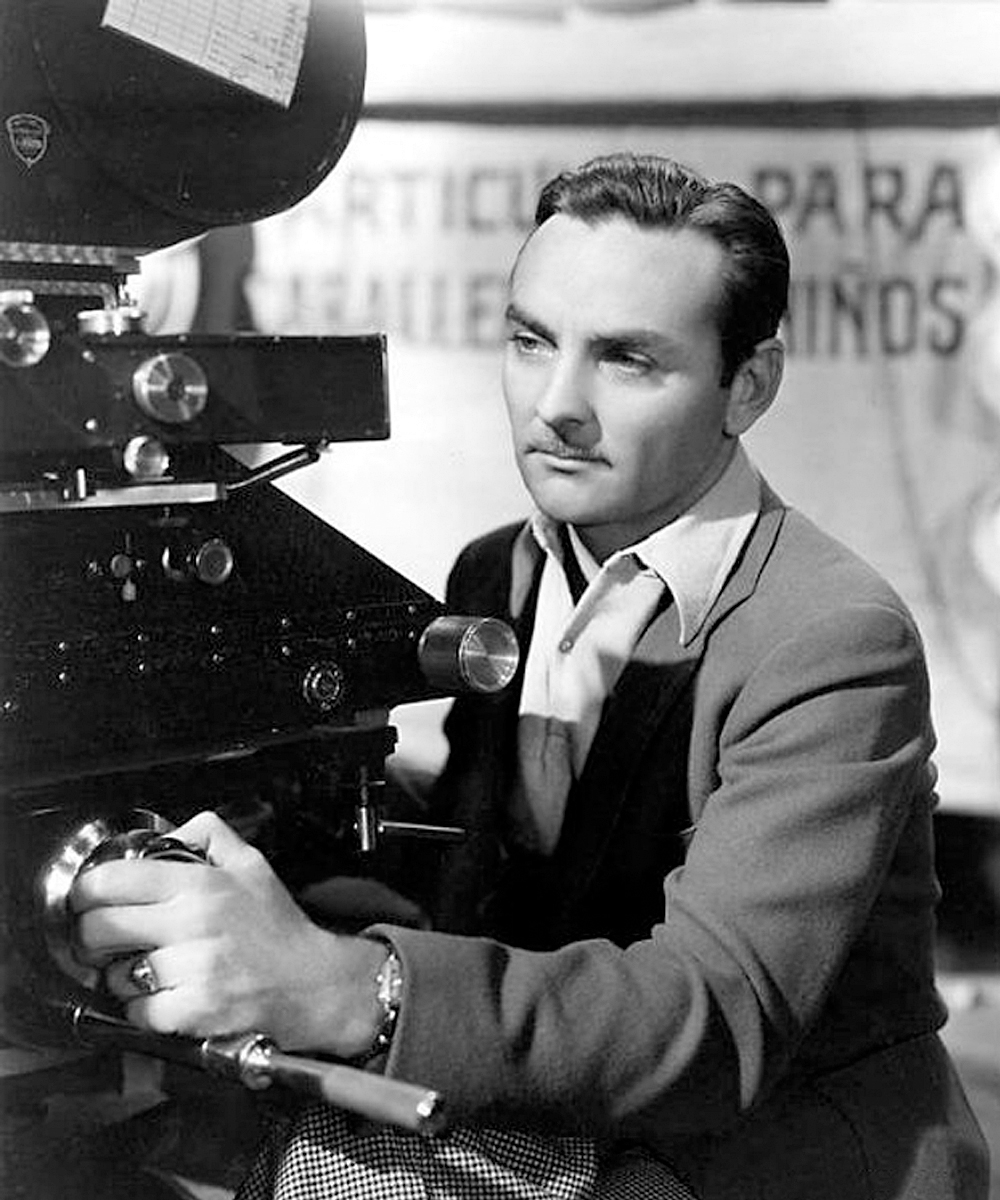
As previously mentioned, Hollywood history has always seen Ted Tetzlaff as a cinematographer rather than a director. Born Dale H[erbert] Tetzlaff in 1903 in Los Angeles, his father was the notorious racing car driver and stunt man “Terrible Teddy” Tetzlaff. Probably wisely, the young Tetzlaff decided not to follow in his father’s footsteps. Instead, he worked as a Hollywood cinematographer from the 1920s to the mid-1940s and shot some 116 movies, beginning with Atta Boy (1926) and including My Man Godfrey (1936), Road To Zanzibar (1941), Kiss The Girls Goodbye (1941), I Married A Witch (1942) and You Were Never Lovelier (1942). He joined Columbia in 1928 and at the height of his career was lensing a dozen films a year. He filmed three movies for Frank Capra and was a particular favourite with Carole Lombard, who particularly admired the way he shot her. He was reunited with Lombard when he moved to Paramount in 1934. In total, he shot ten films starring Lombard and the actress even stipulated that he was to accompany her when she was loaned to other studios for film projects.
Lombard’s known attachment to Tetzlaff was so strong that it caused George Raft to walk off the set of Concertina (later known as The Princess Comes Across – 1936), fearing that the cameraman would give his co-star all the best angles and neglect him! Raft gave the studio an ultimatum:
“You can put the names of any 10 cameramen in a hat and the one you pull out is all right with me, providing it isn’t Tetzlaff – because I won’t work with him.”
The studio gave Raft a day to change his mind. He didn’t. So they fired him – and Paramount ripped up his contact for good measure. Tetzlaff took his first stab at directing with World Premiere (1941) – which was not a success and then with Hearts In Springtime (1941) on which he is uncredited. His career as an A-list cinematographer continued to flourish thought and in 1943 he was nominated for an Oscar for Best Cinematography for The Talk Of The Town. During the war, he served with the US Army, where he rose to the rank of major, then returned – to a fateful union. He was appointed Director of Photography on Notorious (1946) for Alfred Hitchcock, who obviously valued Tetzlaff. In one famous moment during production, Hitchcock and Tetzlaff were deep in conversation when a fire broke out on set. Hitchcock insisted on finishing his conversation with Tetzlaff before instructing that the fire be extinguished. Tetzlaff liked to cheek and tease Hitchcock and openly referred to him as ‘Pop’ on set.
Ted Tetzlaff: Motion Picture Photographer to Director – Ezra Goodman
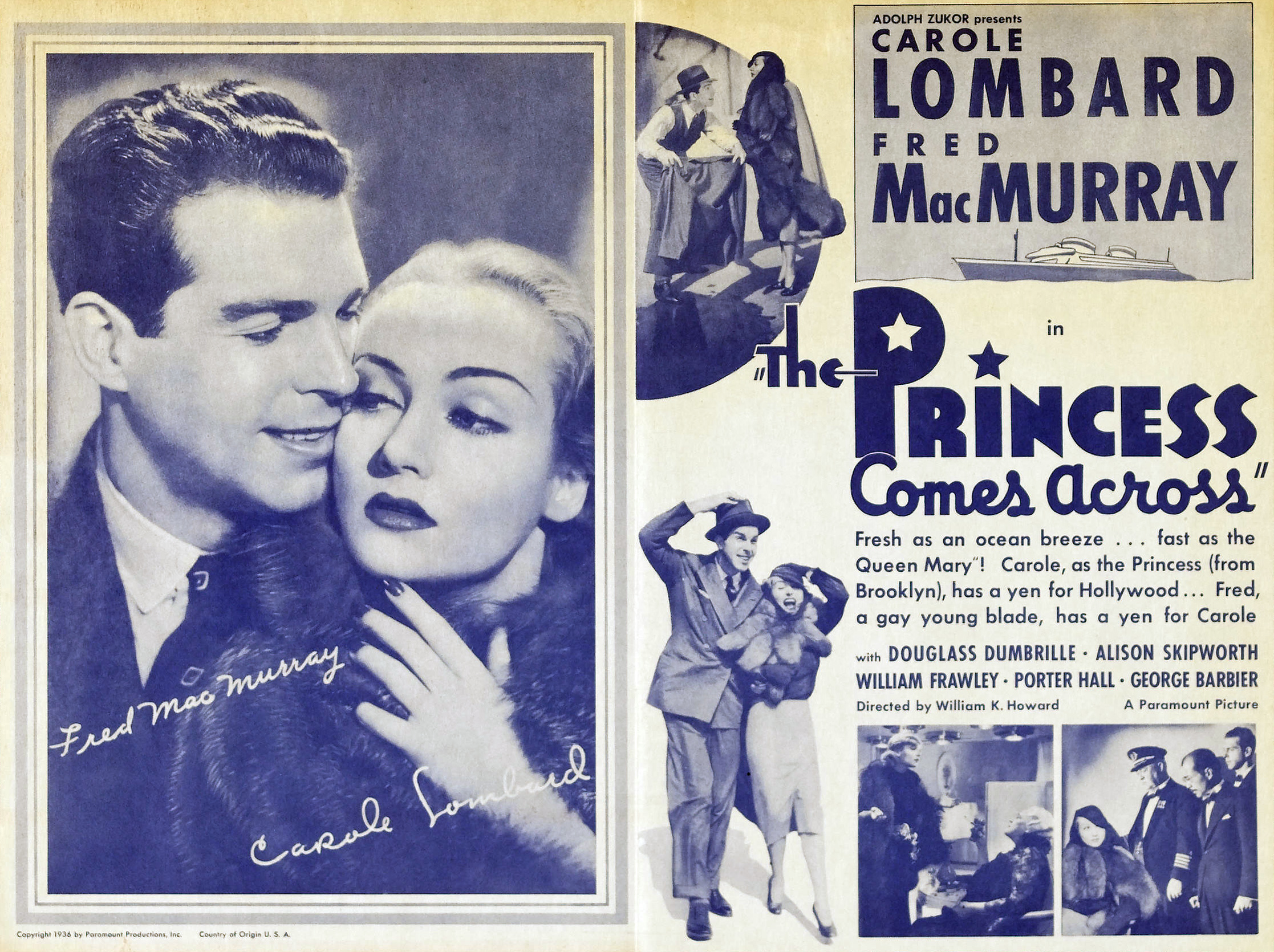
- US: Universal 2-DVD/6-film Carole Lombard: The Glamour Collection (2006)
- Universal DVD-R (2013)
- Kino 3-BD Carole Lombard Collection II (2021) | CLC I (2020)
- Australia: Bounty DVD (2011)
- Romantic Movie Stories: The Princess Comes Across (1936)
- Lux Radio Theatre: The Princess Comes Across, December 5, 1938 – Madeleine Carroll and Fred MacMurray; only partially survives
It was here that he undoubtedly learned the skills he put to such good use on The Window. Following Notorious, Tetzlaff directed Riff-Raff (1947) with Pat O’Brien. Although little known now, this film noir piece has been praised for the cinematographic skills which the inexperienced director brought to the movie – particularly in the opening six minute storm sequence which is entirely without dialogue… It was released in the same year that Tetzlaff made The Window. Tetzlaff continued with film noir at first, directing cult favourite Johnny Allegro (1949) with George Raft. Despite his earlier fight with Tetzlaff he was obviously willing to work with him here and also later in A Dangerous Profession (1949). A thriller of a different sort, RKO’s The White Tower (1950) was meant to be directed by Edward Dmytrk, but Tetzlaff stepped in when Dmytrk was blacklisted in Hollywood. Bosley Crowther, writing in The New York Times, highlights the perfect cinematographic skills which enhanced Tetzlaff’s ability to direct, just as they had in The Window:
“Taking his cast and his cameras directly to the Alps, Mr. Tetzlaff has filmed in Technicolor a great many grand and thrilling scenes of sweeping alpine panoramas and of diligent climbers going up. He has caught the terrible tension of these human flies scaling sheer rock walls, hanging by slim handgrips to ledges and dangling desperately in the air from slender ropes, He has visioned the breath-taking beauty that unfolds to the climber’s eye, the lash of a snowstorm on the bleak heights, the horror of a fatal slip and fall.”
Tetzlaff stayed with RKO until the early 1950s when he became a freelance director. In 1953, he made Son Of Sinbad in 3D, but it wasn’t released until 1955 after interference by Howard Hughes. The over abundance of 1950s cheesecake in the movie earned it a Condemned rating by the Catholic Legion of Decency. Tetzlaff’s last film before retiring was the Western The Young Land (1959) with Patrick Wayne and Dennis Hopper. It too was beset with delays before release, which may have contributed to Tetzlaff’s decision to retire. Ted Tetzlaff died on the 7th January 1995, aged 91.
Bobby Driscoll – Tommy Woodry

“I was carried on a satin cushion and then dropped into a garbage can” – Bobby Driscoll
Peter Pan was the boy who never grew up. Unfortunately Bobby Driscoll – the boy who brought Peter Pan to life in the Disney movie – did. And it killed him. Robert Cletus Driscoll was born in Cedar Rapids, Iowa on March 3rd 1937. His father was an insulation salesman and, in 1943, the family moved to Los Angeles, California, on doctor’s advice after Bobby’s father developed a lung condition relating to the asbestos insulation he’d been selling. It was Bobby’s barber who recommended that the five-year-old should try out for the movies, and the barber’s son got Bobby an audition at MGM for a small part in the 1943 family drama Lost Angel. Bobby’s little role in Lost Angel helped him to get a part in the Fox war drama The Fighting Sullivans (1944) and soon all the studios were talking about the new ‘wonder child’ who could learn his lines – and really act. Studios would actually recommend him to each other and he made several films between his debut and 1946 for a variety of studios, including Sunday Dinner for a Soldier (1944), The Big Bonanza (1944), So Goes My Love (1946), and Alan Ladd’s O.S.S. (1946). Everyone in Hollywood loved him. Dan Ameche said:
“He’s got a great talent. I’ve worked with a lot of child players in my time, but none of them bore the promise that seems inherent in young Driscoll.”
Bobby was more sanguine. When asked what his plans were, he told reporters, “I’m going to save my money and go to college, then become a G-man.” Disney Studios took the unprecedented step of putting Bobby under exclusive contract at age nine as their first contracted child star. He played the lead in Song of the South (1946). He and his co-star on the picture, Luana Patten, then became nicknamed ‘Disney’s sweetheart team’ and the two joined Burl Ives on Disney’s So Dear to My Heart (1948). His mother recalled how Bobby always worked with a very real (and mature) dedication for the studio:
“He was so well supervised by Disney. People weren’t even allowed to use a swear word in front of him. He had a great deal of love for Walt Disney. And he always did whatever the director told him to do. He was in this movie once with Sonny Tufts. He couldn’t have been more than seven and they stood him on a box for some reason. Well, he fell and caught his foot and wound up hanging there – upside down, crying his eyes out without making a sound. Because the director had told him before that noise cost money.”
Disney enjoyed a close relationship with RKO and happily leant Bobby out for two movies – If You Knew Susie (1948) starring Eddie Cantor and, of course, The Window. In 1950 he received a special Oscar for ‘Outstanding Juvenile Actor of 1949’ for his work on both films. Bobby was then cast as Jim Hawkins in Disney’s immortal Treasure Island. However, it was to be filmed in Britain and Bobby ran afoul of British immigration when it was discovered that he didn’t have a valid work permit. Given six weeks’ leave to appeal, Byron Haskin, the director, hurriedly shot all of Bobby’s close ups before he was unceremoniously deported. A British stand in then was used for the long shots. Bobby experienced more problems when Disney’s plans for him to star in a new version of Tom Sawyer fell through, due to rights issues and the film never happened. There were also plans for him to star as one of Robin Hood’s merry men in a new Disney version which would have reunited him with Robert Newton as Friar Tuck. This fell through too.
During this time he made a bad mistake common to child actors. He started to grow up. Severe acne limited his big screen appeal in his teens and heavy make up was needed to be applied for both his TV and film appearances. He did however provide his voice for the animated Goofy Jr. and Peter Pan in the classic Disney movie (1953). Not only did he provide the voice, but he acted out scenes from the cartoon on an empty sound stage. These were filmed and then given to the animators for reference. The Peter Pan you see in the finished movie doesn’t just feature Bobby’s voice. The character’s performance is based on his acting too. (For fans of the J.M. Barrie classic, this is particularly noteworthy because it is the first recorded time when a boy played the part of Peter Pan. Before the film, the part was traditionally played by women).
Walt Disney himself once championed Bobby as his favourite child actor and saw him as the embodiment of his own youth. However, after seeing him work on Peter Pan, he started to go cold on the actor and thought he was now suited to the role of bullies. There weren’t many starring roles for bullies in Disney productions, so Bobby’s film work started to dry up. The studio let him go in 1953, officially citing ‘acne’ for the termination of his contract! The other big studios weren’t all that interested in a heavily spotty former child actor either. Bobby sought work in television instead, appearing in shows including Dragnet, Climax!, Medic and Navy Log. Bobby’s parents took the decision to remove him from the Hollywood Professional School for child actors and put him in a normal school instead. It was to prove a disastrous decision. Bobby was teased mercilessly by the other kids for being a washed-up child star. He later recalled:
“The other kids didn’t’ accept me. They treated me as one apart. I tried desperately to be one of the gang. When they rejected me, I fought back, became belligerent and cocky – and was afraid all the time.”
At the Hollywood school he had been a straight-A student. At his new state school, his grades just collapsed. His parents sent him back to the Hollywood Professional School – but the damage had been done. Bobby had started to experiment with drugs to ease his unhappiness – at first marijuana and then heroin as well as cocaine and amphetamines. He was busted for drugs possession in 1956 and although the charges were eventually dropped, he was now toxic in the film and TV industries. He also started to become distant from his loving family. His mother recalled:
“Drugs changed him. He didn’t bathe. His teeth got loose. He had an extremely high IQ, but narcotics affected his brain.”
At the age of 20, the boy who had once earned $50,000 a year could be found working in a haberdashers for $75 a week. He was to make just two more films – The Scarlett Coat (1955) with Cornell Wilde and The Party Crashers (1958). He also made two final TV appearances in 1960 – in The Best of the Post and The Brothers Brannagan. The early 1960s saw Bobby fall foul of the law again, first with a charge of ‘assault with a deadly weapon’ and then a serious narcotics violation that saw him imprisoned in a rehabilitation centre. In 1965, Bobby headed for New York and Broadway hoping to find work in the theatre. He failed. Instead he became part of Andy Warhol’s famous Greenwich Village ‘Factory’ project. He turned his attention to art but eventually drifted away and New York City simply swallowed him up.
Two children found his body on March 30th 1968, in an abandoned tenement building less than three blocks from where some scenes from The Window had been shot. Bobby was just 31 years old. The official cause of death was drugs-related. Bobby was carrying nothing to identify him and his sole possessions were two empty beer bottles and some religious pamphlets. His body was labelled as just another unknown John Doe and given a state burial. Almost two years later, as his father lay dying, Bobby’s mother and officials at Disney made an effort to find out what had happened to Bobby. Fingerprint records at the NYPD revealed that the John Doe they had unceremoniously buried was the former child star. Today, Bobby Driscoll still lies in an unidentified pauper’s grave on Hart Island, New York. To quote a line from Peter Pan, delivered by Bobby himself: “Once you’ve grown up you can never come back…”
Bobby Driscoll 1937-1968 – Don Brockway
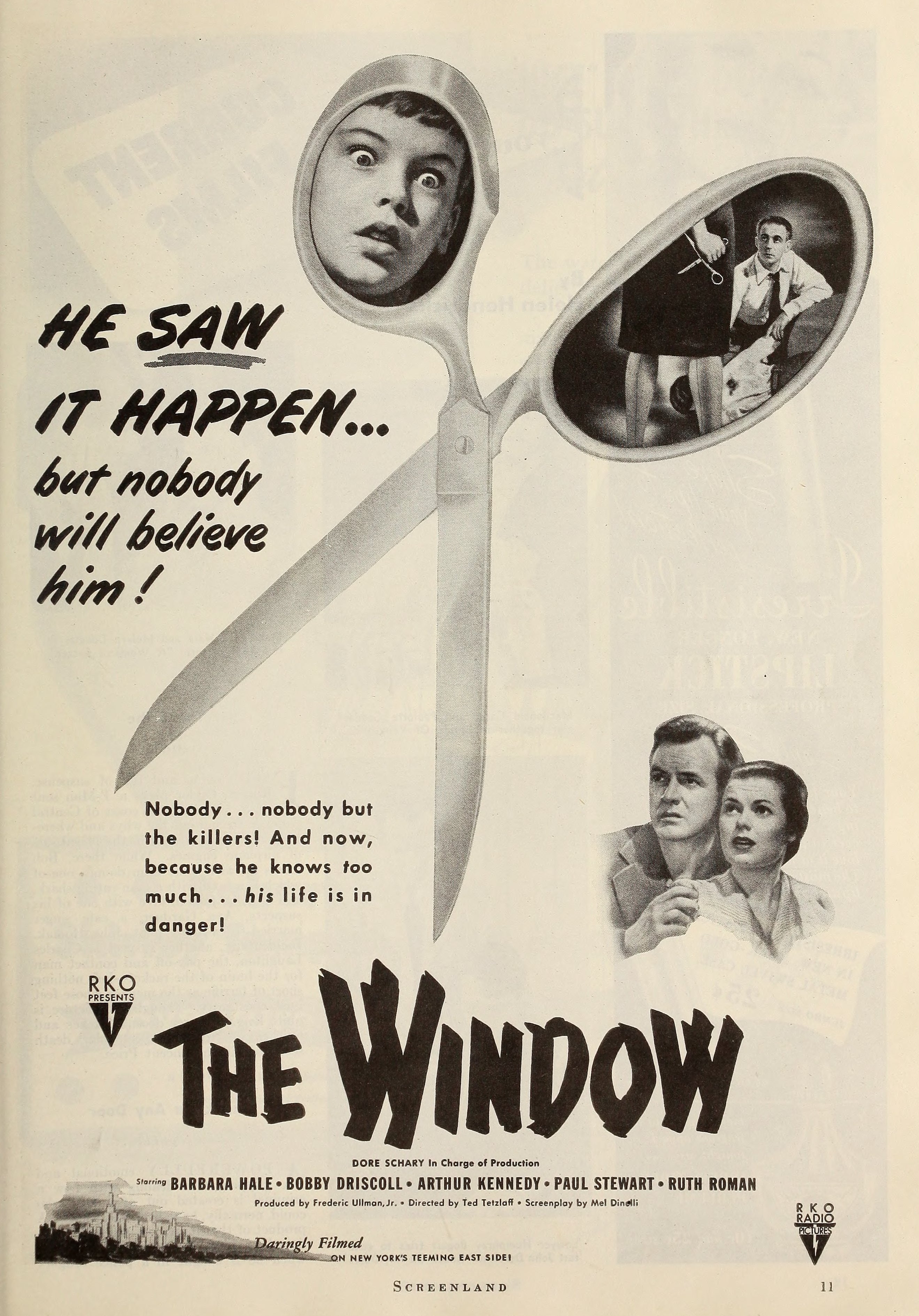
Screenland magazine ad
The Window: Film Noir Terror Through the Eyes of a Child | Film Noir File: Cast and Crew, Part 2 | Collectors Guide
Related articles
- Alfred Hitchcock Collectors Guide: Rear Window
- François Truffaut Collectors Guide: The Bride Wore Black