- Revisiting contemporary and modern critical appreciation
- Alfred Hitchcock classic is Master of Suspense at his most playful
- Charming soirée on the French Riviera sees a man wrongly accused
- Cary Grant comes out of retirement for Grace Kelly and reinvigorates his career
Note: this is part of an ongoing series of 150-odd Hitchcock articles; any dead links are to those not yet published. Subscribe to the email list to be notified when new ones appear.
To Catch a Thief: Writing on a Classic | Making of a Masterpiece | Collectors Guide, Pt 2: Soundtrack and audio mixes, 3: Home video, 4: 2020s revisions
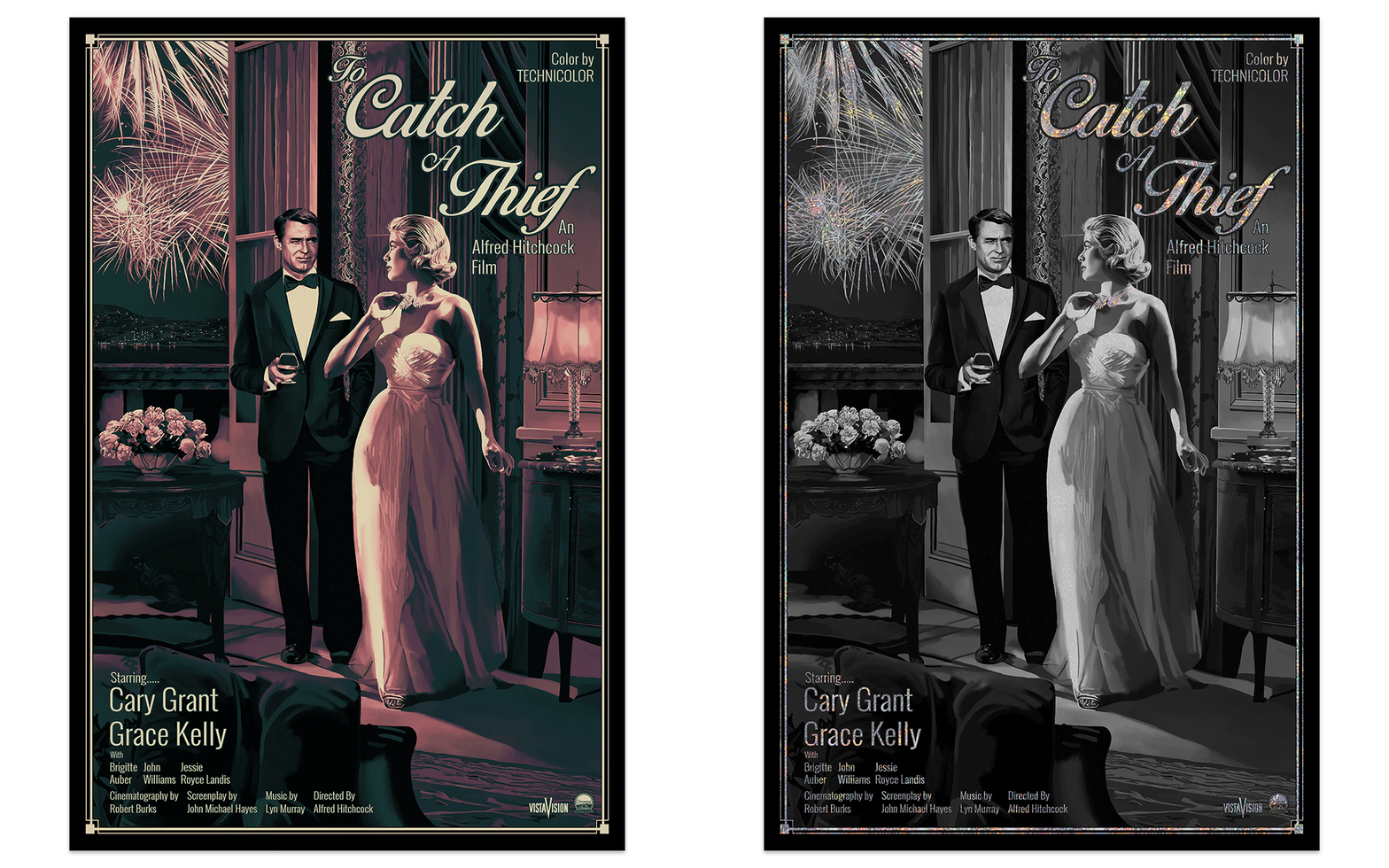
Poster by Dakota Randall, 2024
“I didn’t want to do the film,” the fifty-year-old and newly retired screen actor Cary Grant said in early 1954. Grant had just been approached by director Alfred Hitchcock about a new project – a film based on David Dodge’s novel To Catch a Thief. Upon receiving Hitchcock’s telegram while in Hong Kong, however, Grant reconsidered the offer. The director’s latest endeavor would be shot on location in the south of France and, more important, would co-star a talented and beautiful leading lady. “It was only after Hitchcock told me I’d play opposite Grace Kelly that I accepted,” Grant recalled.
And so, out of an early retirement Cary Grant came, but the actor and his director had to wait to begin production until June 1954, when Grace Kelly had completed her other film obligations. Starring as retired cat burglar John Robie, Grant plays the lead role in To Catch a Thief. A new copy-cat thief is on the loose and in order to clear his own name, Robie becomes embroiled in a series of adventures along the French Riviera. Grace Kelly, as Frances Stevens, becomes involved in the chase when her mother, portrayed by Jessie Royce Landis (North by Northwest), is robbed. Kelly is trying to catch the thief (Robie), but simultaneously is trying to catch the man.
“A Leg or a Breast?”
Billed as a comedy/thriller, To Catch a Thief flaunted itself in the face of the 1950s production code. John Michael Hayes’ screenplay has been highly credited for its “verbal and visual sexual puns.” The banter between Kelly and Grant is daring, particularly during a picnic scene in which the actress says to Grant, “I’ve never caught a jewel thief before. It’s so stimulating,” and then adds – as she offers him cold chicken – “Do you want a leg or a breast?” He responds, “You make the choice.”
For Alfred Hitchcock, Grace Kelly symbolized the cool sexual elegance of a beauty that could be admired from afar, but who “close up, was far more than that.” Combined with a script filled with innuendo and witty double entendres, the charisma between the beautiful Kelly and handsome Grant created an openly sexual atmosphere on-screen. “She was the most beautiful woman I’d ever known,” Grant later said, but “it seemed like the only passionate words of love I ever spoke to her were with Hitchcock staring in my face.”
/GraceKelly-58b96e123df78c353cdb54c8.jpg)
A Cast of Characters
The film’s month-long production on the Riviera was completed without the usual anxiety associated with on-site location filming. Every evening, promptly at six o’clock, Cary Grant called an end to the day. Saying he’d had enough of studio dominance, the actor’s contract stipulated specific working hours. The camaraderie and professional respect among director, cast and crew were exceptional as well. “Hitchcock always made us feel that we were collaborators, he knew we weren’t idiots,” Grant recalled, “and working with him was very comfortable.”
Humor tied the trio of Grant, Kelly and Hitchcock together. The director, demonstrating his usual love of puns, initiated a game they played in which all crew members were renamed according to their positions, “the cameraman, was Otto Focus, the script girl, Mimi O’Graph…, etc.” In July, they returned to Hollywood to begin studio shots. During the week-long effort to film the climactic costume ball and rooftop sequence, Hitchcock suddenly stopped the cameras and mounted the high scaffolding. The director then summoned writer Hayes to join him, saying, “Look at them all down there. They think we’re discussing something important or profound. But I only wanted to find out whether you’re as frightened of heights as I am.”
Behind the Scenes
To Catch a Thief opened to poor reviews in August 1955, but thanks to Cary Grant’s box office appeal and Grace Kelly’s Oscar win for The Country Girl, the film was an enormous success. It grossed more than $4.5 million upon its release and won an Academy Award for Best Cinematography. Alfred Hitchcock enjoyed “puncturing the pretense” of what he considered the excess of manners among the French. He greeted actor Rene Blancard, who played Commissioner Lepic, one morning saying, “Did you sleep well?” “Yes, thank, you,” replied Blancard, and the director continued, “And with whom, Monsieur?” Blancard was dumbfounded.
Cary Grant, who came out of retirement to star in To Catch a Thief, would go on to film North by Northwest with director Hitchcock in 1959. As one of Hitchcock’s favorite choices as leading man, Grant had worked with the director on two previous films, Notorious and Suspicion. Grace Kelly, who had starred in Hitchcock’s Dial M for Murder and Rear Window, met her future husband, Prince Ranier of Monaco, while on location on the Riviera. She was impressed with his palace gardens and asked to see them. Kelly would star in only two other films after To Catch a Thief before retiring from Hollywood to marry the prince. – US Paramount/Time Life VHS (1992)
“Not only did I enjoy that kiss last night, I was awed by its efficiency.”
The French Riviera… two luminous stars (Grace Kelly, Cary Grant)… and the Master of Suspense, Alfred Hitchcock, behind the camera. They all add up to one romantic, dazzling screen thriller in the Paramount Centennial Collection. Grant plays John Robie, a retired jewel thief once known as “The Cat,” who catches the eye of Frances Stevens (Kelly), a pampered, vacationing heiress. But when a new rash of gem thefts occurs amongst the luxury hotels of the spectacular French playground, it appears that “The Cat” is on the prowl once again. Is Robie truly reformed? Or is he deviously using Frances to gain access to the tempting collection of fabulous jewelry belonging to her mother (Jessie Royce Landis)? Romantic sparks fly as the suspense builds in this glittering Hitchcock classic that nabbed an Oscar for Best Cinematography.
Winner: Best Cinematography, 1955 (Robert Burks). Additional nominations: Best Costume Design: Color (Edith Head); Best Art Direction/Set Decoration: Color (Hal Pereira, Joseph McMillan Johnson, Sam Comer, Arthur Krams).
“I’ve never caught a jewel thief before. It’s stimulating!”
To Catch a Thief, director Alfred Hitchcock’s stylish romantic thriller, was the second entry in a string of six films produced for Paramount Pictures in the latter half of the 1950s. Many film critics agree that the timeframe between the early 1950s and the early 1960s was the peak filmmaking period for the Master of Suspense. Hitchcock’s stint at Paramount began in July of 1953 with his preparation for the filming of his acclaimed thriller Rear Window, which was released in August of 1954. The next year saw the release of both To Catch a Thief and The Trouble with Harry, the latter of which marked the motion picture debut of actress Shirley MacLaine. Hitchcock’s prolific output for Paramount culminated with his American remake of The Man Who Knew Too Much, the spellbinding Vertigo, and the scream-inducing Psycho.

“Francie, dear, when the stakes are right, you’ll gamble!”
Ironically, as a player contracted to MGM in Culver City, actress Grace Kelly would spend a considerable amount of time across town, in Hollywood, on loan-out to Paramount. In addition to Rear Window and To Catch a Thief, she would also star in Paramount’s The Country Girl, opposite Bing Crosby and William Holden, and be reteamed with Holden for The Bridges At Toko-Ri. Both films were released in 1954, and Kelly’s performance in The Country Girl landed the Philadelphia native the Best Actress Academy Award in a field containing equally talented competitors: Dorothy Dandridge, Judy Garland, Audrey Hepburn and Jane Wyman.
“Sorry I ever sent her to finishing school. I think they finished her there.”
To Catch a Thief would be Grace Kelly’s third and final outing for Hitchcock; the director had utilized her to great acclaim in two previous films, Dial M for Murder and the aforementioned Rear Window. Indeed, the actress would appear in only two more films after Thief — The Swan and High Society (both 1956) — before retiring from the screen to marry Prince Rainier of Monaco and assume the title of Princess Grace (the two had met in May of 1955 at the Cannes Film Festival). But Kelly’s cool allure and poised demeanor on-screen were unforgettable — so much so that Hitchcock, by 1962, was hoping to coax her back in front of the cameras in the title role of Marnie. It was an offer she seemed willing to consider until outcry from the citizenry of Monaco — who didn’t want to see their regal princess playing a habitual thief with serious psychological problems — put an end to the matter.
“Ever had a better offer in your whole life? One with everything?”
To Catch a Thief also marked actor Cary Grant’s return to the screen after his announced retirement in February of 1953, following the release of Dream Wife. Weary of competing with younger newcomers for roles, and convinced that most moviegoers were “no longer interested in seeing him” on the screen, Grant had tired of the Hollywood rat race. However, having previously worked with Hitchcock on Suspicion and Notorious, the actor reluctantly agreed to take on the role of John Robie in To Catch a Thief — a decision that subsequently led to 11 more years of screen performances, in such popular and diverse films as An Affair to Remember, Indiscreet, Houseboat, North by Northwest, Operation Petticoat, That Touch Of Mink, Charade, Father Goose, and Walk, Don’t Run.
“I have a feeling that tonight you’re going to see one of the Riviera’s most fascinating sights.”
Familiar and comfortable with his stars, and assured of colorful, breathtaking locations on the French Riviera, Hitchcock turned his focus to a relatively new and exciting filming process: Paramount’s VistaVision. This widescreen process, developed by the studio’s camera and film processing departments, assured moviegoers (who were becoming more and more enamored with television, in the comfort of their own living rooms) of a “theater screen completely filled with a clear, sharp and bright picture.”
Paramount’s first VistaVision release was 1954’s White Christmas, and Hitchcock, known for possessing an intense visual sense as a director, chose the VistaVision format for filming To Catch a Thief — and all of his subsequent Paramount films, through Vertigo. It appears that the director was captivated with the end result as seen on the screen: following Vertigo, when Sir Alfred’s next film collaboration took him to MGM for North by Northwest, he requested the use of Paramount’s VistaVision equipment for that motion picture classic as well. – US Paramount DVD (2009)
To Catch a Thief: Writing on a Classic | Making of a Masterpiece | Collectors Guide, Pt 2: Soundtrack and audio mixes, 3: Home video, 4: 2020s revisions
Related articles
This is part of a unique, in-depth series of 150-odd Hitchcock articles.