Soundtrack and essays
- Score credited to composing icon Franz Waxman but he has little input
- Mainly has source music plucked from Paramount’s vaults by the director
- Naturalistic: mostly music emanates from the characters’ actions onscreen
- But film’s popularity has ensured there are several re-recordings and suites
- Numerous writings cover almost every angle of one of the director’s best works
Note: this is part of an ongoing series of 150-odd Hitchcock articles; any dead links are to those not yet published. Subscribe to the email list to be notified when new ones appear.
Rear Window: Writing on a Classic, Pt 2: More writing | Collectors Guide, Pt 2: Soundtrack and essays, 3: Home video, 4: Remakes

Deadly nightshade… the watcher watched by Alejandro Mogollo Díez, 2021, original, “screen test” | books
Contents
Soundtrack
Lisa: “Where does a man get inspiration to write a song like that?” Jeff: “He gets it from the landlady once a month.”
This is the last of five Hitch films credited with music by 12-time Academy Award nominee and two-time winner Franz Waxman, although in this case his contributions are entirely diegetic and channelled through Jefferies’ composer neighbour. They’re limited to the titles and opening sequence, all ‘heard’ on the neighbour’s radio; and the love theme, a piano tune otherwise known as “Lisa”. Its melody was blatantly appropriated by Waxman from Rêverie for solo piano by Claude Debussy but in the film it’s progressively ‘written’ onscreen by the neighbour, played by multi-talented real-life singer-songwriter Ross Bagdasarian. The tune’s difficult, ongoing composition mirrors the struggles of the film’s featured players and its eventual completion at the end, heard as a record on the composer’s gramophone, neatly ties up the various character arcs – but not too tightly…
- Hip-O CD AH Presents… Signatures in Suspense/alt (1999) Juke Box #6 (2:29)
- él/Cherry Red CD Music from the Films of AH (2010) Juke Box #6
- Milan CD Grace Kelly et la musique (2013) Juke Box #6
- Cinezik 2-LP Best Scores from Alfred Hitchcock’s Films/alt (2020) Lisa (2:51)
- Disques Cinémusique MP3 Best James Stewart/Franz Waxman Movie Themes (2021/2024) Main Title (1:17)
- DC MP3 Best Grace Kelly Movie Themes/Music from 1950s Thriller Movies (2021/2024) Main/Juke/Lisa
The original score recordings were conducted by Waxman himself leading the Paramount Studio Orchestra. But between Hitch’s own ill-advisedly meagre, poorly-stored holdings on the film and disasters like the 2008 Universal Studios fire, it’s very unlikely there are any extant music stems for this and most other Universal-owned Hitchcocks. Which would also explain why Universal never attempted an anachronistic stereo remix for the soundtrack, as they did with Vertigo and Psycho. All that appears to survive is mixed into the finished soundtrack, a few snippets of which have thus far seen separate release.
Bootlegs:
- UK: Chrome Dreams CD (2010)
- UK: Enlightenment 4-CD/rear (2018)
- Holland: Factory of Sounds 3-CD and 2-CD/rear (2015/2018)
- Holland: Vinyl Passion LP/rear, also on orange or white vinyl (2017/2020)

This French Milan Records CD, otherwise known as Grace Kelly and Music: From High Noon to High Society, has a gorgeous cover designed by Paul Rogers but is extremely scarce.
- Hitchcock’s Ear: Music and the Director’s Art (2012) – David Schroeder
- Great Scores: Rear Window – Craig Lysy/alt
- The sound of loneliness: Rear Window’s soundtrack – John Fawell
- The Subjective Film: Rear Window – Elisabeth Weis, The Silent Scream: AH’s Soundtrack (1982) info
- The Musical Function of Sound in Rope, Lifeboat and Rear Window – Helen Cox and David Neumeyer
Ironically, for a film with no real ‘score’ to speak of, Rear Window occupies one of the lengthiest chapters of Schroeder’s book but it’s as much an analysis of the film itself as the music: he correctly describes it as “a Shakespearean comedy disguised as a suspense thriller.” It’s also a soap opera in long-shot, whose various plot points are punctuated throughout by several dozen uncredited incidental pieces of classical and popular music, many of which are assiduously documented by Schroeder. For instance, at one point Miss Torso dances in her apartment to Leonard Bernstein’s music for the ballet Fancy Free followed by Franz Schubert’s Rosamunde, soon followed by Nat King Cole’s hit song “Mona Lisa” as briefly heard being sung by the composer’s party guests. Its composers are Jay Livingston and Ray Evans, who wrote Doris Day’s “Que Sera, Sera” for The Man Who Knew Too Much, and a similar but far more obscure song for Vertigo.
- LP/CD Plays Standards/St. Louis Blues (1953) Jimmy Rowles
- MGM 10″/7″ The High and the Mighty/Lisa (1954) Leroy Holmes and His Orchestra
- Vinyl/MP3 The Rear Window Theme (Lisa) (1954) Victor Young and His Singing Strings
But of course, “Lisa” is the best known piece, being sold as sheet music, much-covered during the 1950s as an instrumental and vocal with added lyrics by Harold Rome, and included in a couple of more recently recorded Rear Window Suites.
- 10″/LP The Man and His Music (1954) Geraldo and His Orchestra
- CD Geraldo Swings (live 1954)
- EP/LP Serenade to a Princess/alt (1956, reissued 1957) David Carroll and His Orchestra
- 2-CD/MP3 Psycho: The Essential AH (1999) City of Prague Philharmonic Orchestra cond. Paul Bateman
Suites:
- Pro-Arte CD H: Master of Mayhem (1990) San Diego Symphony Pops Orchestra cond. Lalo Schifrin (8:38)
- RPO CD/MP3 The Golden Age of Hollywood 4 (2013) Royal Philharmonic cond. José Serebrier (11:22)
- Toccata CD/MP3 Music for AH (2014) Danish National Symphony Orchestra cond. John Mauceri (9:38) review
Lastly, in one of the film’s most touching scenes, Miss Lonelyhearts’ imaginary dinner date is set to the sadly ironic strains of Bing Crosby’s “To See You Is to Love You” playing on the radio. The song appeared in 1952’s Road to Bali, in which he starred with Bob Hope and Dorothy Lamour, was released as a single and later recorded by Dean Martin. Road to Bali accidentally became public domain when it fell victim to America’s previously swingeing copyright laws, meaning poor quality releases proliferate. However, there are just a few restored releases struck from original owner Paramount’s vault materials:
- Prime Video HD
- US: Shout 3-DVD/5-film Bob Hope Collection (2010)
- Kino DVD and BD (2017), also in 7-BD On the Road with Hope and Crosby
- UK: Universal 7-DVD Complete Road To Boxset (2005)
- Italy: Koch DVD (2012)
- Spain: Sony DVD (2007, reissued 2013)
Yasuto Hikosaka | Kenta Yamada
Essays, etc
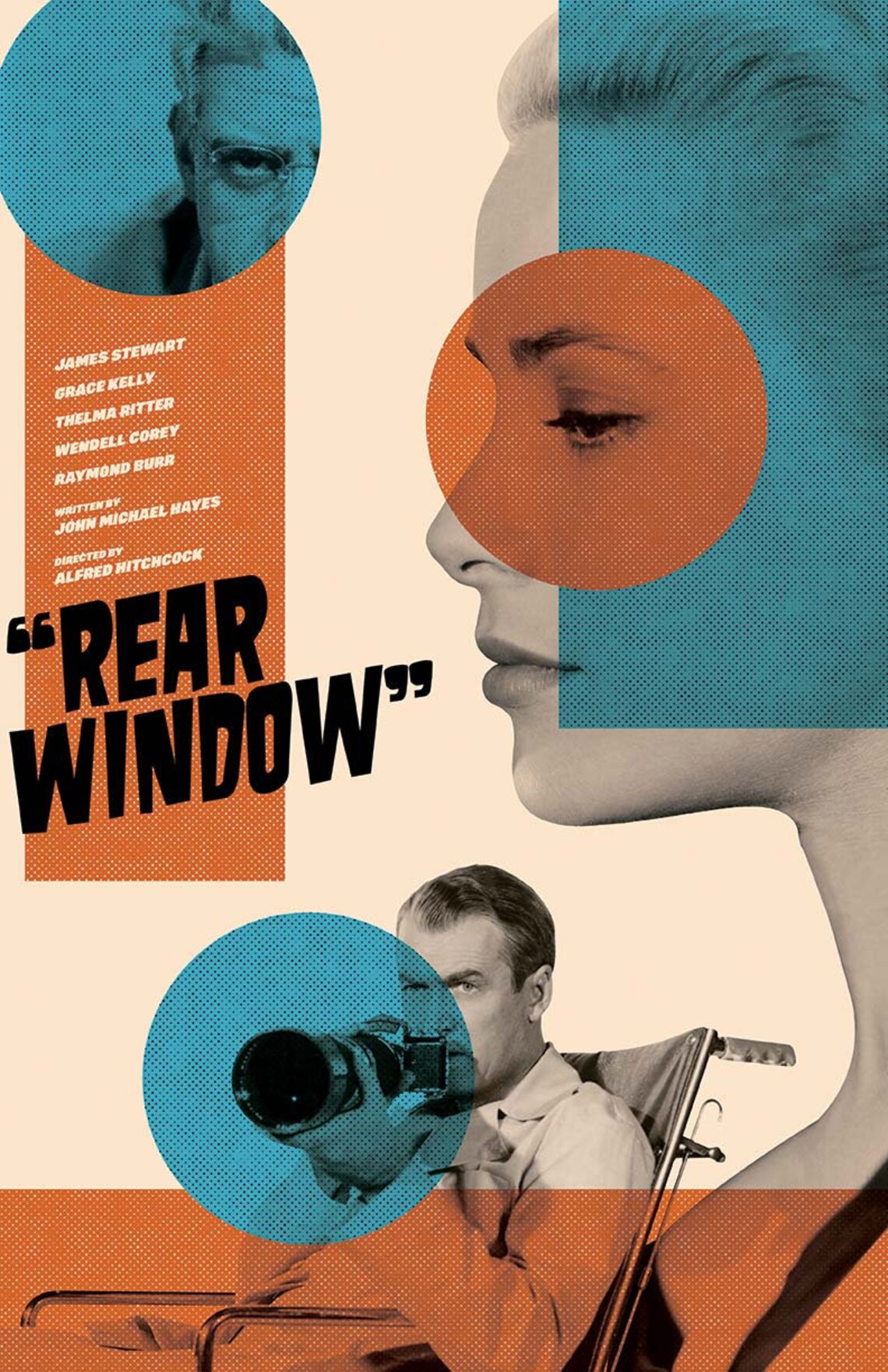
Poster by Mike Sapienza, 2020
- H’s Rereleased Films: From Rope to Vertigo (1991) – ed. Walters Raubicheck and Srebnick
- The Art of Looking in Rear Window (1997) – Stefan Sharff
- AH’s Rear Window (2000) – ed. John Belton (intro/#2), includes…
- The Making of Rear Window – Scott Curtis
As one of Hitch’s most popular films, expectedly, there are more writings and books on Rear Window than you can shake a spade at, covering almost every conceivable aspect of its production, distribution and reception, except… As is sadly par for the course, they make little or no mention of its many versions and restorations, or home video releases. Which is where my own articles come in.
- H’s Rear Window: The Well-Made Film (2001) – John Fawell
- Writing with Hitchcock: AH and John Michael Hayes (2001/2011) – Steven DeRosa
- Rear Window: The Making of a Hitchcock Masterpiece (2025) – Jennifer O’Callaghan

50 ltd. ed. giclée poster by Doug John Miller, 2020 | work in progress, video
- Rear Window Redux – Matthew Knox
- Rear Window – Interiors Journal; it ‘cheats’!
- 5 Secrets of the Rear Window Set – Nathan Smith
- Photographing Rear Window/alt – Arthur E. Gavin
The set’s the star. And what a set! These essays cover everything you could want to know about its construction and operation.
- Hitchcock’s Techniques Tell Rear Window Story – David Atkinson | letter
- Greenwich Village Building Starring in Rear Window – Lannyl Stephens
- Control Freak Constructing a Virtual Cityscape: Rear Window – Etienne Boumans
- Inside the real Greenwich Village apartment that inspired Rear Window – Lou Lumenick
- Architecture of the Gaze: Jefferies’ Apartment and Courtyard – Steven Jacobs, The Wrong House: The Architecture of AH (2007/2014) review, #2
Intelligent, courageous, resourceful… and more than a little easy on the eye. Grace Patricia Kelly as Lisa Carol Fremont is truly a heroine for the ages.
- Grace Kelly in Rear Window – Neil Sinyard
- Story of a Dress: Rear Window – Laurie Brookins
- Channelling Grace Kelly in Rear Window – Ada Pîrvu
- Alfred Hitchcock & Grace Kelly: A Trilogy – Elaine Lennon
- Fashion Dreams: Hitchcock, Women, and Lisa Fremont – John Fawell
- Framing Fascination: Studies of Rear Window – multiple essay links
- Rear Window – Joe Valdez
- Rear Window – Rick Gould
- Rear Window – Adrian Martin
- Rear Window: Too Perfect? – Ken Mogg
- Rear Window Aesthetics – Doug Yablun
- Use of the camera in Rear Window – SPQR
- Rear Window and the Male Gaze – Nick Harl
- Rear Window: The Ticking Clock – Jenny Diski
- Teaching Rear Window – Matthew H. Bernstein
- Rear Window and self-reflexivity – Carl Li Wong
- I’ve Never Seen… Rear Window Rebecca Nicholson
- Rear Window: Watching the Watcher – Frank H. Wu
- My Favourite Hitchcock: Rear Window – Killian Fox
- Recuperation and Rear Window – Murray Pomerance
- The guilty pleasures of Rear Window – Chris Fujiwara
- Rear Window: Refocusing the Spectator – Steve Jenkins
- Through Hitchcock’s Rear Window Again – Patricia Ferrara
- Hitchcock as an Auteur: The Evolution of Themes – Eli Solt
- The Architecture of Gazing in Rear Window – Matthew Jones
- Torturing women and mocking men: Rear Window – John Fawell
- The Hitchcock film that captures our social isolation – Sidney Gottlieb
- The Importance of Set Design in Rear Window – Thea Marshall-Behrendt
- “Rear Window Ethics”: Analysing Voyeurism and Its Role – Holly Buckley
- Looking at The Birds and Marnie Through the Rear Window – Robin Wood
- Rear Window: Intermedialities of Peeping in the Plural – Martin P Rossouw
- How Rear Window Made Us All Voyeurs and Detectives/alt – Michael Sragow
- Jimmy Stewart, Mon Prochain: A Reading of Rear Window – Joanne Faulkner
- Gender Flip-flopping in Hitchcock: Rear Window, Vertigo and Psycho – Nicole Motahari
- Disabled by Desire: Body Doubles in Rear Window (1942, 1954, 1998)/alt – Nancy Steffen-Fluhr
- Architecture and the Cinematic Window: Rear Window and the Fantasy Frame – David Bertolini
- The Strange Case of Lars Thorwald: Rounding up the Usual Suspect in Rear Window – Julian Smith
- Did They Think They Were Gods? Masculinity as Performance in Rear Window and Vertigo – Greg Young
- Backyard Ethics: Rear Window – Jonathan Rosenbaum, Essential Cinema: On the Necessity of Film Canons (2004)
- The Author of this Claptrap: Woolrich, Hitchcock and Rear Window – Pamela Wojcik, Hitchcock at Source: Auteur as Adaptor (2011) ed. Boyd and Palmer

Poster by Mike Holloway, 2018; references
Rear Window: Writing on a Classic, Pt 2: More writing | Collectors Guide, Pt 2: Soundtrack and essays, 3: Home video, 4: Remakes
Related articles
This is part of a unique, in-depth series of 150-odd Hitchcock articles.