- Heat is on: temperatures soar and stakes are high in claustrophobic thriller
- Princess in peril: future royal Grace Kelly plays plucky heroine to perfection
- It’s perhaps the most-loved role in her small but perfectly-formed filmography
- James Stewart’s effective but stretches credibility as her much older, reluctant beau
- The worm that turned: criminal becomes a crimefighter in his other best-known roles
- Imitation of life: Director makes up star Raymond Burr to mock his erstwhile producer
- Enormous stage set traps multiple characters in search of an exit – from their current lives
Note: this is part of an ongoing series of 150-odd Hitchcock articles; any dead links are to those not yet published. Subscribe to the email list to be notified when new ones appear.
Rear Window: Writing on a Classic, Pt 2: More writing | Collectors Guide, Pt 2: Soundtrack and essays, 3: Home video, 4: Remakes

Poster by Jonathan Burton, 2017; variant/#2
Socko Alfred Hitchcock suspense thriller with James Stewart and bright b.o. prospects.
A tight suspense show with a bright boxoffice outlook is offered in Rear Window, one of Alfred Hitchcock’s better thrillers. James Stewart’s established star value, plus the newer potentiality of Grace Kelly, currently getting a big buildup, and strong word-of-mouth possibilities indicate sturdy grossing chances in the keys and elsewhere. Hitchcock combines technical and artistic skills in a manner that makes this an unusually good piece of murder mystery entertainment. A sound story by Cornell Woolrich and a cleverly dialoged screenplay by John Michael Hayes provide the producer-director with a solid basis for thrill-making. Of equal importance in delivering tense melodrama are the Technicolor camera work by Robert Burks and the apartment-courtyard setting executed by Hal Pereira and Joseph MacMillan Johnson.
Hitchcock confines all of the action to this single setting and draws the nerves to the snapping point in developing the thriller phases of the plot. He is just as skilled in making use of lighter touches in either dialog or situation to relieve this tension when it nears the unbearable. Interest never wavers during the 112 minutes of footage.
Stewart portrays a news photographer confined to his apartment with a broken leg. He passes the long hours by playing peeping-tom on the people who live in the other apartments overlooking the courtyard. It’s a hot, humid summer so shades are rarely drawn to block his view of intimate goings-on. In one of the apartments occupied by Raymond Burr and his invalid, shrewish wife, Stewart observes things that lead him to believe Burr has murdered and dismembered the wife.
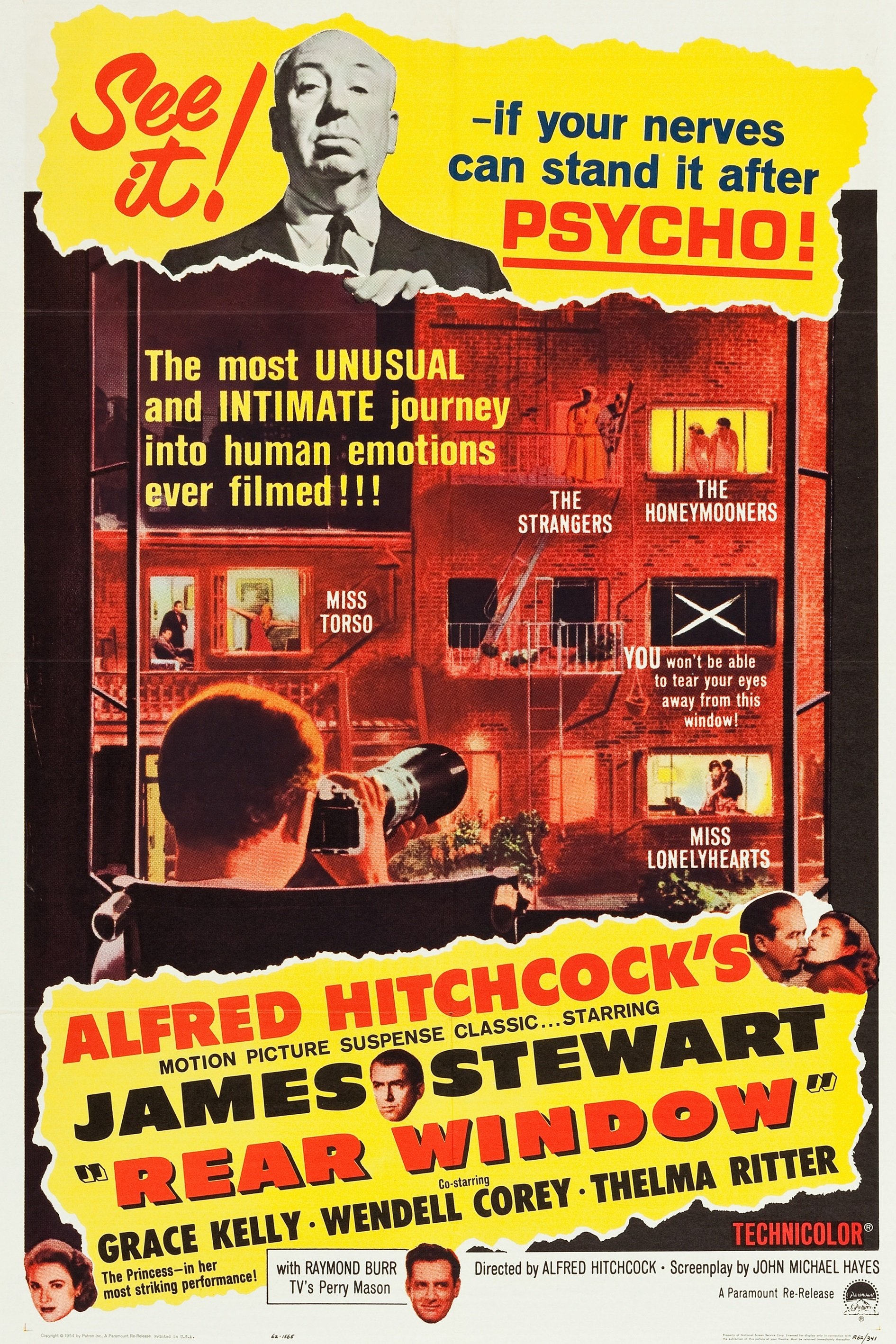
US 1962 re-release poster
From then on suspense tightens as Stewart tries to convince Wendell Corey, a policeman buddy, his suspicions are correct. Already sold on the idea are Miss Kelly, Stewart’s girl, and Thelma Ritter, the insurance nurse who comes daily to tend his needs. With their help, Stewart eventually is able to prove his point, and almost gets himself killed doing it. Adding to the grip the melodrama has on the audience is the fact that virtually every scene is one that could only be viewed from Stewart’s wheelchair, with the other apartment dwellers seen in pantomime action through the photog’s binoculars or the telescopic lens from his camera.
There’s a very earthy quality to the relationship between Stewart and Miss Kelly. She’s a Park Avenue girl not above using all her physical charms to convince Stewart they should get married. This is carried to the point where she arrives one evening set to spend the night and gives him what she calmly calls “a preview of coming attractions” by donning frilly nightgown and negligee. Both do a fine job of the picture’s acting demands. Types that one might find in a Greenwich Village apartment add interest. Miss Torso, roundly played by Georgine Darcy, is a peeping-tom’s delight, particularly when she loses her strapless bra.
There is great sadness to Miss Lonely Hearts, played by Judith Evelyn, a woman with an overwhelming desire for a man, yet not knowing what to do when she coaxes one in from the streets. There’s a honeymoon joke in the actions of newlyweds Rand Harper and Havis Davenport. He’s seen raising the shade at intervals, only to be called back to her arms by the bride. Ross Bagdasarian, a composer; Sara Berner and Frank Cady, a couple with a little dog, and the other types glimpsed all seem like real people, and their soundless contributions give the principles top-notch support. Burr is very good as the menace, as are Corey and Miss Ritter. The production makes clever use of natural sounds and noises throughout, with not even the good score by Franz Waxman being permitted to intrude unnaturally into the drama. – Brog., Variety
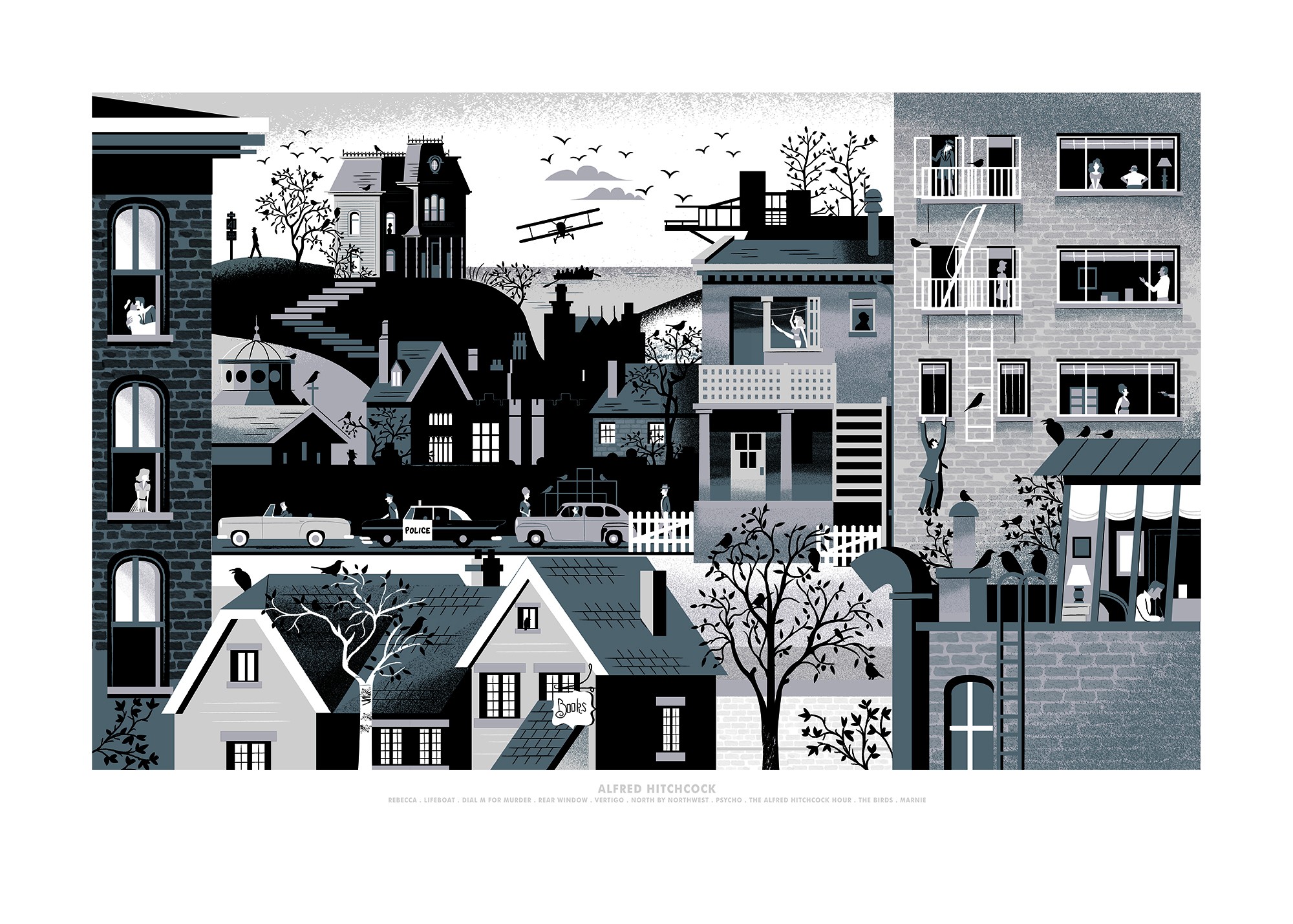
Print by Alexandre Clérisse, 2017 (detail, video); he also illustrated Now Playing: A Seek-and-Find Book for Film Buffs/French, Spanish (2016). If you like this, check out Pierpaolo Rovero’s stunning Rear Window-inspired vistas, such as his Paris series.
None of Hitchcock’s films has ever given a clearer view of his genius for suspense than Rear Window. When professional photographer L.B. “Jeff” Jefferies (James Stewart) is confined to a wheelchair with a broken leg, he becomes obsessed with watching the private dramas of his neighbors play out across the courtyard. When he suspects a salesman may have murdered his nagging wife, Jefferies enlists the help of his glamorous socialite girlfriend (Grace Kelly) to investigate the highly suspicious chain of events… Events that ultimately lead to one of the most memorable and gripping endings in all of film history.
According to Alfred Hitchcock, “subjective treatment” — putting the audience in the mind of a character — is the purest form of the cinema. “I suppose Rear Window is the best example of it,” he told interviewer Peter Bogdanovich. “Close-up of a man; what he sees; his reaction to it. And that can’t be done in any other medium — can’t be done in the theater, can’t be done in a novel. You put the audience in the mind of a particular character.”
The 1954 suspense classic Rear Window, based on a short story by American mystery writer Cornell Woolrich, earned Hitchcock his fourth Best Director Academy Award nomination and today stands as one of his most impressively “cinematic” suspense films. James Stewart stars as a globe-trotting news photographer, sidelined by a broken leg and continued to a wheelchair in his sweltering Greenwich Village apartment. To pass the time, he uses his camera’s telephoto lens to spy on his neighbors and begins to suspect that the costume jewelry salesman (Raymond Burr) in the building across the courtyard has murdered his invalid wife.
Stewart had not been happy with the 1948 film Rope, his only prior association with Hitchcock, but the actor knew he wanted to do Rear Window as soon as he read screenwriter John Michael Hayes’ initial treatment. The results of this second collaboration were much more felicitous; Hitchcock and Stewart would subsequently team on two more occasions, for 1956’s The Man Who Knew Too Much and 1958’s Vertigo, one of the shining credits in both men’s long screen careers.
“I was feeling very creative at the time,” Hitchcock once said of Rear Window. “My batteries were well charged.” Hitchcock shot the film on a single set, creating a group of little stories (Stewart and his many neighbors) that, according to the Master of Suspense, “comprise a small universe.” At the center of this universe, closely monitoring the comings and goings of his neighbors, is Stewart — sometimes joined by his elegant, very Grace Kelly-ish girlfriend, played by… Grace Kelly.
“Sure, he’s a snooper, but aren’t we all?” Hitch rhetorically asked interviewer François Truffaut. “I’ll bet you that nine out of ten people, if they see a women across the courtyard undressing for bed, or even a man puttering around in his room, will stay and look; no one tums away and says, ‘It’s none of my business. They could pull down their blinds, but they never do; they stand there and look out.” With its scenes of nail-biting suspense, first-rate performances and ahead-of-their-time love scenes, Rear Window was a financial hit and the recipient of four Academy Award nominations. – US/Canada Universal DVDs (2001)
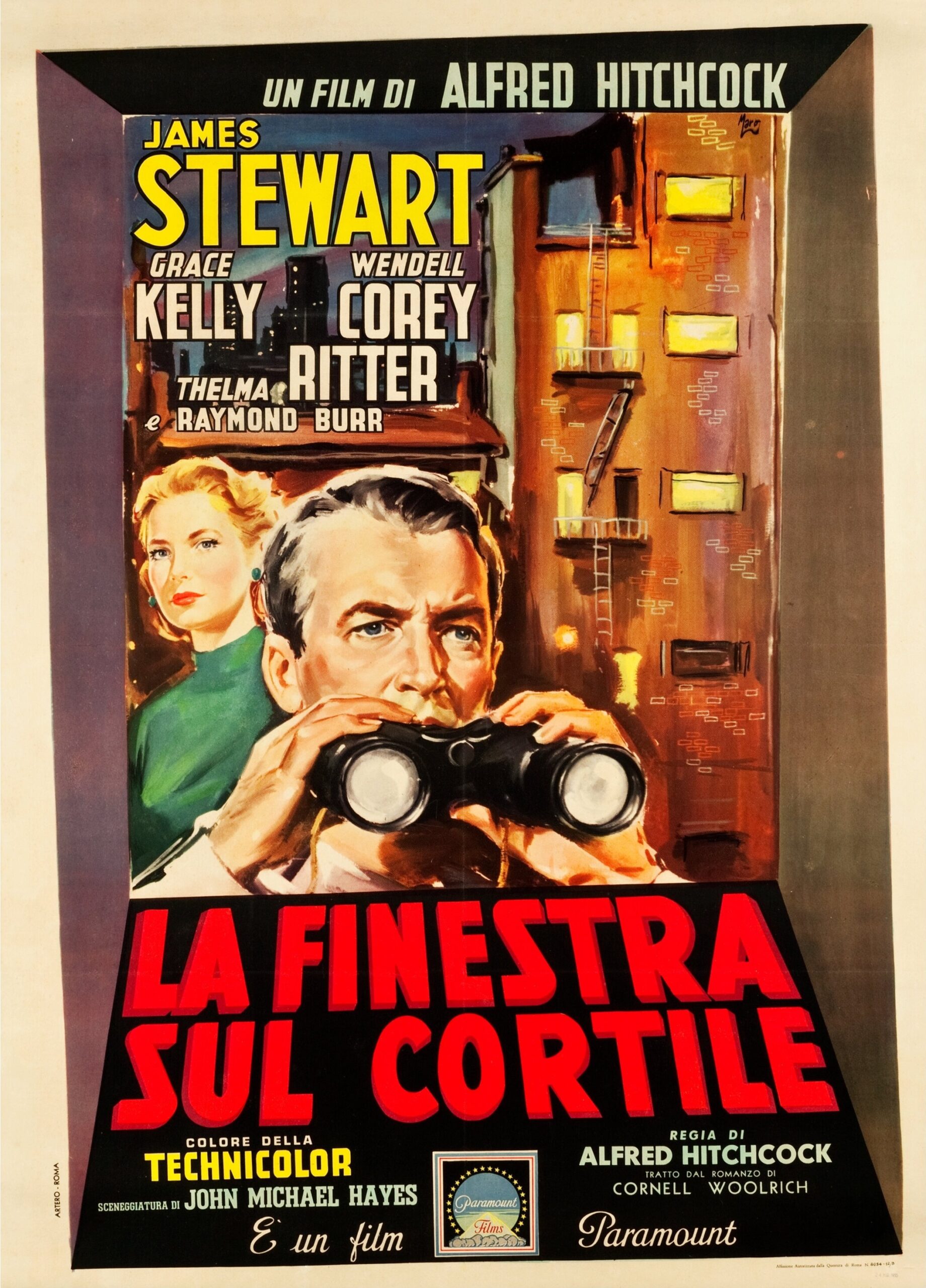
Rear Window aka La finestra sul cortile (1954, dir. Alfred Hitchcock) Italian two sheet poster
Based on a 1942 short story by Cornell Woolrich, Rear Window earned Alfred Hitchcock his fourth Best Director Oscar nomination and today stands as one of his most impressively “cinematic” suspense films – despite the fact that it was shot on a single set (Paramount’s Stage 18). Ironically, Hitchcock’s earlier film Rope also featured the “one-set” gimmick (again a Manhattan apartment) – and that 1948 movie shaped up as one of the master director’s more memorable failures. Undeterred, he attempted it a second time with Rear Window and brought back the star of Rope, James Stewart, to headline the new production.
Hitchcock briefly considered shooting the film on location in Greenwich village, then decided to build the needed sets on a Paramount sound stage. To create the proper Lower Manhattan flavour, he sent four photographers there with instructions to shoot the Village from all angles, in all weather and under all lighting conditions. Hitchcock had the whole block of flats that Stewart’s character surveys built as a studio set after he was unhappy with the lighting he was achieving on location. At the time, this was the biggest studio set ever constructed.
At Paramount, 50 men worked two months constructing the $75,000 set, which consisted of the facing backs of an number of apartment buildings. In addition to Stewart’s apartment, the other apartments (seen from Stewart’s window) also ‘worked’, having been furnished to suit the character of their occupants. Lighting the various sets became a problem, particularly during a shot of Stewart in the foreground as the camera focused on action taking place in the apartments across the courtyard. For one scene, Paramount had to employ every light that wasn’t being used on the lot – in addition to lights borrowed from Columbia and MGM.
The proper amount of light was finally attained, but the heat on the set was intense. “‘Suddenly, in the middle of it, the lights set off the sprinkler system,” Stewart recalled. “Not just a section of it, but on all the stages, and we’re not talking about little streams of water but torrents.” All activity stopped as the set was plunged into wet darkness. But Hitchcock was unfazed. According to Stewart, “He sat there and told his assistant to get the sprinklers shut off and then to tell him when the rain was going to stop, but in the meantime to bring him an umbrella.”
_02C.jpg)
Grace Kelly co-starred as Stewart’s elegant girlfriend; the actress was simultaneously offered top roles in On the Waterfront and Rear Window, and opted for the latter. Kelly’s life changed the following year, during production of another Hitchcock film (To Catch a Thief), when she met Monaco’s Prince Rainier, her future husband. Hitchcock took keen interest in every aspect of production – even wardrobe. Preparing to shoot a scene of Kelly in a sheer nightgown, he eyed the actress and then called for costume designer Edith Head. “The bosom is not right,” he told Head. “We’re going to have to put something in there.”
In Kelly’s dressing room, Head told the actress that Hitchcock wanted her to put in falsies. Kelly thought they would show. The two women instead began making adjustments in the nightgown itself – using no falsies. “When I walked out onto the set,” Kelly later revealed, ‘”Hitchcock said, ‘See what a difference they make.'” Rear Window became a huge hit: the million dollar movie premièred in August 1954, and by May 1956 had grossed $10 million. It also reaped four Academy Award nominations: Best Director, Screenplay, Cinematography and Sound. Its theatrical reissues were also resounding box office successes.
The songwriter in the apartment across the courtyard was played by real-life songwriter Ross Bagdasarian. Two of the party girls in that scene are played by future stars Kathryn Grant (later Mrs. Bing Crosby [who features on the soundtrack]) and Marla English. And watch for Alfred Hitchcock to make his cameo on that same set. In the 1998 TV remake of Rear Window, Christopher Reeve played the leading role, re-written to make him a newly paralyzed architect. It was Reeve’s first role since the accident that caused his real-life paralysis. The actor received a Screen Actors Guild Award and a Golden Globe nomination for his performance. – PAL Universal DVDs (2001/2005)
Poster by Adam Simpson, 2014 | detail, alt
As we’re stuck in our homes, looking at our neighbours…
This is how I created my Rear Window poster for @MondoNews and @UniversalPics a while back. #RearWindow #hitchcock #lockdown #posters #cinema #stuckinside #posterdesign #COVID19 pic.twitter.com/5zcR0smiWo
— Adam Simpson (@adsimpsonstudio) January 10, 2021
Rear Window: Writing on a Classic, Pt 2: More writing | Collectors Guide, Pt 2: Soundtrack and essays, 3: Home video, 4: Remakes
Related articles
This is part of a unique, in-depth series of 150-odd Hitchcock articles.