- Revisiting contemporary and modern critical appreciation
- Alfred Hitchcock’s stylish thriller met with universal acclaim
- Critics and fans alike made it much-imitated, enduring success
- Multi-level soap opera that turns audience into peeping Toms
- Inner lives laid bare: how well do you know your neighbours?
Note: this is part of an ongoing series of 150-odd Hitchcock articles; any dead links are to those not yet published. Subscribe to the email list to be notified when new ones appear.
Rear Window: Writing on a Classic, Pt 2: More writing | Collectors Guide, Pt 2: Soundtrack and essays, 3: Home video, 4: Remakes
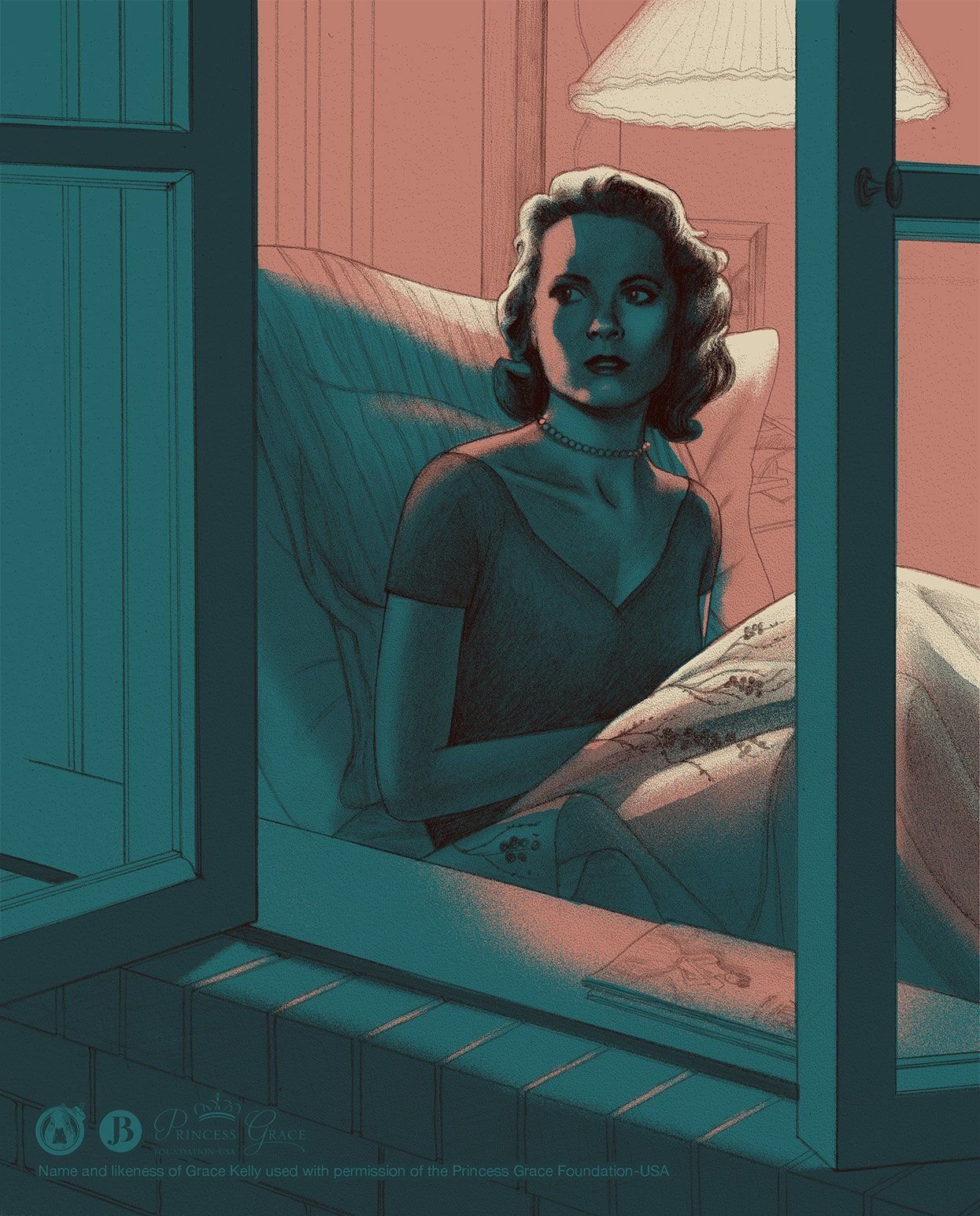
Poster/alt by Jonathan Burton, 2017
Ever since he froze his audience in their seats with The 39 Steps, Alfred Hitchcock has held a superbly trademarked reputation. Through the years, instead of trying to dodge his role, the maestro of stylized suspense has generally concentrated on working intricate fugal variations into his familiar tune. But always there is the overhanging sense of dread, the sharpness of subplots and minor characters, the singularly omniscient camera eye. His latest effort, Rear Window, is a masterpiece in any man’s composition book.
Its only scene—a narrow courtyard in Greenwich Village—is as confined as a stage set, but the story could be done only with the movie camera. The players, headed by James Stewart and Grace Kelly, do their work magnificently. They give their roles the casual flavor of everyday life, without reaching for the stagey realism of too many foreign films. Stewart, a foot-loose photographer for a picture magazine, finds himself incapacitated with a broken leg after an uncommonly strenuous bit of news coverage. Recovering, he sits day after day in his apartment, looking out on the court around him through his large rear window. The assortment of lives thus discerned includes a rather unhappy couple on the second floor across the court—he, a traveling man, and she, a querulous, invalid wife.
Late one night Stewart is awakened by a scream. The traveling man makes three suspicious trips down the stairs, carrying his heavy sample case. Then daylight, and the blinds remain drawn. Stewart and the audience get a sinister feeling that murder has been done— though Stewart’s police-lieutenant friend stubbornly disbelieves him. For the rest of the movie, as Hitchcock turns on the chills, Stewart, his gracefully ardent girl friend (Miss Kelly), and his ably wisecracking nurse (Thelma Ritter) try to trap a murderer. At the finish, the murderer (a very harried man) almost traps them but is frustrated by a group of unusually fast-traveling boys from the sixth precinct. Summing Up: Air-cooling unneeded. – Newsweek
Peeping Tom Spots a Killer – Life | Look mag
Sin City Effect | fan trailers: 09, 18, 20/#2, 21, 21, 21, 22
“If you don’t experience delicious terror when you see Rear Window,” Alfred Hitchcock once said, “then pinch yourself — you are most probably dead.”
The Master of Suspense amply defends his well-deserved title with this witty and macabre tale of voyeurism and murder starring Academy Award winner Jimmy Stewart and one of the most beautiful women ever to grace the screen, the late Princess of Monaco, Grace Kelly. Considered by both the peerless director and his critics to be among the Master’s greatest films, Rear Window attempts to unearth the Peeping Tom in all of us, and illustrate how obsessive curiosity can kill more than a cat.
The tale is literally seen through the eyes of Hitchcock’s protagonist L.B. “Jeff” Jefferies (Stewart). An avowed bachelor and freelance photographer, Jeff is reluctantly confined to his Greenwich Village apartment during a summer heat wave due to a broken leg. Things begin to heat up considerably for Jeff and his amorous girlfriend Lisa (Grace Kelly) when he begins to pass the time by spying on all the neighbors in his courtyard, an action brought vividly to life through Hitchcock’s ever-moving camera.
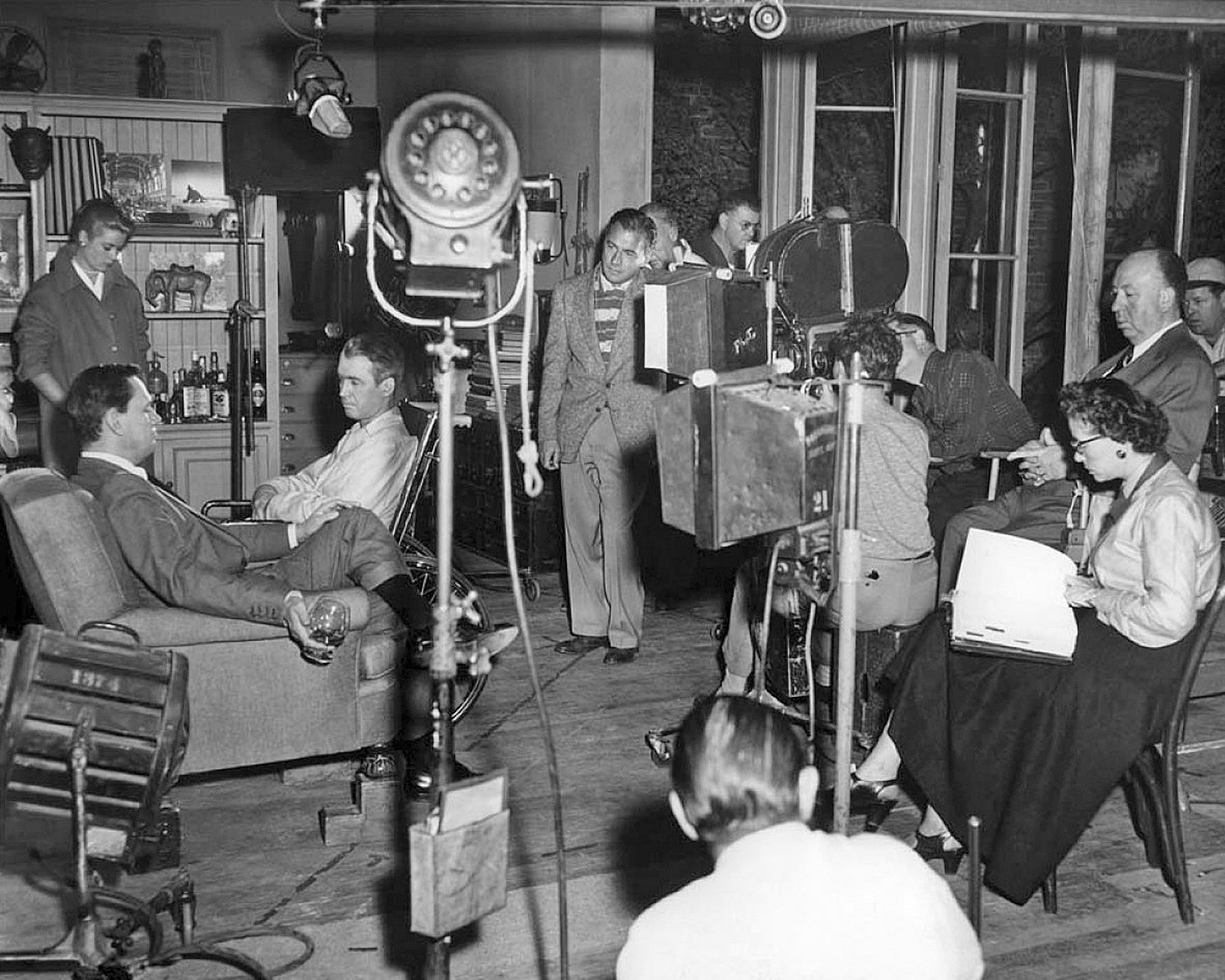
L-R: Grace Kelly, Wendell Corey, James Stewart, cinematographer Robert Burks, script supervisor Irene Ives and Hitchcock
When Jeff’s high powered binoculars spot a neighbor, Lars Thorwald (Raymond Burr), apparently disposing of the body of his freshly murdered invalid wife, the photographer attempts to convince Lisa and a detective friend (Wendell Corey) to investigate. After constant nagging, and the discovery of a dead dog near the area where Jeff suspects the body is buried, Lisa acts as his “legs” and attempts to uncover more clues. Entering Lars’ apartment, Lisa gets the evidence required to summon the police. But by the time they arrive, Lars escapes. Aware of Jeff’s suspicions, Lars breaks in on the wheelchair-bound man and a desperate struggle ensues. The fight ends in typically ironic Hitchcock fashion, leaving the viewer to interpret the future behavior of the Master’s cast of characters.
Rear Window is among the handful of Hitchcock classics that legal entanglements rendered unavailable for viewing for over two decades. Since its reissue last year [1983], it has again received critical acclaim from the nation’s movie critics and movie fans. The feature was based on a short story by Cornell Woolrich and boasts a screenplay by long-time Hitchcock scenarist John Michael Hayes. The compelling musical score was written by the immortal Franz Waxman and the timeless costumes designed by multiple Academy Award winner Edith Head. – US MCA LD/CED (1984) LDDb
In 1954, Alfred Hitchcock released the classic suspense thriller, Rear Window. On the surface, it’s a simple story: A broken leg confines L.B. Jefferies (James Stewart) to a wheelchair. Looking for a diversion, he spends his days peering through his courtyard window into the lives of his mixed-up neighbors… a song- writer, spinster and dancer. His voyeurism seems harmless until he uncovers what he thinks is a murder of an invalid by her husband (Raymond Burr). As Jefferies zeroes in on the suspected murder, we see the action through his eyes. Along with Jefferies, we continue to narrow our focus: First through his binoculars and then through his telephoto lens. As Jefferies gets closer to the solution, so do we.
However, his nurse (Thelma Ritter) and girlfriend Lisa (Grace Kelly) don’t take his theory seriously. They are annoyed at his preoccupation with the lives of others… until they, too, are drawn into the suspense and mystery. They even become his “legs” and look for clues in the courtyard, which leads us to the absolutely terrifying conclusion. When the suspense is finally over, watch closely as Hitchcock restores order to all of the lives of the neighborhood. Indeed, it’s a film that invites us to watch it again and again; and rewards us further on each successive occasion. As Hitchcock said upon the movie’s re-release in 1968, “If you do not experience delicious terror when you see Rear Window, then pinch yourself—you are most probably dead.” – US MCA VHS (1988)
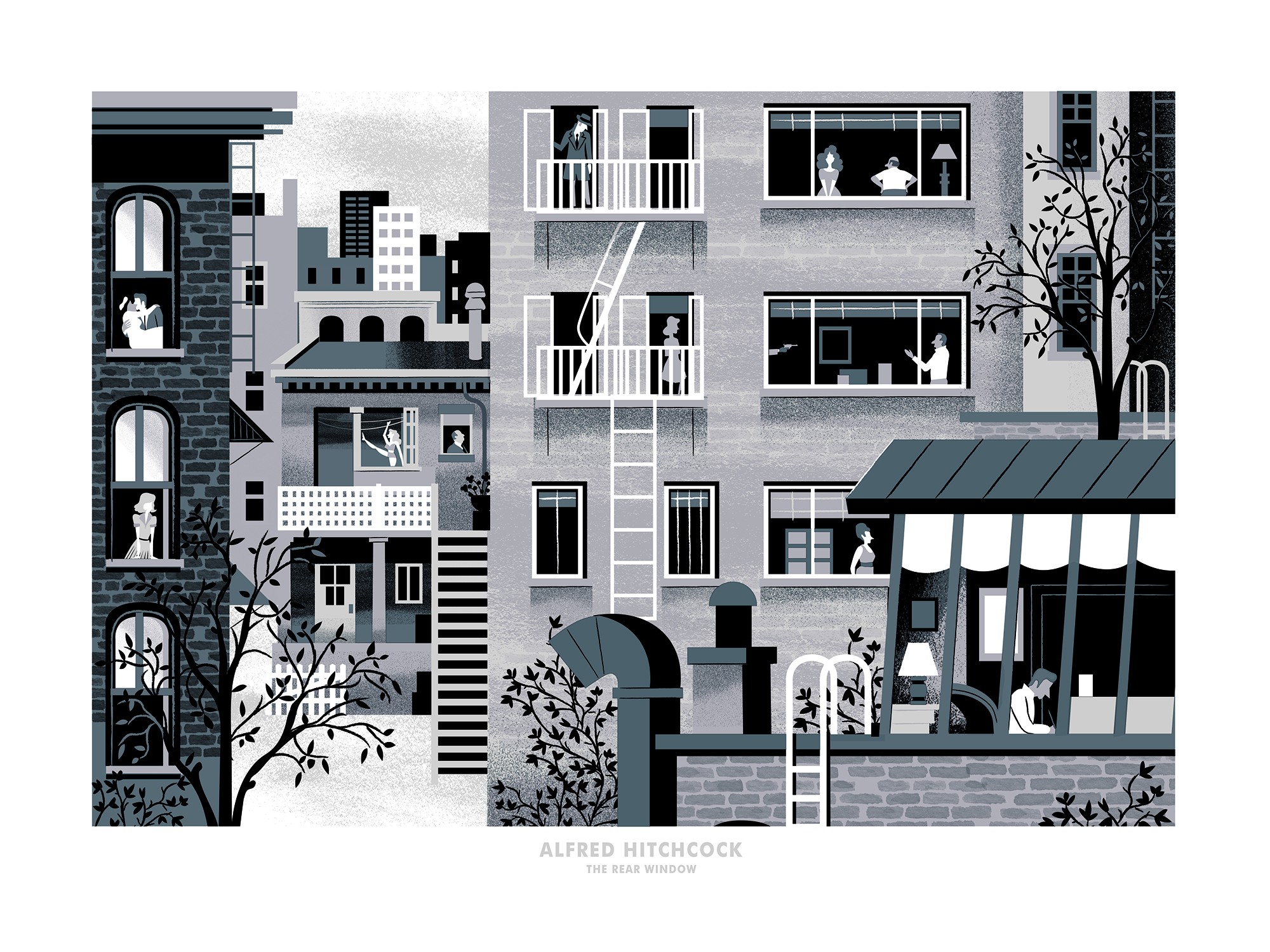
Print by Alexandre Clérisse, 2017 (detail); he also illustrated Now Playing: A Seek-and-Find Book for Film Buffs/French, Spanish (2016)
Alfred Hitchcock amply demonstrates why he’s been called “The Master of Suspense” with this witty and macabre tale of voyeurism and murder starring two of the screen’s all-time favorites, Academy Award winner Jimmy Stewart and the late Grace Kelly. As a photographer with a broken leg, Stewart takes up the fine art of spying on his Greenwich Village neighbors during a summer heat wave. But things really begin to get hot for Stewart, Kelly and the unassuming audience when he suspects neighbor Raymond Burr of murdering his invalid wife and burying her body in a flower garden. Unavailable for viewing for over two decades, Rear Window is among the peerless director’s favorite films and is considered by critics to be one of his greatest.
“I was feeling very creative at the time, said director Alfred Hitchcock of his 1954 movie Rear Window. Indeed, Rear Window finds the master of suspense at the top of his form. James Stewart stars as L.B. Jefferies, a press photographer laid up in his Greenwich Village apartment with a broken leg. To pass the time, Jefferies indulges his journalistic curiosity by peeking into the windows of the apartments across the courtyard from his own. The diversion turns sinister when Jefferies begins to suspect one of his neighbors, an adulterous husband, of doing away with his wife. Aided by his glamorous girlfriend, Lisa, played by Grace Kelly, Jefferies attempts to confirm his suspicions, quickly becoming embroiled in a deadly intrigue.
The Technical Challenge
Rear Window, which was shot almost entirely within the confines of Jefferies’ apartment, presented an extraordinary technical challenge. By limiting himself to his character’s viewpoint, Hitchcock hoped to emphasize the sense of confinement experienced by the wheelchair-bound photographer. As in two of the director’s earlier films, Lifeboat and Rope, the restricted space pressed Hitchcock’s ingenuity to the limit. To prepare for the film, Hitchcock supervised the construction of a gigantic, composite set on one of Paramount’s largest sound stages, complete with 31 apartments – 12 of them fully furnished.
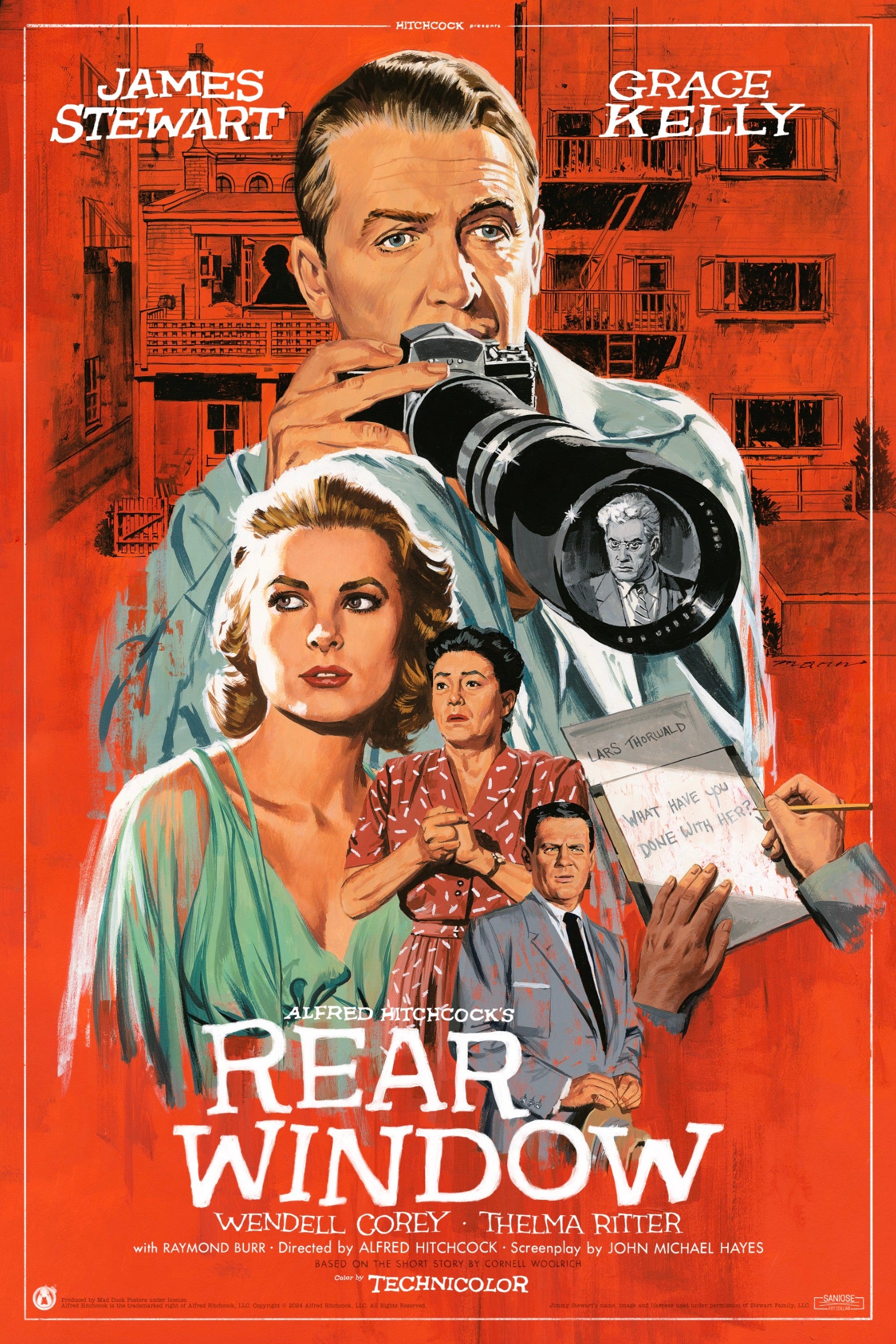
Poster by Paul Mann, 2024; variants. A little artistic licence has been taken on the original pale pink of her négligée as it would throw the colour scheme off balance.
In addition, the multi-level courtyard viewed from Jefferies’ rear window featured gardens, trees, fire escapes, smoking chimneys, and even a busy street, complete with pedestrians and moving traffic. The mock apartment building also featured 20 windows and doors, each individually rigged with lights to create the illusion of a bustling neighborhood at all hours of the day and night. It proved to be the biggest electrical job ever undertaken at the studio; at one point, nearly every piece of lighting equipment on the Paramount lot was pressed into service.
Based on Real Life
Screenwriter John Michael Hayes based his witty, double-edged script on a short story by author Cornell Woolrich, but Hitchcock enlivened the account with a wealth of grisly detail culled from two real-life murder cases, in one, a man named Patrick Mahon had killed and dismembered his victim, tossing the body parts from the window of a moving train until only the head remained. This he placed into a roaring fire.
Though Hitchcock was unable to incorporate this particular detail, he made use of the research: “in all cases involving mutilation, you see, the biggest problem for the police is to locate the head.” This macabre information would play a critical role in Rear Window. The second murder case to fire Hitchcock’s imagination involved a London doctor who, having murdered his wife, made the mistake of allowing his mistress to wear the dead woman’s jewelry, leading to his discovery and arrest. In Rear Window, Grace Kelly, having furtively entered the suspected murderer’s apartment, slips an incriminating wedding ring on her own finger.
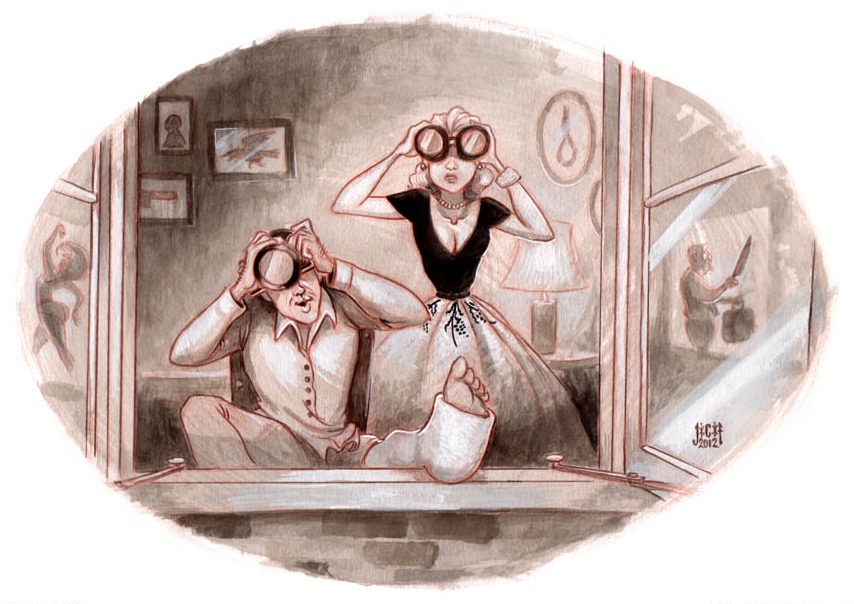
“Couples that spy together pry together” by James C Trujillo, 2012 | Tumblr, blog
A Race of Peeping Toms
The wedding ring served a dual purpose for Hitchcock, subtly underscoring another of his themes. Throughout Rear Window, the fast-living Jefferies doggedly resists his girlfriend’s hints of marriage, fearing that it would compromise his adventurous life as a photojournalist. Over the course of the film, Jefferies gradually sets aside his role as a detached observer of life in favor of a more active part in the developing drama. For Hitchcock, Jefferies’ transformation holds an important message. As the photographer’s nurse, played by Thelma Ritter, observes in the movie’s early moments: “We have become a race of Peeping Toms. People ought to get outside and look at themselves for a change.”
Behind the Scenes
Rear Window, which received four Oscar nominations, was Hitchcock’s 40th film. James Stewart, who stars as the photographer L.B. Jefferies, was 46 years old when Rear Window premièred in 1954. That same year saw the release of another of the actor’s most famous films, The Glenn Miller Story. Grace Kelly, who starred as Lisa Fremont, turned down the role opposite Marion Brando in Elia Kazan’s On the Waterfront to appear in Rear Window. The part brought her Best Actress awards from both the National Board of Review and the New York Film Critics.
Alfred Hitchcock, who frightened audiences around the world with his suspenseful films, was once asked if he himself could be easily frightened. “Very easily,” the director replied. “Here’s a list in order of adrenaline production: 1. Little children, 2. Policemen, 3. High places; 4. That my next picture won’t be as good as the last one.” – US MCA-Universal/Time Life VHS (1990)

Poster by Federico Babina, 2017; Facebook, Twitter
Rear Window: Writing on a Classic, Pt 2: More writing | Collectors Guide, Pt 2: Soundtrack and essays, 3: Home video, 4: Remakes
Related articles
This is part of a unique, in-depth series of 150-odd Hitchcock articles.